Artificial Intelligence (AI), Machine Learning (ML), and Blockchain are reshaping cybersecurity, offering smarter, faster, and more resilient defenses against evolving threats. This article explores how these technologies enhance security, their real-world applications, and the ethical quandaries they present. By examining technical breakthroughs, societal impacts, and future possibilities, we uncover a roadmap to a more secure digital future.

Introduction & Context
Cybersecurity has always been a cat-and-mouse game. As technology evolves, so do the threats that exploit it. However, the stakes have never been higher. From ransomware attacks paralyzing hospitals to phishing scams targeting millions of individuals, the digital landscape is fraught with peril. Enter Artificial Intelligence (AI), Machine Learning (ML), and Blockchain—a triad of technologies poised to revolutionize how we defend against cyber threats.
These technologies are not just incremental improvements; they are paradigm shifts. AI brings predictive capabilities, ML enables systems to learn from past attacks, and Blockchain ensures data integrity through its decentralized architecture. Together, they promise a future where cybersecurity is not just reactive but proactive, adaptive, and resilient.
But with great power comes great responsibility. As these technologies integrate deeper into our digital lives, they raise complex ethical questions about privacy, bias, and accountability. This article delves into these themes, offering a comprehensive look at how AI, ML, and Blockchain are shaping the future of cybersecurity.
Technical Breakdown
AI and ML: The Brain of Cybersecurity
At the heart of AI’s impact on cybersecurity is its ability to analyze vast amounts of data in real time. Machine Learning (ML) algorithms, for instance, can detect anomalies in network traffic—such as unusual login patterns or data transfers—that might indicate a breach. These systems learn over time, improving their accuracy and reducing false positives.
Analogy: Think of ML as a security guard who gets smarter with every shift. Initially, they might mistake a janitor for an intruder, but over time, they learn to differentiate between routine and suspicious activities.
One standout application is behavioral analytics. By creating a baseline of normal user behavior, AI can flag deviations that suggest compromised accounts. For example, if an employee who usually logs in from New York suddenly accesses the system from Moscow, the system can trigger an alert.
Blockchain: The Backbone of Trust
Blockchain’s decentralized nature makes it a powerful tool for cybersecurity. Unlike traditional databases, which are vulnerable to single points of failure, Blockchain distributes data across a network of nodes. This architecture ensures that even if one node is compromised, the data remains secure.
Real-World Use Case: Blockchain is being used to secure Internet of Things (IoT) devices. By recording device interactions on a tamper-proof ledger, it becomes nearly impossible for hackers to spoof devices or inject malicious commands.
Synergy: AI-Powered Smart Contracts
Smart contracts—self-executing agreements coded on Blockchain—become even more potent when integrated with AI. For instance, an AI system could monitor supply chain data in real time and trigger smart contracts to release payments only when conditions like delivery deadlines are met.
Case Studies
1. Ransomware Detection with AI
Ransomware attacks, where hackers encrypt a victim’s data and demand payment for its release, are among the most devastating cyber threats. AI has proven instrumental in combating this menace. By analyzing the assembly language patterns of ransomware, AI systems can detect and neutralize threats before they execute.
Success Story: In 2022, a leading cybersecurity firm used ML algorithms to reduce ransomware response times by 70%, saving millions in potential damages.
2. Blockchain in Healthcare Security
The healthcare industry, a prime target for cyberattacks, has embraced Blockchain to secure patient data. By decentralizing medical records, Blockchain ensures that even if a hospital’s system is breached, patient data remains inaccessible to hackers.
Lesson Learned: While Blockchain enhances data security, its implementation requires significant investment and expertise, often posing a barrier for smaller institutions.
3. AI-Driven Fraud Detection in Banking
Banks are leveraging AI to detect fraudulent transactions in real time. By analyzing transaction patterns, AI systems can flag anomalies, such as unusually large withdrawals or transactions from unfamiliar locations.
Outcome: A major bank reported a 40% reduction in fraud losses within a year of deploying an AI-driven fraud detection system.
Ethical Debate
The integration of AI, ML, and Blockchain into cybersecurity is not without controversy. Here are some of the key ethical dilemmas:
Privacy vs. Surveillance
AI’s ability to monitor and analyze user behavior raises significant privacy concerns. While these systems are designed to detect threats, they often collect vast amounts of personal data, creating potential for misuse.
Question: How do we balance the need for security with the right to privacy?
Algorithmic Bias
ML models are only as good as the data they are trained on. If the training data contains biases, the AI system may perpetuate these biases, leading to unfair outcomes.
Example: A biased algorithm might flag transactions from certain regions as fraudulent more frequently, leading to discrimination.
Accountability and Transparency
When an AI system makes a mistake—such as failing to detect a breach—who is held accountable? Moreover, the “black box” nature of many AI systems makes it difficult to understand how decisions are made.
Solution: Developing explainable AI (XAI) systems that provide clear reasoning for their decisions.
Future Directions
The future of AI-driven cybersecurity is both promising and challenging. Here are some potential advancements:
1. Federated Learning for Collaborative Security
Federated learning allows multiple organizations to train AI models collaboratively without sharing sensitive data. This approach could lead to more robust threat detection systems while preserving privacy.
2. Quantum-Resistant Blockchain
As quantum computing advances, traditional cryptographic methods may become obsolete. Developing quantum-resistant Blockchain systems will be crucial to maintaining data security.
3. Ethical AI Frameworks
Establishing global standards for ethical AI use in cybersecurity will be essential. These frameworks should address issues like bias, transparency, and accountability.
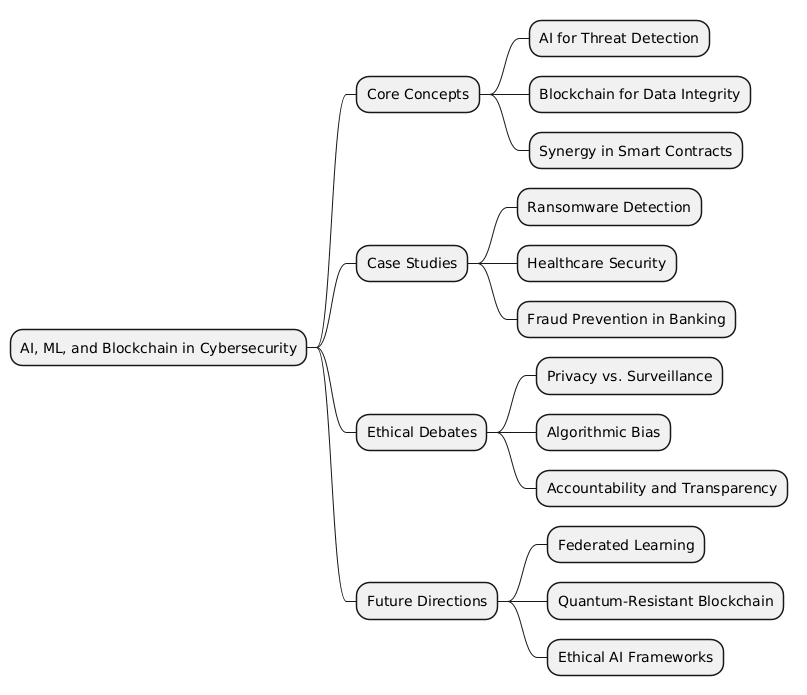
Mind Map
Key Takeaways
💡 Insightful Idea: AI and Blockchain together offer a proactive, adaptive approach to cybersecurity, shifting from reactive to predictive defense mechanisms.
⚠️ Warning or Challenge: Ethical dilemmas, such as privacy invasion and algorithmic bias, must be addressed to ensure responsible use.
🔍 Key Detail or Discovery: Behavioral analytics powered by AI can detect anomalies in real time, significantly reducing response times to cyber threats.
🚀 Future Opportunity: Federated learning and quantum-resistant Blockchain systems represent the next frontier in cybersecurity innovation.
🌍 Societal Impact: By securing critical sectors like healthcare and banking, these technologies not only protect data but also build public trust in digital systems.
This article underscores the transformative potential of AI, ML, and Blockchain in cybersecurity while advocating for a balanced approach that prioritizes ethics and inclusivity. As these technologies evolve, they hold the promise of a safer, more secure digital future.