Hyperautomation and Generative AI are revolutionizing how businesses operate, offering unprecedented efficiency and innovation. This article explores their societal and technological impacts, highlighting key case studies and ethical considerations. Discover how these technologies are shaping the future of industries worldwide.

Introduction & Context
In the rapidly evolving landscape of technology, Hyperautomation and Generative AI stand at the forefront, promising to reshape how businesses function. As organizations strive to improve efficiency and remain competitive, these technologies offer solutions that go beyond traditional automation. Hyperautomation, a term popularized by Gartner, refers to the use of advanced technologies like AI, machine learning, and robotic process automation (RPA) to automate complex business processes. Meanwhile, Generative AI, with its ability to create new content and ideas, complements these efforts by providing innovative solutions to longstanding challenges.
The journey to this technological frontier has been marked by significant milestones. The concept of automation has evolved from simple mechanization to sophisticated AI-driven processes capable of learning and adapting. This evolution reflects broader cultural and historical shifts towards digital transformation and data-driven decision-making. In today’s context, Hyperautomation and Generative AI are not just buzzwords; they are essential tools for businesses aiming to thrive in a digital-first world.
Technical Breakdown
At its core, Hyperautomation involves integrating multiple technologies to create a seamless, automated operational ecosystem. This includes RPA, which automates repetitive tasks; AI, which provides cognitive insights and decision-making capabilities; and machine learning, which enables systems to learn from data and improve over time. These components work together to eliminate inefficiencies and enhance productivity.
Imagine a factory where robots not only assemble products but also predict maintenance needs and optimize production schedules based on real-time data. This is the essence of Hyperautomation—creating a self-sustaining system that minimizes human intervention while maximizing output.
Generative AI, on the other hand, focuses on creativity and innovation. It uses algorithms to generate new ideas, designs, or content based on existing data. For instance, in the fashion industry, Generative AI can design unique clothing patterns by analyzing current trends and consumer preferences.
Case Studies
1. Banking and Financial Services
In the banking sector, Hyperautomation has revolutionized customer onboarding processes. By integrating RPA with AI, banks can now automate identity verification, credit checks, and account setup, significantly reducing the time and effort required for new customer registration. This not only enhances customer satisfaction but also ensures compliance with regulatory standards.
2. Healthcare
A leading healthcare provider implemented Generative AI to streamline patient data management and improve diagnostic accuracy. By analyzing vast amounts of medical data, AI systems can generate insights that assist doctors in making informed decisions, ultimately leading to better patient outcomes.
3. Retail
Retailers are leveraging Hyperautomation to optimize supply chain operations. Automated systems track inventory levels, predict demand fluctuations, and manage logistics, ensuring products are available when and where they are needed, thus enhancing the overall shopping experience.
Ethical Debate
The integration of Hyperautomation and Generative AI into business processes raises important ethical questions. On the one hand, these technologies offer significant benefits, such as increased efficiency and reduced human error. On the other hand, they pose challenges related to job displacement and privacy concerns.
For instance, while automation can eliminate mundane tasks, it may also lead to job losses in certain sectors. Furthermore, the use of AI in decision-making processes raises questions about transparency and accountability. Who is responsible when an AI system makes a mistake? How can businesses ensure that AI-driven decisions are fair and unbiased?
Future Directions
Looking ahead, the potential for Hyperautomation and Generative AI is vast. As technology continues to advance, these systems will become even more integrated into daily operations, driving innovation across industries. Key areas for future exploration include enhancing AI’s ability to understand and generate human-like responses, improving data security in automated systems, and developing frameworks for ethical AI deployment.
Moreover, as businesses increasingly rely on these technologies, there will be a growing need for skilled professionals who can manage and optimize automated systems. This shift will require new educational and training programs to prepare the workforce for the demands of a digital economy.
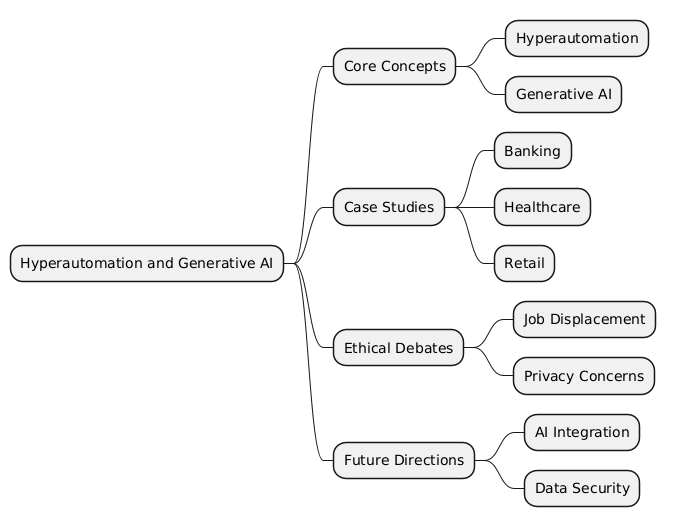
Mind Map
Key Takeaways
- 💡 Insightful Idea: Hyperautomation and Generative AI are transforming industries by automating complex processes and fostering innovation.
- ⚠️ Warning or Challenge: The rise of automation poses ethical dilemmas, including job displacement and privacy issues.
- 🔍 Key Detail or Discovery: Successful implementation of these technologies can lead to significant efficiency gains and improved customer experiences.
- 🚀 Future Opportunity: Advancements in AI and machine learning will further enhance the capabilities of automated systems.
- 🌍 Societal Impact: As businesses embrace these technologies, there will be a growing need for policies and frameworks to ensure ethical and equitable deployment.