Gemini, Google’s advanced AI language model, is poised to transform how we interact with technology and create content. By integrating creativity, precision, and multilingual capabilities, Gemini sets a new benchmark in AI innovation. This article delves into its features, applications, ethical considerations, and future impact.
Introduction & Context
In the ever-evolving landscape of artificial intelligence, Google has consistently positioned itself as a pioneer. Its latest innovation, Gemini, represents a significant leap forward in AI language models. Gemini is not merely an upgrade to existing systems; it’s a reimagining of what AI can achieve in understanding and generating language.
Born from years of research and development, Gemini builds upon the successes of its predecessors, such as BERT and LaMDA, while addressing their limitations. It emerges at a time when the demand for AI-driven solutions in content creation, translation, and ideation is surging. With its ability to generate creative text, answer complex queries, and even compose music or code, Gemini is designed to cater to diverse audiences—from marketers and educators to developers and creatives.
But Gemini is more than just a tool; it’s a reflection of Google’s ambition to shape the future of communication and creativity. As AI becomes increasingly integrated into our daily lives, models like Gemini raise critical questions about their societal impact, ethical considerations, and long-term implications.
Description
Gemini is Google’s flagship AI language model, trained on an extensive dataset comprising text, code, and multimedia inputs. It leverages advanced neural networks and multimodal learning to perform tasks that were once considered the domain of human creativity and expertise.
Key Features:
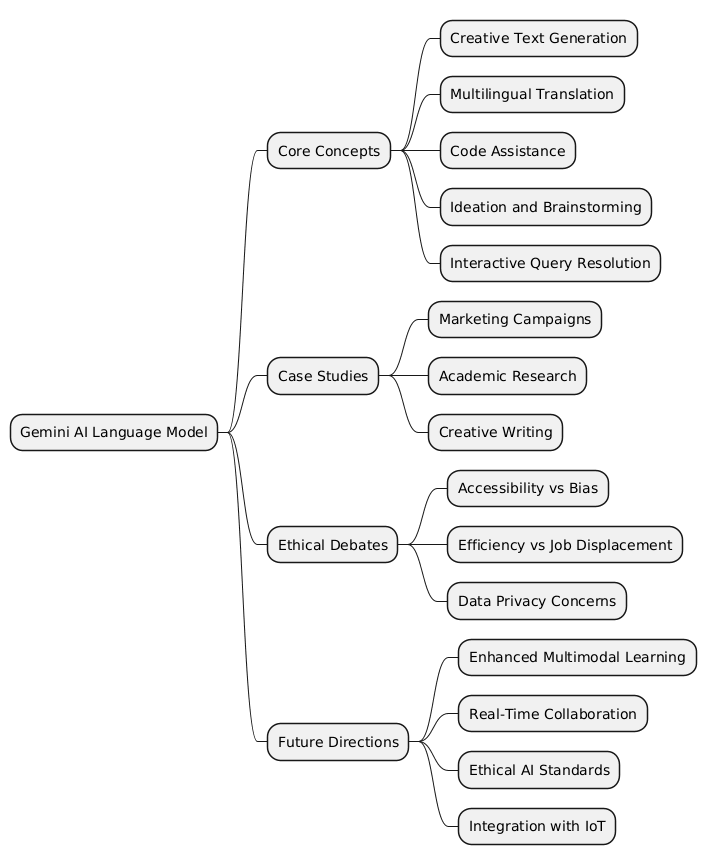
- Creative Text Generation: Gemini can produce poems, scripts, articles, and even musical compositions with remarkable fluency and originality.
- Code Assistance: It supports developers by generating and debugging code across multiple programming languages.
- Multilingual Translation: Gemini excels in translating content into numerous languages, preserving context and cultural nuances.
- Ideation and Brainstorming: It can generate innovative ideas, helping professionals in marketing, design, and content creation.
- Interactive Query Resolution: Gemini provides detailed answers to open-ended, challenging, or niche questions.
Unlike earlier models, Gemini incorporates feedback loops and reinforcement learning, enabling it to refine its outputs based on user interactions. This adaptability makes it a versatile tool for both personal and professional use.
Use Cases
Gemini’s versatility is best illustrated through real-world applications. Below are three compelling examples:
1. Content Creation for Marketing Campaigns
A marketing team tasked with launching a global campaign used Gemini to generate culturally sensitive slogans and taglines. By leveraging its multilingual capabilities, the team crafted messages tailored to diverse audiences, reducing the need for extensive localization efforts.
2. Academic Research and Summarization
University researchers employed Gemini to summarize complex academic papers and translate them into accessible language for public dissemination. Its ability to simplify jargon while retaining accuracy proved invaluable.
3. Creative Writing and Storyboarding
A film production company utilized Gemini to brainstorm plot ideas and draft initial scripts. The model’s creative text generation capabilities accelerated the pre-production phase, allowing writers to focus on refining the narrative.
How to Use Gemini
Using Gemini is straightforward, thanks to Google’s intuitive interface. Follow these steps to get started:
- Access Gemini: Visit Gemini AI and create a Google account if you don’t already have one.
- Choose Your Mode: Select the type of task—creative writing, translation, coding, or brainstorming—from the dashboard.
- Input Your Prompt: Provide a detailed prompt specifying your requirements. For example, “Write a blog post on renewable energy trends in 2025.”
- Customize Outputs: Adjust settings for tone, format, and language preferences.
- Review and Refine: Evaluate the generated output and provide feedback to improve future interactions.
- Export or Share: Download the final result or share it directly via integrated platforms like Google Docs or Gmail.
Gemini also offers API access for developers seeking to integrate its capabilities into their own applications.
Ethical Debate
While Gemini’s capabilities are groundbreaking, they are not without controversy. Here are the key ethical considerations:
Pros:
- Accessibility: Gemini democratizes access to advanced AI, empowering individuals and small businesses.
- Efficiency: It reduces the time and effort required for tasks like content creation and translation.
- Innovation: By enabling creative ideation, Gemini fosters innovation across industries.
Cons:
- Bias and Accuracy: Like all AI models, Gemini is susceptible to biases in its training data, which can lead to skewed or inaccurate outputs.
- Job Displacement: The automation of creative and technical tasks raises concerns about the future of employment in these fields.
- Data Privacy: Users must trust Google with sensitive information, raising questions about data security and misuse.
Societal Implications:
The widespread adoption of Gemini could reshape industries, from education to entertainment. However, it also necessitates robust governance frameworks to ensure ethical usage and mitigate risks.
Future Directions
Gemini is just the beginning. Google’s roadmap for AI includes several exciting possibilities:
- Enhanced Multimodal Learning: Future iterations may integrate visual and auditory inputs, enabling Gemini to analyze images and videos alongside text.
- Real-Time Collaboration: Gemini could evolve into a collaborative tool for teams, offering real-time suggestions during meetings or brainstorming sessions.
- Ethical AI Standards: Google is likely to invest in developing transparent algorithms to address biases and improve accountability.
- Integration with IoT: Gemini could be embedded into smart devices, making AI assistance ubiquitous in homes and workplaces.
As AI continues to advance, Gemini exemplifies the potential—and the challenges—of integrating intelligent systems into our lives.
Mind Map
Key Takeaways
💡 Insightful Idea: Gemini redefines AI language models with its creative and multilingual capabilities.
⚠️ Warning or Challenge: Addressing biases and ensuring data privacy are critical for ethical adoption.
🔍 Key Detail or Discovery: Gemini’s ability to generate and refine creative content sets it apart from predecessors.
🚀 Future Opportunity: Enhanced multimodal learning could make Gemini a cornerstone of smart technologies.
🌍 Societal Impact: Gemini has the potential to democratize access to advanced AI tools, reshaping industries worldwide.
This article offers a comprehensive exploration of Gemini, showcasing its transformative potential while critically examining its ethical and societal implications.