Generative AI is reshaping organizational roles and productivity in unprecedented ways. Its integration into workplaces promises transformative efficiencies but also presents ethical and operational challenges. This article explores the technical, societal, and future implications of generative AI, offering insights into its potential and pitfalls.

Introduction & Context
The Industrial Revolution mechanized labor. The Digital Revolution digitized it. Now, the Productivity Revolution, driven by generative AI, is automating creativity and decision-making. This paradigm shift isn’t just about faster algorithms or smarter machines—it’s about rethinking how organizations operate, how leaders lead, and how society adapts.
Historically, technological revolutions have disrupted industries and reshaped economies. The printing press democratized knowledge, the assembly line revolutionized manufacturing, and the Internet transformed communication. Generative AI, with its ability to create text, images, and even code, stands poised to redefine knowledge work itself. This isn’t merely a technological evolution; it’s a cultural and organizational transformation.
The current wave of generative AI adoption comes at a time when businesses are under immense pressure to innovate, streamline operations, and stay competitive. But as companies rush to integrate these tools, they face a critical question: How do we harness AI’s potential responsibly and effectively?
Technical Breakdown
At its core, generative AI relies on large language models (LLMs) and neural networks trained on vast datasets. These models, like OpenAI’s GPT or Google’s Gemini, use advanced algorithms to predict and generate content based on user inputs. But how do they work, and why are they so impactful?
The Mechanics: From Data to Creativity
Generative AI models are powered by deep learning, a subset of machine learning that mimics the way neurons in the human brain process information. These models are trained on terabytes of data—everything from books and articles to code repositories and images. Using techniques like transformer architectures, they learn to identify patterns, relationships, and contexts within this data.
For example, when you prompt an AI model to generate a marketing email, it doesn’t simply retrieve a pre-written template. Instead, it analyzes your input, predicts the most relevant structure and tone, and synthesizes a unique response. This process involves:
- Tokenization: Breaking down text into smaller components (e.g., words or characters).
- Embedding: Mapping these components into numerical vectors for computational processing.
- Attention Mechanisms: Weighing the importance of different words or phrases to understand context.
- Decoding: Generating coherent and contextually relevant output.
Real-World Analogy: AI as a Master Chef
Imagine generative AI as a master chef. Instead of following a single recipe, it has access to a global library of culinary knowledge. When tasked with creating a dish, it considers the ingredients (input data), understands the desired flavor profile (context), and crafts a meal (output) that’s both innovative and tailored to the diner’s preferences.
The Tools: Beyond Text
While text generation is a hallmark of LLMs, generative AI extends far beyond. Tools like DALL-E create images from textual descriptions, while GitHub Copilot assists developers by generating code snippets. These capabilities are transforming industries, from healthcare (diagnostic AI) to entertainment (AI-generated scripts).
But with great power comes great complexity. The training and deployment of these models require immense computational resources. For instance, training OpenAI’s GPT-4 reportedly cost $78 million. This raises questions about accessibility and environmental sustainability.
Case Studies
1. Healthcare: Accelerating Diagnostics
Generative AI is revolutionizing healthcare by enhancing diagnostic accuracy and efficiency. IBM’s Watson Health, for instance, analyzes patient data to recommend personalized treatment plans. Similarly, AI tools are being used to summarize patient histories, aiding doctors in making quicker, more informed decisions.
Lesson Learned: While these tools improve efficiency, they underscore the importance of data quality. Biased or incomplete datasets can lead to inaccurate diagnoses, highlighting the need for robust data governance.
2. Customer Service: Enhancing Engagement
Bank of America’s virtual assistant, Erica, exemplifies how generative AI enhances customer interactions. By analyzing transaction histories and customer queries, Erica provides personalized financial advice and support. This not only improves customer satisfaction but also reduces operational costs.
Lesson Learned: AI’s ability to personalize at scale is a game-changer. However, organizations must ensure transparency and explainability to maintain customer trust.
3. Content Creation: Redefining Creativity
BuzzFeed’s AI-powered “Infinity Quizzes” demonstrate how generative AI is transforming content creation. By leveraging user inputs and AI-generated responses, the platform creates personalized quizzes that engage millions of users.
Lesson Learned: Generative AI democratizes creativity but raises questions about originality and intellectual property rights.
Ethical Debate
Generative AI’s potential is immense, but so are its challenges. As organizations adopt these tools, they must navigate a complex web of ethical dilemmas.
Pros
- Enhanced Productivity: AI automates routine tasks, freeing humans for higher-value work.
- Personalization: From tailored marketing campaigns to individualized learning experiences, AI enhances user engagement.
- Innovation: Generative AI accelerates research and development, particularly in fields like drug discovery.
Cons
- Bias and Fairness: AI models can perpetuate societal biases present in their training data.
- Transparency: The “black box” nature of AI makes it difficult to explain or trust its decisions.
- Job Displacement: Automation threatens to displace workers, particularly in roles focused on repetitive tasks.
Societal Implications
The rise of generative AI raises fundamental questions about the future of work. If AI can perform tasks traditionally reserved for humans, how do we redefine employment, education, and economic systems? Moreover, as AI-generated content floods the digital landscape, distinguishing fact from fiction becomes increasingly challenging.
Future Directions
The journey of generative AI is just beginning. Here’s what lies ahead:
1. AI Literacy
As AI tools become ubiquitous, organizations must invest in AI literacy programs. Employees need to understand not just how to use these tools but also their limitations and ethical implications.
2. Regulation and Governance
Governments and organizations must establish clear guidelines for AI use. From data privacy to algorithmic accountability, robust governance frameworks are essential to mitigate risks.
3. Sustainability
The environmental impact of AI training and deployment cannot be ignored. Developing energy-efficient models and leveraging renewable energy sources will be critical.
4. Human-AI Collaboration
The future isn’t about humans versus machines; it’s about collaboration. Organizations must focus on integrating AI in ways that augment human capabilities rather than replace them.
5. Breakthroughs in Healthcare
With advancements in medical diagnostics and drug discovery, generative AI has the potential to revolutionize healthcare, improving outcomes and saving lives.
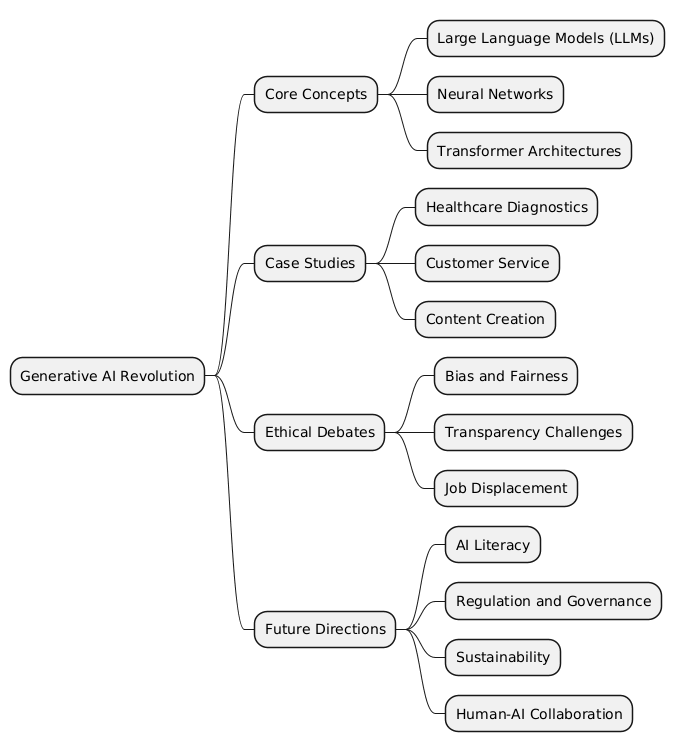
Mind Map
Key Takeaways
💡 Insightful Idea: Generative AI automates creativity, reshaping industries and redefining productivity.
⚠️ Warning: Without robust governance, AI risks perpetuating biases and eroding trust.
🔍 Key Detail: The success of generative AI hinges on data quality and transparency.
🚀 Future Opportunity: Advancements in healthcare could be AI’s most transformative application.
🌍 Societal Impact: AI demands a rethinking of work, ethics, and education to ensure inclusive progress.
Generative AI is more than a technological marvel; it’s a societal catalyst. The question isn’t whether to adopt it, but how to do so responsibly.