
- As artificial intelligence reshapes industries, the role of the Chief AI Officer (CAIO) emerges as a critical leadership position.
- This article explores the book The Chief AI Officer’s Handbook, which provides a comprehensive guide to integrating AI into business strategies, managing teams, and ensuring ethical compliance.
- From technical insights to ethical dilemmas, we unpack how AI leadership will shape the future of innovation and society.

Introduction & Context
In the last decade, artificial intelligence (AI) has transitioned from an experimental technology to a cornerstone of modern industry. As businesses increasingly adopt AI to automate processes, optimize decisions, and personalize customer experiences, a new leadership role has emerged: the Chief AI Officer (CAIO). This role is not just a title—it’s a recognition of the strategic importance of AI in shaping the future of organizations.
Jarrod Anderson’s The Chief AI Officer’s Handbook arrives at a pivotal moment, offering a roadmap for leaders navigating this complex terrain. With over three decades of experience in AI, Anderson provides a holistic guide to integrating AI into business strategies, building high-performing teams, and addressing ethical challenges.
The book’s relevance is underscored by projections from McKinsey & Company, which estimate that AI could contribute $2.6 to $4.4 trillion annually to the global economy. Yet, despite this potential, many organizations struggle to harness AI effectively, often due to a lack of strategic oversight. Anderson’s handbook aims to bridge this gap, positioning the CAIO as the linchpin of AI-driven transformation.
Technical Breakdown
At its core, The Chief AI Officer’s Handbook is a technical guide, demystifying complex AI concepts and translating them into actionable strategies. Let’s explore some of its key technical pillars.
1. AI Strategy Development
Anderson emphasizes that AI initiatives must align with overarching business goals. This involves:
- Crafting a clear AI vision: Define how AI will drive value, whether through cost reduction, revenue growth, or innovation.
- Setting measurable KPIs: Use specific metrics like customer satisfaction scores or operational efficiency improvements to track progress.
- Building a phased roadmap: Start with pilot projects to demonstrate quick wins before scaling AI across the organization.
2. Data as the Lifeblood of AI
Data quality and governance are foundational to AI success. Anderson outlines a systematic approach:
- Data collection: Standardize formats and integrate disparate systems to ensure consistency.
- Data quality: Implement automated tools to clean and validate data, reducing errors and biases.
- Data governance: Establish clear ownership and access controls to maintain data integrity and compliance.
3. AI Team Dynamics
Building a high-performing AI team requires balancing technical expertise with creativity. Anderson identifies three key traits:
- Curiosity: Team members should constantly seek new knowledge.
- Creativity: Innovative problem-solving is essential for navigating AI’s complexities.
- Collaboration: Cross-functional teams combining data scientists, engineers, and domain experts ensure holistic solutions.
4. Ethical AI Frameworks
Ethical considerations are woven throughout the book. Anderson advocates for:
- Bias audits: Regularly test AI models for discriminatory patterns.
- Transparency: Use explainable AI (XAI) techniques to make decision-making processes understandable.
- Accountability: Assign clear roles for ethical oversight, ensuring AI aligns with societal values.
Case Studies
Anderson illustrates his principles through real-world examples, offering valuable lessons for AI leaders.
1. Predictive Maintenance in Manufacturing
A hypothetical case study in the book follows APEX Manufacturing, which implemented AI-driven predictive maintenance to reduce equipment downtime. By retrofitting machines with IoT sensors and analyzing real-time data, APEX achieved a 40% reduction in unexpected failures and a 25% improvement in operational efficiency.
2. AI in Customer Experience
A retail giant used AI to personalize customer interactions, leveraging algorithms to recommend products and optimize inventory. This initiative increased sales by 20% and improved customer satisfaction scores. However, the project also highlighted the importance of ethical data use, as initial models faced criticism for reinforcing biases.
3. AI Governance in Finance
A financial institution implemented an AI-driven fraud detection system but faced challenges with data quality and regulatory compliance. By adopting Anderson’s governance framework—complete with regular audits and privacy-preserving techniques—the institution reduced false positives and regained customer trust.
Ethical Debate
The rapid adoption of AI raises profound ethical questions, many of which Anderson addresses in his book.
Pros
- Efficiency Gains: Automating repetitive tasks allows employees to focus on strategic initiatives.
- Enhanced Decision-Making: AI’s ability to analyze vast datasets leads to more informed strategies.
- Global Impact: From healthcare to climate modeling, AI has the potential to address pressing global challenges.
Cons
- Bias and Discrimination: AI systems trained on biased data can perpetuate inequalities.
- Privacy Concerns: The collection and use of personal data necessitate robust safeguards.
- Job Displacement: Automation may lead to workforce disruptions, requiring reskilling initiatives.
Societal Implications
Anderson argues that ethical AI is not just a technical challenge but a societal imperative. He calls for cross-disciplinary collaboration, involving ethicists, policymakers, and technologists to ensure AI serves humanity equitably.
Future Directions
Looking ahead, Anderson identifies several trends that will shape the future of AI leadership:
1. AI Regulation
Governments worldwide are introducing frameworks to govern AI use. The EU’s AI Act, for example, emphasizes transparency, accountability, and risk management. CAIOs must stay ahead of these regulations to ensure compliance.
2. Generative AI
Tools like ChatGPT and DALL·E are redefining creativity, enabling businesses to generate content, designs, and even software code. However, these tools also raise questions about intellectual property and misinformation.
3. Quantum AI
The convergence of quantum computing and AI promises to solve previously intractable problems, from drug discovery to climate modeling. While still in its infancy, this field represents a frontier for innovation.
4. Human-AI Collaboration
Rather than replacing humans, AI will augment human capabilities. Anderson envisions a future where AI and humans work symbiotically, combining computational power with human intuition.
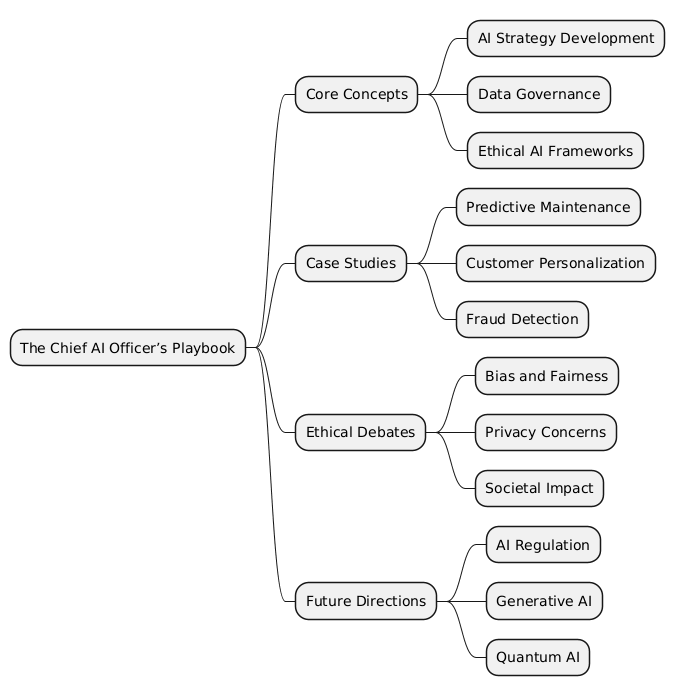
Mind Map
Key Takeaways
💡 Insightful Idea: AI’s potential lies in its strategic alignment with business goals, not just its technical capabilities.
⚠️ Warning: Ethical lapses in AI can erode trust and lead to regulatory penalties.
🔍 Key Detail: Data quality is the foundation of effective AI systems; without it, even the best algorithms fail.
🚀 Future Opportunity: Emerging fields like quantum AI and generative AI offer untapped potential for innovation.
🌍 Societal Impact: Responsible AI leadership is essential to ensure technology benefits humanity equitably.