Artificial Intelligence (AI) is reshaping industries, and product managers stand at the helm of this transformation. By demystifying AI infrastructure, ethical dilemmas, and real-world applications, this article explores how professionals can harness AI to revolutionize product development. From technical insights to societal implications, we uncover the roadmap for building and managing AI-powered products.
Introduction & Context
Artificial Intelligence has moved from the pages of sci-fi novels to the core of modern industry. Its transformative potential is evident in fields as diverse as healthcare, finance, and creative arts. As we navigate the Fourth Industrial Revolution, AI is no longer a luxury but a necessity for competitive businesses. Yet, adopting AI is not without its challenges—technical, ethical, and operational.
The role of the AI product manager has emerged as a critical link between technical teams and business stakeholders. This article explores the strategies, tools, and ethical considerations that empower product managers to integrate AI into their products successfully. From understanding machine learning (ML) infrastructure to navigating ethical pitfalls, we explore how to turn AI into a competitive advantage.
Technical Breakdown
The Building Blocks of AI Product Management
AI products thrive on well-structured data pipelines, robust algorithms, and scalable infrastructure. At the heart of these systems are machine learning models, which can be broadly categorized into supervised, unsupervised, semi-supervised, and reinforcement learning models. Each serves a unique purpose:
- Supervised Learning: Think of it as a teacher guiding a student. This model uses labeled datasets to predict outcomes, such as spam detection in emails.
- Unsupervised Learning: This is akin to exploring a new city without a map. It identifies patterns in unlabeled data, useful for clustering customers by behavior.
- Reinforcement Learning: Imagine training a dog with rewards and penalties. This model learns optimal actions through trial and error, often used in robotics and gaming.
Tools and Infrastructure
Managing AI products requires a blend of technical tools and strategic oversight. Key components include:
- Data Lakes and Warehouses: These serve as centralized repositories for structured and unstructured data.
- MLOps (Machine Learning Operations): A framework that ensures the continuous integration, deployment, and monitoring of AI models.
- Explainability Tools: With AI often seen as a “black box,” tools like SHAP (SHapley Additive exPlanations) make model decisions interpretable.
Real-World Analogy
Consider AI product management like running a restaurant. The data is your ingredients, the algorithms are your recipes, and the infrastructure is your kitchen. Just as a chef must balance flavors, a product manager must balance technical feasibility with user needs and ethical considerations.
Case Studies
1. Duolingo: Personalization at Scale
Duolingo leverages AI to tailor language lessons based on user progress, optimizing learning paths through reinforcement learning. This approach has helped the platform maintain over 300 million active users while improving user retention rates.
2. TikTok: The Algorithmic Playground
TikTok’s AI uses computer vision and natural language processing to deliver hyper-personalized video recommendations. By analyzing user behavior, the platform keeps its audience engaged for hours, setting a new benchmark for content recommendation systems.
3. IBM Watson in Healthcare: A Cautionary Tale
IBM Watson’s ambitious goal to revolutionize cancer treatment fell short due to reliance on simulated data rather than real-world datasets. This highlights the importance of robust data quality and realistic testing environments.
Ethical Debate
The Double-Edged Sword of AI
AI’s power lies in its ability to automate decisions at scale, but this comes with risks. Bias in datasets can perpetuate inequality, while opaque algorithms challenge accountability. For instance, facial recognition systems have been criticized for racial bias, leading to wrongful arrests.
Data Privacy and Security
As AI systems collect vast amounts of personal data, questions about consent and security arise. Companies must navigate regulations like GDPR to ensure compliance while fostering user trust.
Balancing Innovation with Responsibility
Ethical AI isn’t just a moral imperative; it’s a business one. Companies that prioritize transparency and fairness are more likely to gain user trust and long-term success.
Future Directions
What Lies Ahead for AI Product Management?
- Quantum Computing: With its ability to process data at unprecedented speeds, quantum computing could revolutionize AI model training.
- Edge AI: Moving AI computations to edge devices (like smartphones) will reduce latency and enhance privacy.
- Democratization of AI: No-code platforms are making AI accessible to non-technical users, broadening its adoption.
- AI in Climate Tech: From optimizing renewable energy grids to monitoring deforestation, AI is poised to play a crucial role in combating climate change.
- Ethical Frameworks: As AI becomes ubiquitous, robust ethical guidelines will be essential to mitigate risks and ensure equitable outcomes.
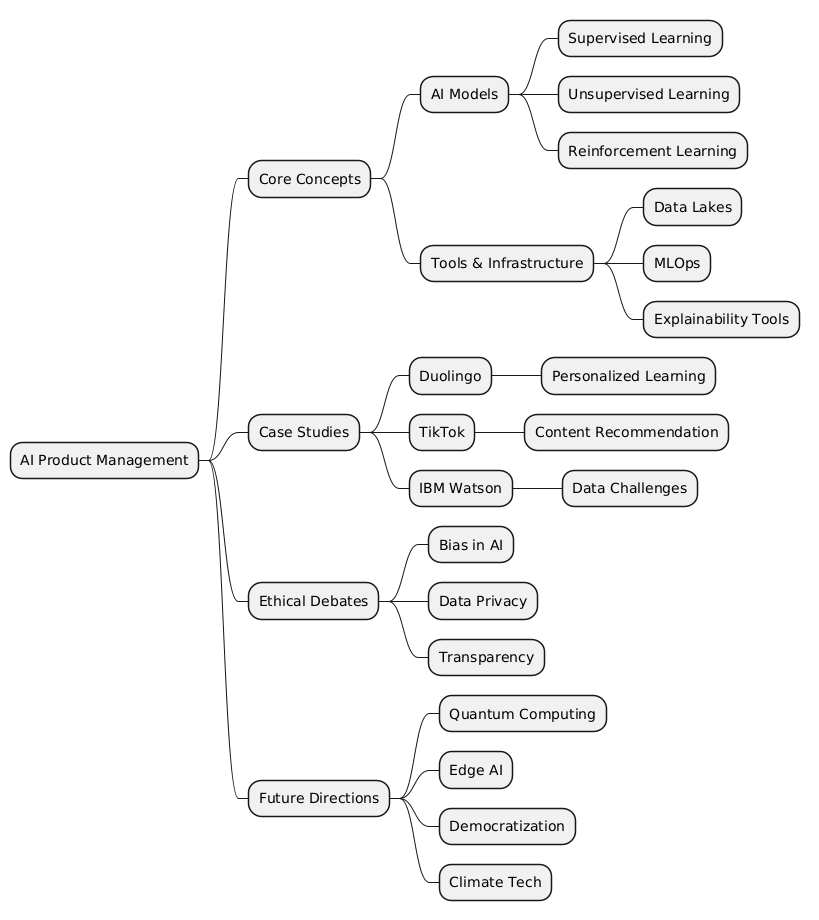
Mind Map
Key Takeaways
- 💡 Insightful Idea: AI product management is about balancing technical complexity with user-centric design.
- ⚠️ Warning: Poor data quality can derail even the most ambitious AI projects.
- 🔍 Key Detail: Explainability tools are crucial for building user trust in AI systems.
- 🚀 Future Opportunity: Quantum computing could redefine AI capabilities in the coming decade.
- 🌍 Societal Impact: Ethical AI practices are essential for equitable and sustainable innovation.
By understanding these elements, product managers can navigate the complexities of AI adoption and lead their organizations into a future defined by innovation and responsibility.