
Copy.ai stands at the forefront of AI-powered text generation, simplifying content creation for businesses and individuals alike. This article explores its transformative impact on marketing, productivity, and creativity while addressing the ethical challenges it poses. Learn how to use Copy.ai effectively and discover its future possibilities.
Introduction & Context
In the age of digital transformation, artificial intelligence is no longer just a futuristic concept; it’s a reality shaping how we live and work. Among the many AI-driven tools revolutionizing industries, Copy.ai has emerged as a groundbreaking solution for content creation. Launched in 2020, Copy.ai leverages natural language processing (NLP) to assist users in generating high-quality text for various purposes, from marketing campaigns to blog posts.
The rise of Copy.ai is not coincidental. Its development aligns with a growing demand for efficiency in content production, driven by the ever-increasing volume of digital communication. Businesses and creators face mounting pressure to produce engaging, optimized, and diverse content at scale. Copy.ai addresses this challenge by offering a virtual assistant capable of crafting compelling text in seconds.
But Copy.ai is more than just a productivity tool; it represents a paradigm shift in how we approach creativity. By automating repetitive tasks, it frees up human writers to focus on strategy, innovation, and storytelling. However, this technological marvel also raises important ethical questions about authorship, originality, and the role of AI in creative fields.
Description
At its core, Copy.ai is an AI-powered text generator designed to simplify and accelerate the content creation process. Built on OpenAI’s GPT (Generative Pre-trained Transformer) technology, Copy.ai uses machine learning algorithms to analyze and generate human-like text based on user-provided prompts.
Key Features of Copy.ai:
- Versatility: Copy.ai supports a wide range of content types, including blog posts, ad copies, product descriptions, emails, and even social media captions.
- Customizability: Users can specify tone, style, and target audience, ensuring the output aligns with their brand identity.
- Ease of Use: The interface is intuitive, requiring minimal technical expertise. Simply input a prompt, and Copy.ai generates multiple text variations instantly.
- Collaboration Tools: Teams can collaborate within the platform, refining drafts and brainstorming ideas in real-time.
- Multilingual Support: Copy.ai offers text generation in multiple languages, expanding its utility for global audiences.
By democratizing access to high-quality writing, Copy.ai empowers individuals and businesses to achieve more with less effort.
Use Cases
Copy.ai’s applications span a variety of industries and scenarios, making it a versatile tool for professionals and creatives alike. Below are three real-world examples that highlight its transformative potential:
1. Marketing Campaigns
A digital marketing agency used Copy.ai to streamline the creation of ad copies for a product launch. By inputting key product features and desired tone, the agency generated dozens of ad variations in minutes. This allowed the team to A/B test different messages, optimizing their campaign performance.
2. E-commerce Product Descriptions
An online retailer leveraged Copy.ai to craft engaging product descriptions for its extensive catalog. The tool’s ability to generate SEO-optimized text helped improve the retailer’s search engine rankings, driving more traffic to their website.
3. Social Media Management
A small business owner used Copy.ai to maintain a consistent social media presence without hiring a dedicated content manager. By generating captions and hashtags tailored to each platform, the owner saved time while boosting audience engagement.
These examples illustrate Copy.ai’s ability to enhance productivity, creativity, and ROI across diverse use cases.
How To Use Copy.ai
Getting started with Copy.ai is straightforward. Here’s a step-by-step guide:
Step 1: Create an Account
Visit Copy.ai and sign up for a free account. Paid plans are available for users who require advanced features.
Step 2: Choose a Template
Browse through Copy.ai’s extensive library of templates, categorized by content type (e.g., blog posts, emails, ad copies). Select a template that suits your needs.
Step 3: Input Your Prompt
Enter a brief description of your content requirements. Include details like tone, target audience, and key points to ensure accurate results.
Step 4: Generate Text
Click the “Create” button. Copy.ai will produce multiple text variations based on your input. Review the options and select the one that best fits your needs.
Step 5: Edit and Finalize
Refine the generated text using Copy.ai’s built-in editing tools. Collaborate with team members if necessary, and export the final version.
Step 6: Implement
Use the finalized content in your marketing campaigns, website, or social media posts. Repeat the process for future projects.
Ethical Debate
While Copy.ai offers undeniable benefits, its widespread adoption raises important ethical considerations. Below are some of the key debates surrounding its use:
Pros:
- 💡 Efficiency: Automates repetitive tasks, allowing users to focus on higher-value activities.
- 🌍 Accessibility: Makes professional-grade writing accessible to individuals and small businesses.
- 🚀 Innovation: Encourages creative experimentation by reducing the cost and time associated with content production.
Cons:
- ⚠️ Originality Concerns: Critics argue that AI-generated text may lack the nuance and creativity of human writing.
- ⚠️ Job Displacement: The automation of writing tasks could impact employment in creative industries.
- ⚠️ Bias and Misinformation: AI models can inadvertently perpetuate biases present in their training data, leading to ethical dilemmas.
Societal Implications:
The rise of tools like Copy.ai prompts us to reconsider traditional notions of authorship and intellectual property. As AI becomes more integrated into creative workflows, society must establish guidelines to ensure ethical and equitable use.
Future Directions
The future of Copy.ai and similar tools is both exciting and uncertain. Here are some potential advancements and challenges:
- Enhanced Personalization: Future iterations of Copy.ai could offer even greater customization, tailoring content to individual preferences with unprecedented precision.
- Integration with Other Technologies: Copy.ai may integrate with voice assistants, AR/VR platforms, and other emerging technologies to create immersive content experiences.
- Regulatory Frameworks: Governments and industry leaders will need to develop policies to address ethical concerns, ensuring responsible AI use.
- Expanding Applications: Beyond content creation, Copy.ai could be adapted for educational purposes, customer support, and more.
- Continuous Improvement: As AI models evolve, Copy.ai will likely become more adept at understanding context, tone, and cultural nuances.
The journey of Copy.ai is far from over, and its impact on the creative landscape will continue to unfold in fascinating ways.
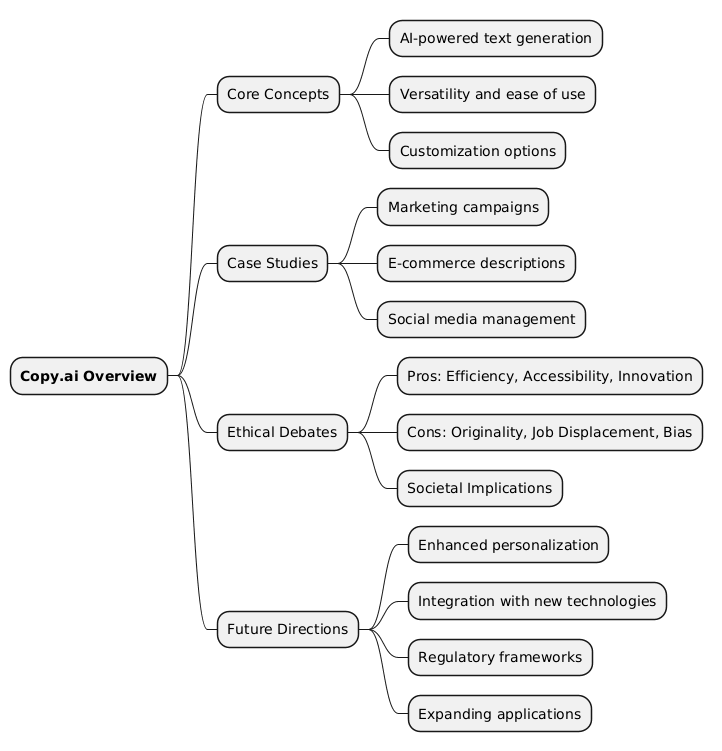
Mind Map
Key Takeaways
- 💡 Insightful Idea: Copy.ai simplifies content creation, empowering users with AI-driven tools.
- ⚠️ Warning: Ethical concerns, such as originality and bias, require careful consideration.
- 🔍 Key Detail: Copy.ai’s versatility spans marketing, e-commerce, and social media.
- 🚀 Future Opportunity: Integration with emerging technologies could redefine creative workflows.
- 🌍 Societal Impact: As AI reshapes industries, society must adapt to new norms around creativity and authorship.
By exploring Copy.ai’s capabilities, challenges, and potential, we gain a deeper understanding of its transformative role in the world of content creation.