
Generative AI is revolutionizing the Banking, Financial Services, and Insurance (BFSI) sector by enhancing operational efficiency, personalizing customer experiences, and driving innovation. However, this technological advancement comes with ethical challenges, including data privacy and bias. As the BFSI sector continues to integrate AI, balancing innovation with ethical responsibility remains crucial for sustainable growth and consumer trust.

Section 1: Context
The journey of Generative AI in the BFSI sector is a testament to the relentless pursuit of innovation. From its early days, where rule-based systems dominated, AI has evolved into a sophisticated tool capable of generating content, simulating scenarios, and providing insights that were once the realm of human experts. This evolution has been driven by advancements in machine learning and neural networks, which have expanded AI’s capabilities beyond mere data analysis to creating new data instances that mimic real-world complexities.
Today, Generative AI is at the forefront of transforming the BFSI sector. It enhances operational efficiency by automating processes, reduces costs, and improves decision-making accuracy. More importantly, it allows for personalized customer experiences, offering tailored financial advice and services that meet individual needs. This personalization is crucial in a sector where customer trust and satisfaction are paramount.
Section 2: Technical Breakdown
At the heart of Generative AI are algorithms and models that learn from vast datasets to generate new content. One of the most prominent models is the Generative Adversarial Network (GAN), which consists of two neural networks: a generator and a discriminator. The generator creates data instances, while the discriminator evaluates them against real data. This adversarial process refines the generator’s ability to produce realistic data, akin to an artist honing their craft under the critique of a discerning audience.
Another key technology is the Transformer model, which revolutionized natural language processing (NLP) by enabling AI to understand and generate human-like text. This model uses an attention mechanism to weigh the importance of different input tokens, allowing for more effective context utilization. An analogy would be a skilled editor who can discern the most relevant parts of a manuscript to craft a coherent narrative.
These technologies are not just theoretical constructs; they are the engines behind real-world applications in the BFSI sector. For instance, AI-driven chatbots use NLP to provide instant customer support, while GANs are employed in fraud detection systems to identify patterns and anomalies that human analysts might miss.
Section 3: Case Studies
JPMorgan Chase’s COiN
JPMorgan Chase has harnessed the power of Generative AI through its Contract Intelligence (COiN) platform. This AI system processes legal documents and extracts critical data points in seconds, a task that previously took thousands of hours annually. By automating these processes, JPMorgan Chase not only reduces operational costs but also minimizes errors, ensuring compliance with regulatory standards.
HSBC’s Fraud Detection System
HSBC has implemented AI to enhance its fraud detection capabilities. By analyzing transaction patterns and detecting anomalies, the AI system improves security and customer trust. This proactive approach to fraud prevention demonstrates the potential of AI to safeguard financial assets and maintain robust security protocols.
Capital One’s Personalized Financial Advice
Capital One utilizes AI to analyze customer data and offer personalized financial advice. The AI system tailors recommendations for credit cards, loans, and other financial products, enhancing customer satisfaction and engagement. This personalized approach makes financial services more accessible and relevant to individual needs.
Section 4: Ethical Debate
The integration of Generative AI in the BFSI sector is not without ethical challenges. One major concern is data privacy. AI systems require vast amounts of data to function effectively, raising questions about how this data is collected, stored, and used. Ensuring compliance with regulations like the General Data Protection Regulation (GDPR) is crucial to maintaining customer trust.
Another ethical dilemma is bias in AI decision-making. AI systems learn from historical data, which can reflect societal biases. If not addressed, these biases can lead to unfair treatment of certain demographic groups, particularly in areas like credit scoring and loan approvals. Implementing robust bias detection and mitigation strategies is essential to ensure fairness and equity in AI outcomes.
Despite these challenges, the potential benefits of Generative AI in the BFSI sector are immense. By enhancing efficiency, personalization, and security, AI can drive innovation and improve customer experiences. However, balancing these benefits with ethical responsibility is crucial for sustainable growth and consumer trust.
Mind Map
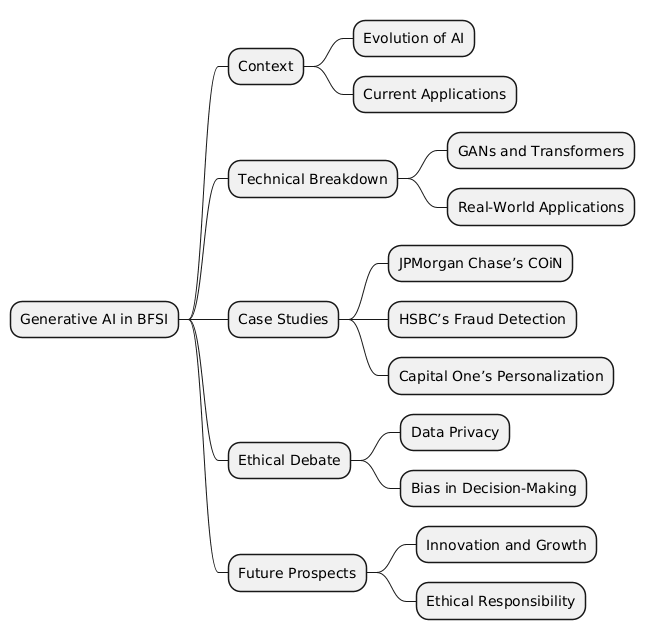
Key Takeaways:
- 💡 Generative AI enhances operational efficiency and personalization in BFSI.
- ⚠️ Ethical challenges include data privacy and bias in AI decision-making.
- 🔍 Real-world applications demonstrate AI’s potential in fraud detection and personalized financial advice.
- 💡 Balancing innovation with ethical responsibility is crucial for sustainable growth.
- ⚠️ Ongoing monitoring and compliance with regulations like GDPR are essential to maintain trust.