Artificial Intelligence (AI) is transforming the healthcare landscape through personalized medicine, offering tailored diagnoses and treatments. By leveraging cutting-edge algorithms, AI provides precise predictions, improving patient outcomes and reducing costs. However, as this technology reshapes medicine, ethical and privacy concerns remain at the forefront of the discussion.

Section 1: Context—A New Era in Medicine
Imagine a world where healthcare isn’t one-size-fits-all but tailored to your unique genetic code, lifestyle, and medical history. This is the promise of AI-assisted personalized medicine. Historically, medicine has relied on generalizations, treating diseases based on population-wide data. But the Human Genome Project, completed in 2003, was a turning point. It unlocked the genetic blueprint of humans, paving the way for precision medicine.
Today, AI amplifies this vision. By processing massive datasets—from genomic sequences to wearable device metrics—AI algorithms identify patterns that human experts might miss. This shift is timely: chronic diseases, aging populations, and pandemics demand smarter, faster, and more accurate solutions.
Diego Rodrigues’ book, AI-Assisted Personalized Medicine: Transforming Diagnosis and Treatment with Advanced Technology, captures this transformation. It chronicles how AI is revolutionizing oncology, cardiology, mental health, and beyond, while addressing ethical dilemmas like data privacy and algorithmic bias.
Section 2: Technical Breakdown—How AI Works in Medicine
At its core, AI in medicine is about pattern recognition. Algorithms analyze data—lots of it—to detect anomalies, predict outcomes, and suggest treatments. Let’s break it down with some real-world analogies:
- Machine Learning (ML) Algorithms
Think of ML as a chef who learns recipes by experimenting with ingredients. For example, an ML model might analyze thousands of mammograms to learn what cancerous tissue looks like. Once trained, it can flag suspicious areas in new scans with remarkable accuracy.- Example: Deep learning models, like convolutional neural networks (CNNs), excel at image analysis. They’ve been used to detect breast cancer microcalcifications earlier than radiologists.
- Natural Language Processing (NLP)
NLP is like a linguist translating complex medical jargon into actionable insights. It mines electronic health records (EHRs) to find patterns, such as correlations between medications and side effects.- Example: IBM Watson Health uses NLP to assist oncologists in identifying treatment options based on patient records and scientific literature.
- Predictive Analytics
Imagine having a weather forecast for your health. Predictive analytics uses historical data to forecast outcomes. For instance, it can predict a diabetic patient’s risk of hospitalization based on glucose levels, diet, and activity data from wearables.- Example: AI-powered platforms like Livongo use predictive models to alert patients about potential health risks in real-time.
- Genomic Analysis
Analyzing DNA is like decoding a complex recipe book. AI accelerates this by identifying genetic mutations linked to diseases.- Example: AI tools analyze BRCA1/BRCA2 gene mutations to assess breast cancer risk, enabling preventive measures like regular screenings or prophylactic surgeries.
Section 3: Case Studies—AI in Action
Case Study 1: Oncology—Targeting Cancer with Precision
AI is a game-changer in oncology. For instance, algorithms analyze tumor DNA to recommend targeted therapies. At Memorial Sloan Kettering Cancer Center, AI systems identify genetic mutations in lung cancer patients, suggesting immunotherapies tailored to their tumor profiles.
Additionally, AI-assisted imaging tools detect early-stage cancers. Google Health’s algorithm, for example, outperformed radiologists in identifying breast cancer in mammograms during trials, reducing false negatives by 9.4%.
Case Study 2: Cardiology—Preventing Heart Attacks
In cardiology, AI predicts cardiac events before they occur. Mayo Clinic uses AI to analyze electrocardiograms (ECGs), identifying patients at risk of atrial fibrillation—a leading cause of strokes.
Wearable devices like Fitbit and Apple Watch also integrate AI. These devices monitor heart rates, alerting users to irregularities. Such early warnings have saved countless lives, providing timely interventions.
Case Study 3: Mental Health—Personalized Therapies
Mental health care is benefiting from AI’s ability to analyze behavioral data. Apps like Woebot leverage AI-driven chatbots to provide cognitive behavioral therapy, adapting conversations to users’ moods.
Meanwhile, AI analyzes clinical data to predict risks of mental health crises. For example, algorithms detect early signs of depression by tracking changes in sleep patterns, social media activity, and speech tone.
Section 4: Ethical Debate—Promise vs. Peril
The Promise
- Improved Outcomes: AI reduces diagnostic errors, personalizes treatments, and predicts complications early.
- Efficiency: Automating repetitive tasks frees up healthcare professionals for critical care.
- Accessibility: Remote monitoring tools democratize healthcare, reaching underserved populations.
The Peril
- Data Privacy Risks: AI relies on sensitive patient data. Breaches could erode trust.
- Example: In 2021, a ransomware attack on a Finnish psychotherapy center exposed patient records.
- Algorithmic Bias: AI models trained on biased datasets may perpetuate health disparities.
- Example: Studies reveal that some AI tools underperform for non-Caucasian patients due to underrepresentation in training data.
- Transparency Issues: “Black box” algorithms lack explainability, making it hard for clinicians to trust AI recommendations.
Solutions in Progress
- Ethical AI Frameworks: Governments are introducing regulations like GDPR (Europe) and HIPAA (USA) to protect health data.
- Explainable AI: Researchers are developing models that clarify decision-making processes, fostering trust.
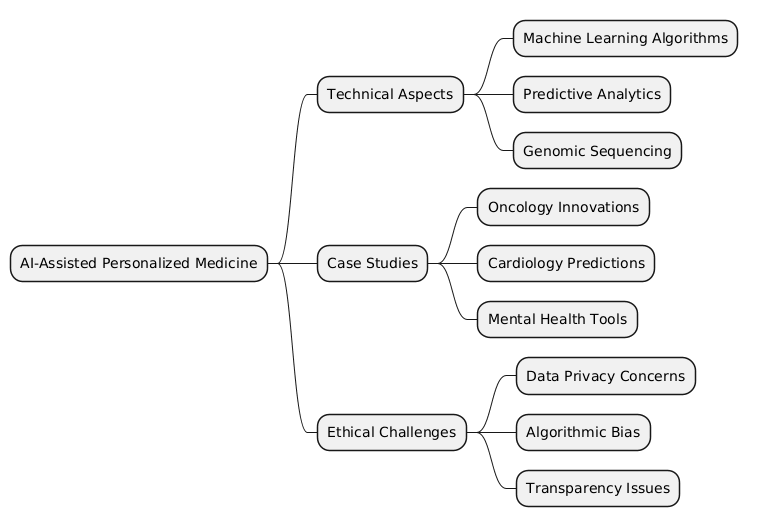
Mind Map
5 Key Takeaways
💡 AI empowers healthcare professionals with precision tools, enhancing diagnostics and treatments.
⚠️ Ethical frameworks are crucial to address data privacy and bias concerns.
🔍 Personalized medicine improves patient outcomes while reducing healthcare costs.
💡 Wearable devices and AI enable continuous, real-time health monitoring.
⚠️ Transparency in AI algorithms fosters trust among clinicians and patients.