Generative AI is reshaping industries faster than any prior technological revolution, enabling businesses to innovate, automate, and personalize at unprecedented scales. Yi Zhou’s AI Native Enterprise serves as a comprehensive guide for leaders navigating this AI-driven transformation, offering insights into building AI-native organizations from strategy to execution. As enterprises grapple with ethical dilemmas and integration challenges, this book underscores the urgency of adopting AI responsibly and strategically.

Section 1: Context – The Evolution of AI and Its Current Relevance
Artificial Intelligence (AI) has evolved from a niche academic pursuit to a transformative force reshaping industries globally. In the mid-20th century, AI pioneers like Alan Turing and Marvin Minsky laid the groundwork for intelligent machines. However, it wasn’t until the 2010s, with advancements in deep learning and computational power, that AI began to deliver on its promises.
Generative AI, the latest wave of innovation, distinguishes itself by creating entirely new outputs—text, images, code, and even strategies—rather than merely analyzing data. OpenAI’s GPT models and Google’s Bard exemplify this leap, enabling businesses to automate creative tasks and develop hyper-personalized customer experiences. As Zhou’s book highlights, this shift isn’t just technological; it’s existential for businesses. Companies must evolve into AI-native enterprises, embedding AI into their core operations to remain competitive.
This urgency is reflected in the rapid adoption of AI across industries. McKinsey estimates AI could generate $13 trillion in global economic value by 2030, yet only 20% of companies have scaled their AI initiatives successfully. Zhou’s work bridges this gap, offering a roadmap for leaders to navigate the complexities of AI adoption.
Section 2: Technical Breakdown – Demystifying Generative AI
At its core, Generative AI relies on foundation models—large, pre-trained neural networks capable of performing a variety of tasks. These models, like GPT-4 or Google Gemini, are trained on massive datasets encompassing text, images, and more. But how do they actually work?
Imagine teaching a child to write poetry. Instead of starting from scratch, you expose them to thousands of poems, helping them understand structure, rhythm, and themes. Similarly, foundation models learn patterns from vast datasets. Fine-tuning then tailors these models for specific tasks, akin to teaching the child to write haikus instead of sonnets.
Key components include:
- Retrieval-Augmented Generation (RAG): Enhances AI by integrating external databases, ensuring outputs are accurate and contextually relevant.
- Prompt Engineering: The art of crafting precise inputs to guide AI responses. For example, asking ChatGPT to “write a humorous product description” yields vastly different results than “explain this product’s technical specifications.”
- MLOps (Machine Learning Operations): Ensures AI models are continuously monitored and updated, akin to maintaining a car for peak performance.
Real-world analogy: Think of Generative AI as a chef with a vast pantry (datasets) and refined techniques (algorithms). With the right recipe (prompt), the chef can create a dish tailored to your exact taste.
Section 3: Case Studies – AI in Action Across Industries
1. Retail: Personalized Customer Experiences
Walmart leverages Generative AI to enhance customer engagement. By analyzing purchase histories and browsing patterns, its AI suggests personalized product recommendations. This not only boosts sales but also improves customer satisfaction. For instance, a user searching for workout gear might receive tailored suggestions for complementary items like protein shakes or fitness trackers.
2. Healthcare: Accelerating Drug Discovery
Pharmaceutical companies like Moderna use AI to expedite vaccine development. Generative AI models analyze biological data to identify potential drug candidates, reducing the time from years to months. During the COVID-19 pandemic, this technology played a pivotal role in developing mRNA vaccines, showcasing its life-saving potential.
3. Media: Content Creation at Scale
BuzzFeed employs AI to generate quizzes and articles, catering to diverse audience preferences. By automating content creation, the company can produce engaging material faster and more cost-effectively. This approach exemplifies how AI can democratize creativity, enabling smaller teams to compete with larger organizations.
Section 4: Ethical Debate – Balancing Innovation and Responsibility
Pros:
- Efficiency Gains: AI automates repetitive tasks, allowing humans to focus on strategic and creative endeavors. For example, AI-driven chatbots handle customer queries 24/7, reducing operational costs.
- Personalization: Generative AI enables hyper-personalized experiences, from tailored marketing campaigns to customized healthcare plans.
- Innovation Catalyst: By generating novel ideas and designs, AI accelerates innovation across industries.
Cons:
- Bias and Fairness: AI models trained on biased datasets can perpetuate inequalities. For instance, facial recognition systems have faced criticism for inaccuracies in identifying people of color.
- Job Displacement: Automation threatens traditional roles, particularly in sectors like manufacturing and customer service.
- Privacy Concerns: The data-intensive nature of AI raises questions about user consent and data security.
Zhou advocates for a Responsible AI Framework, emphasizing transparency, fairness, and accountability. She argues that ethical AI isn’t just a moral imperative but a strategic advantage, fostering trust among customers and stakeholders.
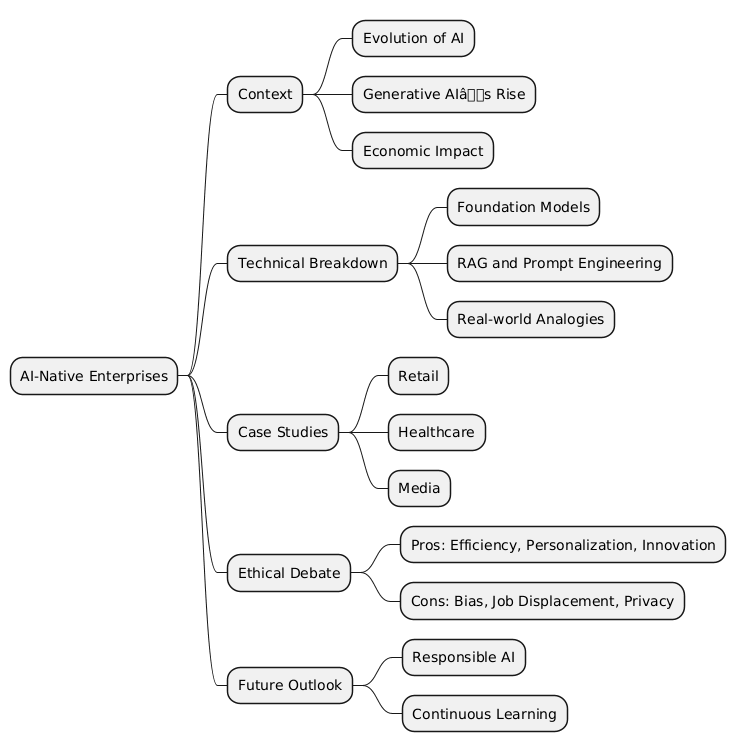
Mind Map
Key Takeaways:
💡 AI as a Necessity: Generative AI is no longer optional; it’s a strategic imperative for businesses.
⚠️ Ethical AI Matters: Transparency and fairness are critical for building trust and avoiding pitfalls.
🔍 Master Prompt Engineering: Effective prompts unlock AI’s full potential, driving better outcomes.
💡 Start Small, Scale Smart: Begin with pilot projects to gain insights before scaling AI initiatives.
⚠️ Continuous Adaptation: AI strategies must evolve with technological advancements and societal expectations.