Prompt engineering is revolutionizing how humans interact with artificial intelligence, unlocking unprecedented creativity and productivity. This article explores the technical foundations, real-world applications, and ethical considerations of crafting effective prompts for AI. By mastering this emerging discipline, we can shape a future where AI becomes a true collaborator in solving complex societal problems.

Introduction & Context
Imagine a world where artificial intelligence (AI) not only understands human language but also collaborates with us to create art, solve complex problems, and automate mundane tasks. This is no longer science fiction—it’s the reality of prompt engineering, an emerging discipline that transforms how we interact with AI systems.
Prompt engineering gained traction with the advent of large language models (LLMs) like OpenAI’s GPT-4 and its successors. These models, powered by billions of parameters, are capable of generating human-like text, writing code, and even creating visual art. However, their output quality depends heavily on the prompts they receive—structured inputs that guide the AI’s responses.
In the past, interactions with AI were rigid, limited to predefined commands or interfaces. Today, prompt engineering allows users to communicate with AI in nuanced, creative ways, turning these systems into versatile tools for education, business, and entertainment. As AI becomes increasingly integrated into daily life, understanding how to craft effective prompts is not just a technical skill—it’s a cultural shift.
Technical Breakdown
At its core, prompt engineering is about crafting precise, context-rich instructions that guide AI systems toward desired outputs. But how does this work, technically? Let’s break it down.
The Anatomy of a Prompt
A well-designed prompt typically includes:
- Context: Setting the stage by providing background information.
Example: “You are a historian specializing in medieval Europe.” - Role Assignment: Defining the AI’s persona or expertise.
Example: “Act as a software engineer debugging Python code.” - Specific Task: Clearly stating the desired outcome.
Example: “Explain quantum entanglement in simple terms suitable for a 12-year-old.” - Constraints: Adding rules or limitations to refine the output.
Example: “Write a 200-word summary without using technical jargon.”
The C.R.E.A.T.E. framework—Context, Role, Examples, Action, Tone, Experiment—is a popular methodology for structuring prompts. By combining these elements, users can elicit high-quality responses tailored to their needs.
How AI Interprets Prompts
AI models process prompts through tokenization, attention mechanisms, and prediction algorithms:
- Tokenization: The prompt is divided into smaller units called tokens (e.g., words or subwords).
Analogy: Think of tokenization as slicing a loaf of bread into manageable pieces. - Attention Mechanisms: The model identifies which parts of the prompt are most relevant.
Analogy: Like a detective scanning a crime scene for clues. - Prediction Mode: The AI predicts the next word or action based on the context provided.
Analogy: Playing an advanced game of Mad Libs at lightning speed.
The model’s performance depends on parameters like temperature (which controls creativity) and top-p (which narrows focus). For instance, a high-temperature setting might generate poetic, imaginative responses, while a low-temperature setting ensures factual accuracy.
Case Studies
1. Marketing Campaigns with AI
A boutique marketing firm used prompt engineering to create a viral campaign for an eco-friendly fashion brand. By crafting a detailed prompt—“Write Instagram captions in the voice of a witty environmentalist targeting Gen Z consumers”—the AI generated captions like:
“These jeans didn’t cost the Earth, but they’ll make you feel on top of it. 🌍 #SustainableStyle”
The campaign increased engagement by 35%, demonstrating how tailored prompts can amplify creativity and relevance.
2. Debugging Code with Personality
A software startup employed AI to debug code, but with a twist. Using prompts like, “Act as Gordon Ramsay reviewing Python scripts,” the AI provided both technical fixes and humorous critiques:
“What’s this? A function named ‘doStuff’? Be more specific, you donkey! Rename it to ‘calculateUserScore’!”
This approach not only improved code quality but also boosted team morale.
3. Accessible Travel Guides
A nonprofit organization developed AI-generated travel guides for visually impaired users. Prompts such as, “Describe the audio experience of visiting the Louvre Museum, focusing on ambient sounds and key landmarks,” enabled the AI to produce detailed, sensory-rich content. The guides were integrated with assistive technologies, enhancing accessibility for thousands of users.
Ethical Debate
While prompt engineering unlocks immense potential, it also raises ethical concerns:
1. Bias and Stereotypes
AI models are trained on vast datasets that often reflect societal biases. Poorly crafted prompts can amplify these biases, leading to harmful or exclusionary outputs. For example, a prompt like “Describe a nurse” might default to stereotypes unless explicitly guided otherwise.
2. Privacy Risks
Prompts containing sensitive information, such as personal data or medical records, risk being stored or misused. Users must anonymize inputs and avoid sharing confidential details.
3. Manipulation and Misinformation
AI’s ability to generate persuasive content can be weaponized. Prompts like “Write a convincing but false news article” demonstrate how easily misinformation can spread. Ethical frameworks, such as the S.H.I.E.L.D. model (Scrutinize, Human-Centric, Inclusive, Evaluate, Legal, Document), are essential for mitigating these risks.
Future Directions
The field of prompt engineering is evolving rapidly, with several exciting developments on the horizon:
1. Autonomous AI Agents
Imagine AI systems that write their own prompts to optimize performance. These self-prompting agents could revolutionize fields like research and customer service, acting as independent collaborators.
2. Multimodal Prompting
Future AI systems will integrate text, images, audio, and video into a single interface. For instance, users could prompt an AI to generate a narrated slideshow or design a virtual reality experience.
3. Quantum Computing
Quantum AI models promise to process information exponentially faster, enabling real-time solutions to complex problems. However, this technology remains in its infancy, with significant technical and ethical challenges to address.
4. Education and Training
Prompt engineering will likely become a standard skill taught in schools and universities. As AI tools democratize access to knowledge, mastering this skill could empower individuals across industries.
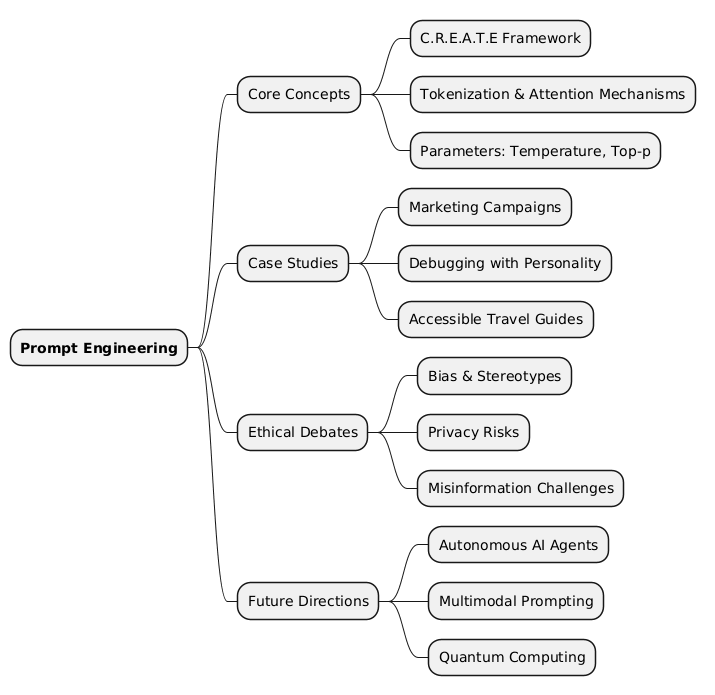
Mind Map
Key Takeaways
💡 Insightful Idea: Prompt engineering transforms AI from a tool into a collaborator, unlocking creativity and productivity.
⚠️ Warning: Ethical considerations, such as bias and privacy, must guide the development of AI prompts.
🔍 Key Detail: The C.R.E.A.T.E. framework offers a structured approach to crafting effective prompts.
🚀 Future Opportunity: Multimodal and quantum AI will expand the possibilities of human-AI collaboration.
🌍 Societal Impact: By democratizing access to AI, prompt engineering can drive innovation across industries.
This article captures the transformative potential of prompt engineering, blending technical depth with societal relevance. As AI continues to evolve, the ability to craft effective prompts will define how we shape the future of human-machine interaction.