Generative AI is reshaping the landscape of content creation, offering unprecedented tools for text, image, video, and audio production. This revolution brings both opportunities and challenges, from democratizing creative processes to raising ethical dilemmas about authenticity and job displacement. In this article, we explore the technology, its real-world applications, and its profound societal implications, while looking ahead to its future potential.
Introduction & Context
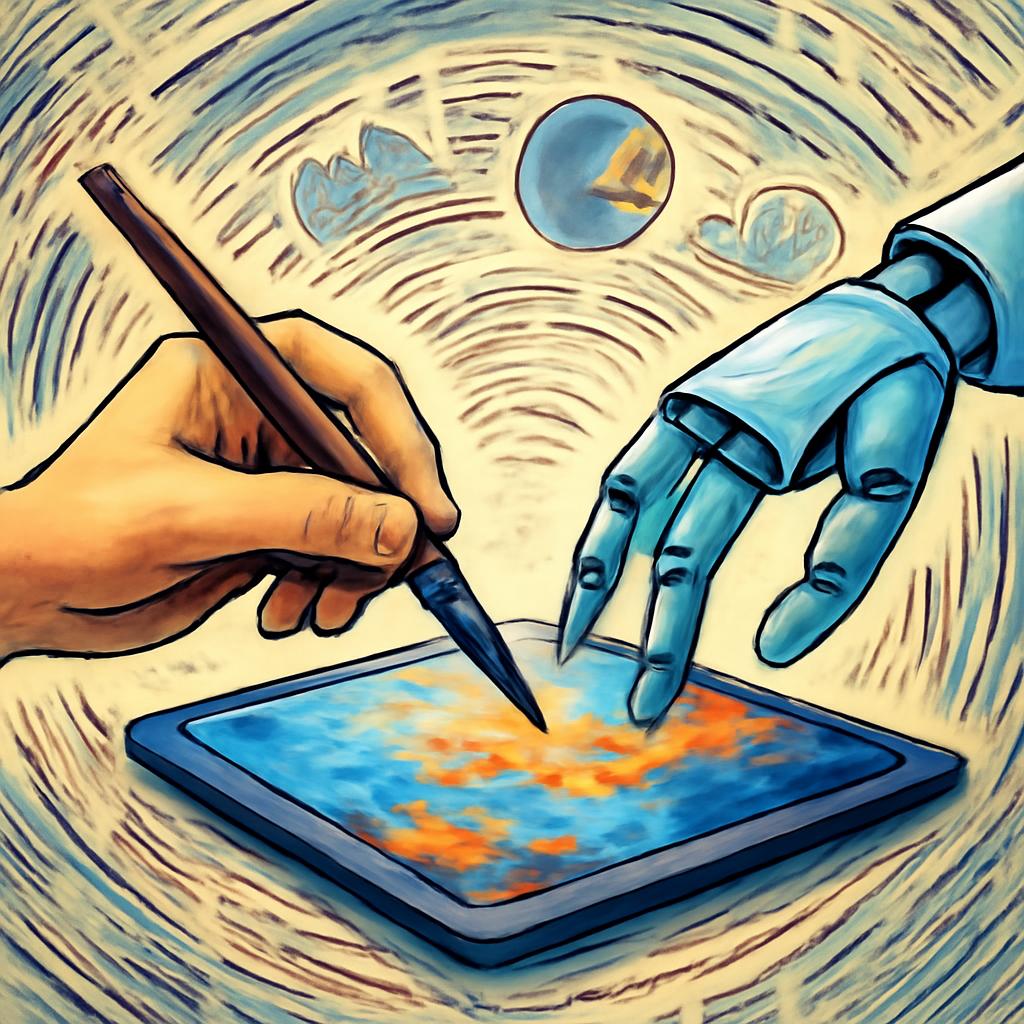
The advent of generative AI marks a watershed moment in technological history, comparable to the invention of the printing press or the arrival of the internet. But unlike these earlier revolutions, the generative AI transformation is unfolding at an unprecedented pace, leaving industries, governments, and individuals grappling to keep up.
At its core, generative AI refers to systems capable of producing human-like outputs—whether text, images, videos, or audio—based on patterns learned from massive datasets. Tools like ChatGPT, DALL-E, and MidJourney have become household names, empowering creators to generate professional-grade content with minimal effort. For instance, a blog post that once took hours of drafting can now be completed in minutes, and realistic images can be created from simple textual prompts.
This democratization of content creation has profound implications. On the one hand, it levels the playing field, allowing small businesses and independent creators to compete with larger entities. On the other, it raises questions about the authenticity, ethics, and long-term impacts of AI-generated content. Are we entering a golden age of creativity, or are we sacrificing originality and human nuance at the altar of efficiency?
The answers are complex. As one industry expert observed, “Generative AI doesn’t replace jobs; it replaces tasks.” This subtle but critical distinction underscores the duality of this technology: it is both a tool for empowerment and a force for disruption. To understand its transformative potential, we must first delve into how these systems work.
Technical Breakdown
Generative AI operates on advanced machine learning architectures, most notably transformers. These models analyze vast datasets to predict and generate human-like outputs. In essence, they are probabilistic systems, trained to anticipate what comes next—whether it’s the next word in a sentence, the next pixel in an image, or the next note in a musical composition.
Key Tools and Their Capabilities
- ChatGPT (OpenAI): A leader in text generation, ChatGPT excels at crafting blog posts, email campaigns, and even poetry.
Analogy: Imagine a tireless ghostwriter with access to all the world’s knowledge, but lacking personal experience or judgment. - MidJourney & DALL-E: These tools specialize in generating images from textual descriptions.
Example: A prompt like “A futuristic cityscape at sunset” can produce a vivid, photorealistic image. - Synthesia & Murf AI: Video and audio generation tools that create lifelike avatars and voiceovers, enabling multilingual content production.
- Stable Diffusion XL: An open-source platform for image generation, allowing developers to customize and innovate collaboratively.
- Jasper AI: Designed for marketers, this tool focuses on automating copywriting tasks at scale.
How It Works:
Consider ChatGPT as an example. When prompted to write a blog post, it:
- Breaks down the input into keywords and context.
- Searches its training data for relevant patterns.
- Generates a coherent response by predicting the most statistically probable sequence of words.
While these systems are marvels of engineering, they are not infallible. They lack the ability to understand nuance, context, or the ethical implications of their outputs. This is why human oversight remains crucial.
Strengths and Limitations:
- Strengths: Speed, scalability, and the ability to generate diverse outputs.
- Limitations: Prone to biases, inaccuracies, and a lack of originality in complex or abstract tasks.
These strengths and weaknesses make generative AI both a powerful ally and a potential liability, depending on how it is deployed.
Case Studies
1. Marketing Campaigns at Scale
A digital marketing agency used Jasper AI to automate email campaigns for 10,000 customers. The results were striking: a 40% increase in engagement rates and a 25% reduction in production time. However, human editors played a critical role in refining the tone and ensuring alignment with the brand’s voice. This highlights the hybrid nature of AI-human collaboration.
2. Visual Storytelling with MidJourney
A non-profit organization leveraged MidJourney to create compelling visuals for a climate change awareness campaign. The AI-generated images, depicting melting glaciers and endangered species, went viral on social media, drawing attention to their cause. Yet, critics questioned whether AI-generated art could fully capture the emotional weight of real-world issues.
3. Education and Training
A university adopted Synthesia to produce training videos in multiple languages, saving thousands in production costs. These videos, featuring AI-generated avatars, were well-received for their accessibility. However, some students felt that the lack of a human instructor diminished the learning experience, raising questions about the role of personalization in education.
4. Journalism and Content Creation
A media company experimented with ChatGPT to draft news articles and opinion pieces. While the AI excelled at summarizing facts and generating coherent narratives, it struggled with investigative reporting and nuanced commentary. This underscores the importance of human expertise in areas requiring critical thinking.
Ethical Debate
The rise of generative AI has sparked intense ethical debates, particularly around issues of bias, authenticity, and societal impact.
The Pros:
- Efficiency: AI accelerates content production, enabling creators to focus on strategy, innovation, and storytelling.
- Accessibility: Small businesses and independent creators can now access tools previously reserved for large corporations.
- Innovation: Generative AI opens new avenues for creativity, such as interactive storytelling and personalized learning experiences.
The Cons:
- Bias and Inaccuracy: AI systems inherit biases from their training data, leading to potentially harmful outputs.
Example: Inaccurate or misleading information in AI-generated political content. - Job Displacement: While AI enhances productivity, it also threatens roles in copywriting, translation, and graphic design.
- Ethical Quandaries: Questions about data sourcing, copyright, and the authenticity of AI-generated content remain unresolved.
Societal Implications:
Generative AI has the potential to exacerbate existing inequalities. Communities without access to these tools risk being left behind, widening the digital divide. Additionally, the environmental cost of training large AI models—measured in energy consumption—poses a significant challenge.
A Call for Regulation:
Policymakers must address these ethical concerns through clear guidelines and regulations. Transparency, accountability, and fairness should be the cornerstones of any AI governance framework.
Future Directions
As generative AI continues to evolve, several key trends and questions emerge:
- Regulation and Governance: How can we ensure ethical AI development and deployment?
- Hybrid Workflows: The future likely involves a symbiotic relationship between humans and AI, where machines handle repetitive tasks while humans focus on creativity and strategy.
- Advancements in Personalization: Expect AI to deliver hyper-personalized content, tailored to individual preferences and behaviors.
- Open-Source Innovation: Platforms like Hugging Face are democratizing AI development, fostering a community-centric approach.
- Sustainability: Researchers are exploring energy-efficient models to mitigate the environmental impact of AI.
Unanswered Questions:
- How will AI reshape creative industries in the long term?
- Can we strike a balance between efficiency and authenticity?
- What safeguards are needed to prevent misuse?
The answers to these questions will shape not only the future of generative AI but also its role in society.
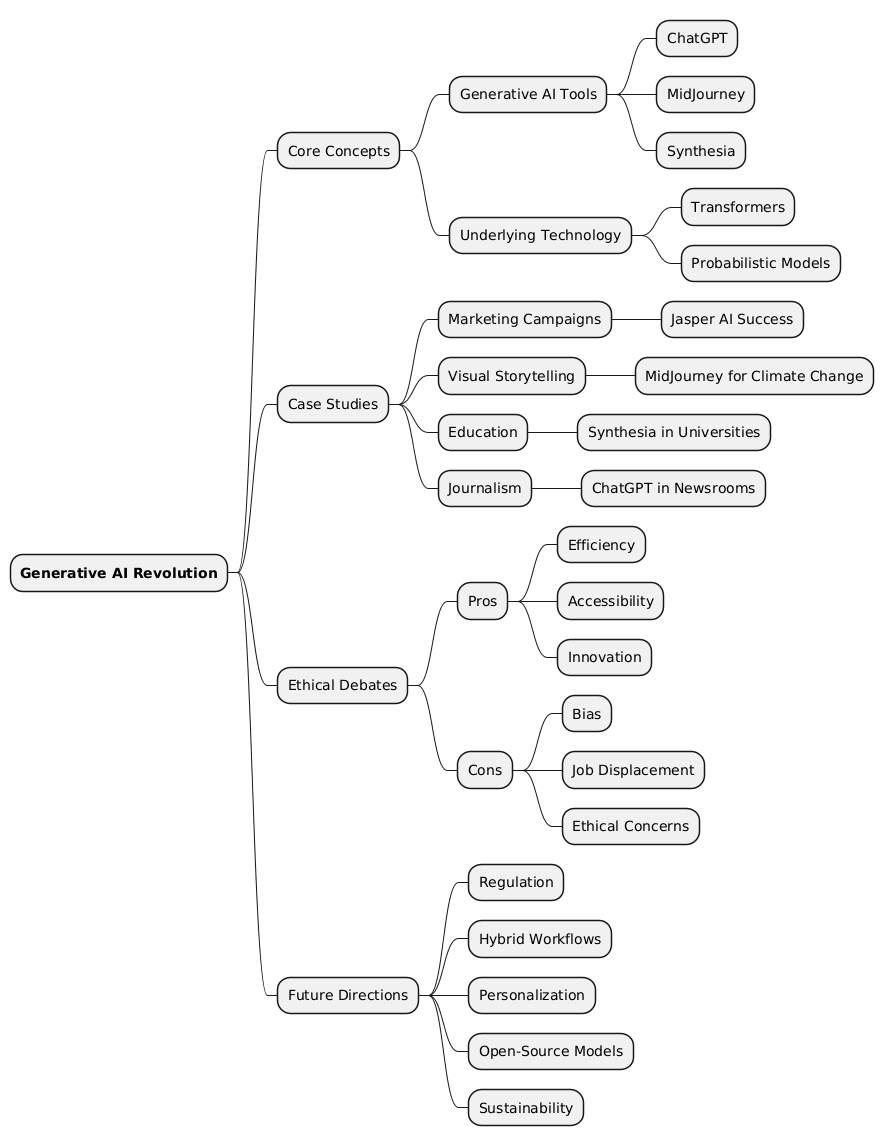
Mind Map
Key Takeaways
💡 Insightful Idea: Generative AI is not a replacement but an augmentation of human creativity.
⚠️ Warning: Blind reliance on AI risks ethical lapses and loss of authenticity.
🔍 Key Detail: Tools like ChatGPT and MidJourney excel in speed but require human oversight for quality.
🚀 Future Opportunity: Hybrid workflows combining AI efficiency with human intuition could redefine industries.
🌍 Societal Impact: Generative AI has the potential to democratize content creation but risks deepening the digital divide.
This extended analysis of generative AI reveals a technology at the crossroads of promise and peril. As we navigate this transformative era, the balance between innovation and ethical responsibility will determine its ultimate impact on society.