- Generative AI is poised to reshape industries, adding $2.6 to $4.4 trillion annually to the global economy.
- Its impact spans customer service, software development, and drug discovery, but raises ethical and workforce challenges.
- This article explores its technological underpinnings, real-world applications, ethical dilemmas, and future implications.

Introduction & Context
Generative AI has become a buzzword in both tech and business circles, but what exactly makes it revolutionary? Since the release of tools like ChatGPT and DALL·E, generative AI has captured global attention, offering capabilities that range from writing essays to creating art. Unlike its predecessors, this technology doesn’t just analyze data—it creates. By leveraging “foundation models,” generative AI has moved beyond specialized tasks, offering a universal toolkit for industries ranging from retail to pharmaceuticals.
The McKinsey report, The Economic Potential of Generative AI: The Next Productivity Frontier, provides a deep dive into how this technology could transform the global economy. With an estimated $2.6 to $4.4 trillion in annual economic impact, generative AI represents a leap forward in productivity, particularly in knowledge work. However, as with any revolutionary technology, it comes with risks: workforce disruptions, ethical quandaries, and environmental costs.
This article unpacks the technical foundation of generative AI, examines its real-world applications, and explores the societal and ethical implications of its rapid adoption.
Technical Breakdown
At the heart of generative AI lies the concept of foundation models, massive neural networks trained on vast datasets. These models, such as OpenAI’s GPT-4 or Google’s PaLM, are designed to perform multiple tasks, from generating human-like text to creating images or even music. Unlike traditional AI models, which are trained for specific purposes, foundation models are versatile and can be fine-tuned for various applications.
Key Components of Generative AI:
- Neural Networks: Mimicking the human brain, these networks consist of interconnected “neurons” that process data in layers.
- Transformers: A neural network architecture that uses “self-attention” mechanisms to focus on relevant parts of input data. This innovation powers language models like GPT.
- Natural Language Processing (NLP): Enables machines to understand and generate human language, a cornerstone of generative AI.
Analogy:
Think of generative AI as a Swiss Army knife. Traditional AI tools are like single-purpose blades—specific but limited. Generative AI, however, is the entire toolkit, adaptable to a wide range of tasks.
Computational Challenges:
Training these models requires immense computational power. For instance, training GPT-4 involved processing billions of words across multiple GPUs (graphics processing units). This high computational demand raises concerns about scalability and environmental impact, as training a single large model can emit as much carbon as 315 tons of CO2.
Case Studies
1. Retail & Customer Service Transformation
Generative AI has revolutionized customer interactions. Companies like Stitch Fix use AI to personalize fashion recommendations, while generative chatbots enhance customer service by providing instant, human-like responses. A McKinsey study showed that generative AI could reduce customer service costs by up to 45% while improving satisfaction rates.
2. Banking: Fraud Detection and Personalization
Banks are leveraging generative AI to combat fraud and tailor customer experiences. For example, Morgan Stanley employs GPT-4 to assist wealth managers by synthesizing complex financial data. This reduces the time spent on research, allowing advisors to focus on client engagement.
3. Pharmaceuticals: Accelerating Drug Discovery
In drug development, generative AI is a game-changer. Companies like Entos use it to design molecules for new drugs, cutting the lead identification phase from months to weeks. This acceleration could save billions in R&D costs and bring life-saving treatments to market faster.
Ethical Debate
While the economic potential of generative AI is undeniable, its ethical implications demand scrutiny.
Pros:
- Increased Productivity: Automating routine tasks allows workers to focus on higher-value activities.
- Enhanced Creativity: Tools like DALL·E democratize art and design, enabling anyone to create professional-quality visuals.
- Economic Growth: By boosting efficiency, generative AI could offset the economic impact of aging populations and declining workforce growth.
Cons:
- Job Displacement: Automation of knowledge work could lead to significant workforce disruptions, particularly in high-wage, white-collar jobs.
- Bias and Fairness: Models trained on biased data can perpetuate stereotypes, leading to unfair outcomes.
- Intellectual Property (IP) Risks: Generative AI’s reliance on existing data raises questions about copyright infringement.
Example of Bias:
A generative AI model trained on historical hiring data might recommend male candidates over equally qualified female candidates due to inherent biases in the dataset.
Environmental Costs:
Training large models consumes vast amounts of energy. As generative AI adoption scales, its carbon footprint could become a significant concern.
Future Directions
Generative AI is still in its infancy, and its future holds both promise and uncertainty.
Potential Advancements:
- Multimodal Models: Combining text, image, and audio capabilities in a single model.
- Real-Time Applications: Advancements in computing could enable real-time generative AI applications, such as live video editing.
- Ethical AI Development: Open-source initiatives and regulatory frameworks could address issues of bias, transparency, and environmental impact.
Unanswered Questions:
- How will generative AI reshape education and workforce training?
- Can regulatory bodies keep pace with the rapid evolution of this technology?
- Will generative AI exacerbate or mitigate global inequalities?
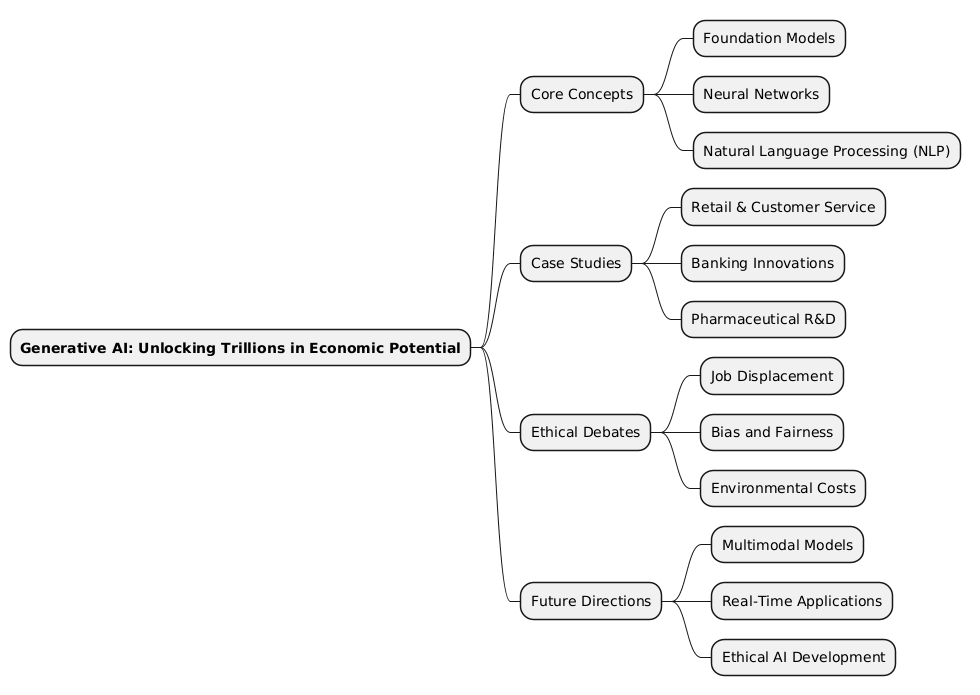
Mind Map
Key Takeaways
💡 Insightful Idea: Generative AI could add $2.6 to $4.4 trillion annually to the global economy.
⚠️ Warning: Workforce disruptions and ethical concerns require immediate attention.
🔍 Key Discovery: Foundation models enable unprecedented versatility in AI applications.
🚀 Future Opportunity: Multimodal models could redefine creativity and productivity.
🌍 Societal Impact: Generative AI has the potential to both bridge and widen global inequalities.
Generative AI represents a transformative leap in technology, offering immense economic potential while posing significant ethical and societal challenges. As we stand on the brink of this new era, the choices we make today will shape the impact of generative AI for decades to come.