Artificial Intelligence (AI) and digitalization are reshaping the global business landscape, driving efficiency, sustainability, and innovation. The book “Business Development via AI and Digitalization” edited by Allam Hamdan and Arezou Harraf explores the profound impact of these technologies across industries, from fintech to education. This article delves into the book’s insights, examining technical breakthroughs, real-world applications, and the ethical challenges posed by AI’s growing influence.

Section 1: Context
The Evolution of AI and Digitalization in Business
The story of artificial intelligence and digital transformation is one of exponential growth. In the early 1950s, AI was a nascent concept, restricted to academic circles and experimental models. Fast forward to the 21st century, and AI systems have become integral to industries like banking, healthcare, and retail. Digitalization, which began with the advent of computers, has accelerated in the past two decades with cloud computing, IoT, and blockchain technologies.
The COVID-19 pandemic acted as a catalyst for digital transformation, forcing businesses to adapt to remote work, online services, and automated processes. The book “Business Development via AI and Digitalization” captures these shifts, offering a comprehensive look at how AI-driven tools are enabling companies to remain agile and competitive.
Section 2: Technical Breakdown
How AI Powers Business Transformation
AI’s transformative power lies in its ability to analyze vast datasets, extract patterns, and provide actionable insights. Let’s break this down using relatable analogies:
- Machine Learning (ML):
Imagine teaching a child to recognize animals by showing them pictures of cats and dogs repeatedly. Similarly, ML algorithms learn by analyzing labeled data. For instance, in retail, ML can predict customer preferences based on past purchases. - Natural Language Processing (NLP):
NLP is like a translator who understands and interprets human language. Virtual assistants like ChatGPT or company chatbots leverage NLP to provide human-like responses, enhancing customer service. - Blockchain for Transparency:
Think of blockchain as a transparent, tamper-proof ledger. It’s particularly transformative in finance, ensuring secure transactions and reducing fraud risks. - Edge Computing:
This technology processes data closer to its source, like a smartphone analyzing photos locally instead of sending them to a cloud server. It’s vital for IoT applications, such as smart grids in energy systems.
Section 3: Case Studies
1. Fintech: AI in Sustainable Banking
In Bahrain, AI is revolutionizing the banking sector by enhancing risk management and customer personalization. For example, AI algorithms analyze customer spending patterns to recommend tailored financial products. Moreover, AI-driven fraud detection systems have reduced cyber threats, ensuring secure transactions.
2. Retail: Augmented Reality Meets AI
Global brands like IKEA and Sephora have integrated AI with augmented reality (AR) to transform the shopping experience. IKEA’s AR app allows customers to visualize furniture in their homes before purchasing, while Sephora’s virtual try-on tool uses AI to recommend makeup products, enhancing customer satisfaction.
3. Education: Smart Learning Platforms
The education sector has embraced AI for personalized learning experiences. Platforms like ChatGPT are being used in universities to enhance critical thinking skills. AI algorithms assess student performance and recommend tailored learning paths, ensuring inclusivity and equity in education.
Section 4: Ethical Debate
The Dual-Edged Sword of AI and Digitalization
While AI offers transformative benefits, it also raises ethical concerns. Here are some pros and cons:
Pros:
- Efficiency: AI automates repetitive tasks, freeing up human resources for creative endeavors.
- Sustainability: Digital tools optimize resource usage, reducing environmental footprints.
- Inclusion: AI-powered platforms bridge gaps in education and healthcare access.
Cons:
- Bias in Algorithms: AI systems can inherit biases from training data, leading to discriminatory outcomes.
- Job Displacement: Automation threatens traditional jobs, necessitating workforce reskilling.
- Privacy Concerns: Data-driven AI systems often raise questions about user privacy and consent.
A recent study by McKinsey highlights that 25% of jobs could face automation by 2030, emphasizing the need for proactive policy measures.
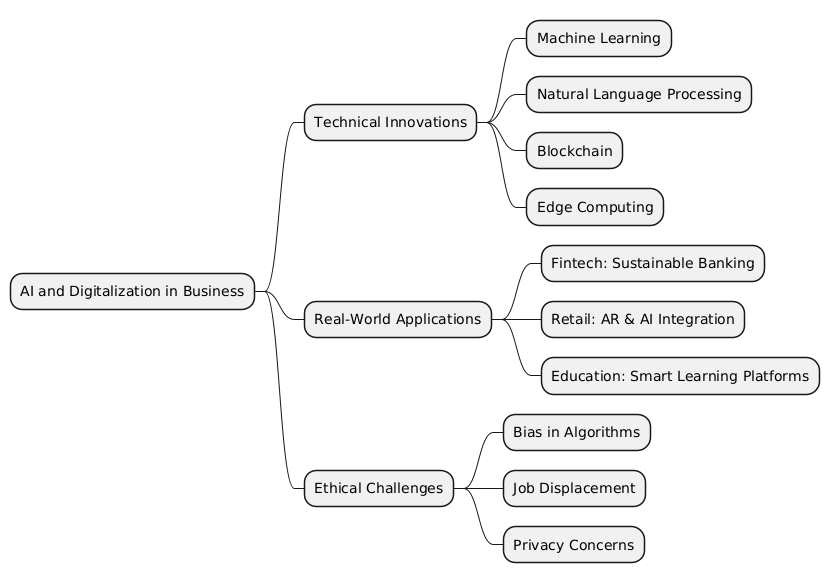
Mind Map
5 Key Takeaways
💡 AI is indispensable for modern business success, driving efficiency and innovation.
⚠️ Ethical considerations like bias and privacy must be addressed proactively.
🔍 Real-world applications in fintech, retail, and education showcase AI’s versatility.
💡 Digitalization enhances sustainability by optimizing resource usage.
⚠️ Workforce reskilling is crucial to mitigate job displacement risks.