AI-assisted programming tools are transforming how software is written, making coding faster, smarter, and more accessible. From automating tedious coding tasks to enabling non-experts to create functional applications, these tools are reshaping industries and redefining what it means to be a developer. However, this revolution also raises significant ethical and practical questions about intellectual property, job displacement, and the future of creativity in programming.

Section 1: Context
The Evolution of Programming: From Assembly to AI
The journey of programming has always been about simplifying complexity. In the 1940s, developers worked with assembly language, manually managing hardware instructions. By the 1950s, languages like Fortran and COBOL introduced high-level abstractions, enabling broader adoption of computing. Fast-forward to the 1990s, IDEs with autocompletion revolutionized productivity by reducing human error and repetitive tasks.
But the 2020s ushered in a seismic shift—AI-assisted programming. Tools like GitHub Copilot and ChatGPT, powered by large language models (LLMs), have redefined what it means to code. These systems not only autocomplete lines but also generate entire functions, debug, and even provide architectural suggestions. The result? Developers can now focus on innovation rather than the minutiae of syntax.
Why Now?
The rise of AI-assisted programming coincides with advancements in AI architectures like transformers. These models, trained on vast datasets, can understand and generate human-like text, including code. As industries grow increasingly reliant on software, the demand for faster, more efficient development has made these tools indispensable.
Section 2: Technical Breakdown
How AI-Assisted Programming Works
At the heart of AI-assisted programming lies the transformer model, a neural network architecture introduced in 2017. Unlike traditional models that process data sequentially, transformers use self-attention mechanisms to analyze entire datasets simultaneously. This allows them to grasp the context of a code snippet, whether it’s a simple loop or a complex API integration.
Real-World Analogy: The Predictive Librarian
Imagine walking into a library and asking for a book recommendation. A traditional librarian might suggest books based on a single keyword. A predictive librarian, however, considers your reading history, current trends, and even your mood. AI-assisted tools operate similarly, analyzing the context of your code to provide highly relevant suggestions.
Key Features of AI-Assisted Tools
- Code Suggestions: Tools like Copilot can autocomplete functions, reducing repetitive typing.
- Debugging Assistance: They identify errors and suggest fixes, akin to having a senior developer peer-review your work.
- Test Generation: Automating unit tests ensures robust code quality.
- Documentation Automation: AI can generate clear, concise documentation, saving hours of manual effort.
The Role of Prompt Engineering
Crafting effective prompts is both an art and a science. For example, asking ChatGPT to “write a Python function that parses dates in multiple formats” yields better results than a vague “help me with date parsing.” Detailed prompts guide the AI, much like a well-written project brief guides a human team.
Section 3: Case Studies
AMD: AI for Hardware Programming
Advanced Micro Devices (AMD) leveraged a custom version of GitHub Copilot to write firmware in SystemVerilog. In an industry where a single error can cost millions, Copilot’s precision proved invaluable. Developers reported that the AI-generated code often adhered more closely to company standards than human-written code, accelerating time-to-market for new chips.
Shopify: Scaling with AI
E-commerce giant Shopify adopted Copilot across its 2,000-strong developer team. The tool handles about 26% of code suggestions, boosting productivity and enabling developers to focus on innovation rather than boilerplate tasks. Interestingly, it also encouraged the adoption of new languages like Rust, showcasing its role as a learning tool.
IBM: Modernizing Legacy Systems
IBM’s Watsonx Code Assistant is tackling the monumental task of converting COBOL to Java. With billions of lines of COBOL still in use, this tool promises to modernize legacy systems without the risks of manual translation. Early pilots show a tenfold improvement in efficiency, underscoring the transformative potential of AI in enterprise settings.
Section 4: Ethical Debate
The Pros
- Democratizing Development: Beginners can now build applications without deep coding expertise.
- Boosting Productivity: Studies show that tools like Copilot reduce coding time by up to 55%.
- Enhancing Creativity: By automating mundane tasks, developers can focus on solving complex problems.
The Cons
- Intellectual Property Issues: AI tools trained on public code repositories raise questions about copyright infringement.
- Bias and Hallucinations: Models can generate biased or incorrect code, leading to potential security vulnerabilities.
- Job Displacement: While AI assists developers, it also threatens to automate roles, particularly for junior coders.
Expert Opinions
Jonathan Ellis, CTO of DataStax, notes, “Copilot and ChatGPT were key to meeting our deadlines, but most developers have yet to take full advantage of these tools.” On the flip side, critics like Matthew Butterick argue that these tools exploit open-source communities without giving back.
Closure
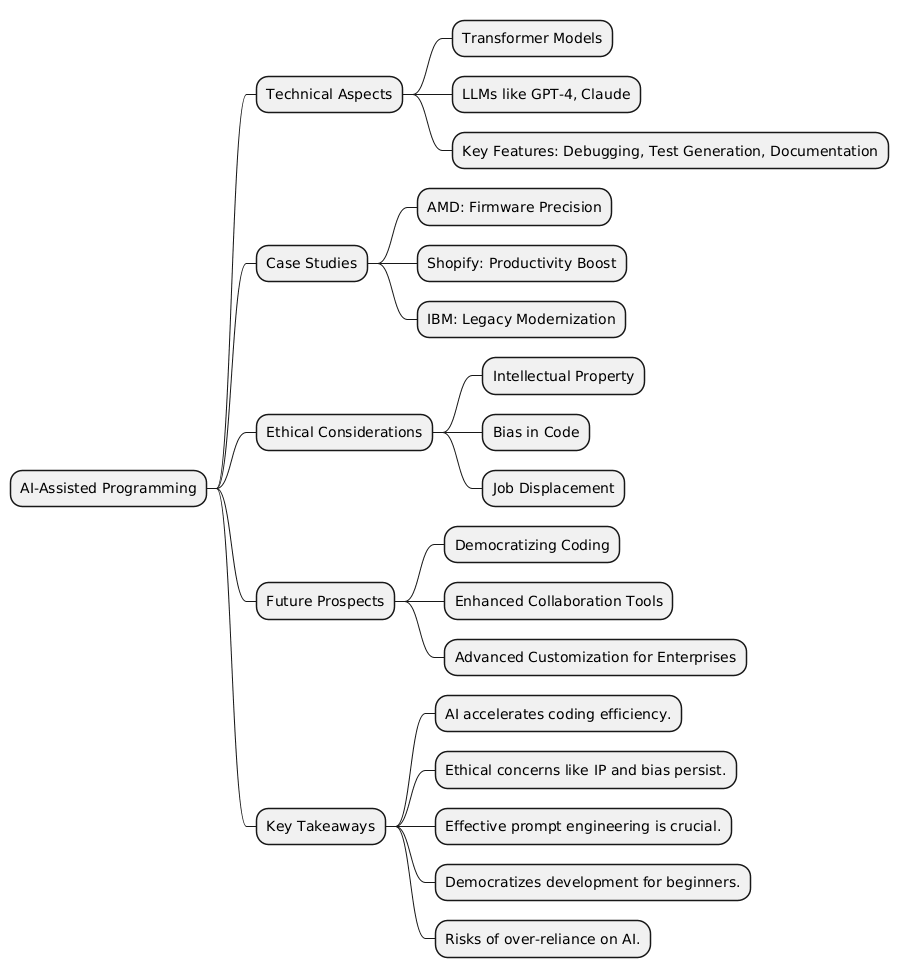
Mind Map: The Future of AI-Assisted Programming
Key Takeaways
- 💡 AI accelerates coding efficiency: Tools like GitHub Copilot reduce development time by automating repetitive tasks.
- ⚠️ Ethical concerns persist: Issues like intellectual property rights and model bias require urgent attention.
- 🔍 Effective prompt engineering is crucial: Crafting precise prompts is key to leveraging AI tools effectively.
- 💡 Democratizing development: AI lowers the barrier for beginners, enabling more people to contribute to software projects.
- ⚠️ Risks of over-reliance: Developers must balance AI assistance with their own expertise to avoid complacency.