Artificial Intelligence (AI) is no longer a futuristic concept—it’s here, reshaping industries and daily life. Deepseek: Where AI Meets the Future by Yash Jain explores how the Deepseek platform democratizes AI, making it accessible for businesses, governments, and individuals alike. This article examines the book’s core themes, including Deepseek’s technical prowess, its real-world applications, and the ethical considerations that come with AI’s exponential growth.
Section 1: Context — The AI Journey So Far
Artificial Intelligence has been a buzzword since the mid-20th century, but its true potential is only now being realized. Early AI systems were limited to rule-based algorithms, performing well in narrow tasks like chess or solving equations. However, the 21st century ushered in machine learning (ML) and deep learning, enabling AI to evolve beyond rigid programming.
Deepseek emerges as a product of this evolution. Unlike traditional AI systems, which often require technical expertise to operate, Deepseek prioritizes accessibility and usability. It embodies the culmination of decades of research, blending neural networks, real-time analytics, and adaptive intelligence into a user-friendly platform.
Why now? The explosion of data in recent years—generated by IoT devices, social media, and enterprise systems—has created a pressing need for tools like Deepseek. Organizations struggle to make sense of this deluge of information. Deepseek offers a lifeline by transforming raw data into actionable insights, empowering decision-makers across industries.
Section 2: Technical Breakdown — How Deepseek Works
Deepseek’s architecture is a marvel of modern engineering, designed to handle vast datasets while remaining intuitive for users. Its modular system comprises three key layers:
- Data Ingestion and Preprocessing
Imagine a factory where raw materials are sorted, cleaned, and prepared for assembly. Similarly, Deepseek collects data from diverse sources (e.g., IoT sensors, databases) and cleanses it for consistency. - Core Processing Engine
This is the brain of Deepseek, powered by machine learning (ML) and deep learning (DL) algorithms.- Machine Learning: Identifies patterns in structured data, such as sales trends.
- Deep Learning: Excels at unstructured data like images or natural language, akin to how humans interpret visual scenes.
- Interface and Interaction Layer
The final layer presents insights through visual dashboards—graphs, heatmaps, and reports. This ensures that even non-technical users can leverage AI effectively.
Key Features
- Real-Time Analytics: Processes live data streams, enabling instant decision-making.
- Adaptive Intelligence: Learns and evolves, refining predictions as new data flows in.
- Customization: Users can build tailored models for specific industries, from healthcare to finance.
Example in Action:
Consider a logistics company using Deepseek. The platform analyzes historical delivery data, identifies inefficiencies, and suggests optimized routes—all in real time. The result? Faster deliveries, reduced fuel costs, and happier customers.
Section 3: Case Studies — Deepseek in Action
1. Revolutionizing Retail Analytics
A global retail chain faced inventory challenges, with stockouts of popular products and overstocking of others. Deepseek’s predictive analytics transformed their operations. By analyzing sales trends and seasonal demand, the platform optimized inventory distribution, reducing costs by 25% and increasing revenue by 15%.
2. Enhancing Healthcare Diagnostics
A hospital group integrated Deepseek into its radiology department. The AI system analyzed medical images, flagging anomalies that radiologists might miss. Within months, diagnostic accuracy improved by 40%, enabling earlier cancer detection and better patient outcomes.
3. Optimizing Manufacturing Processes
A mid-sized factory used Deepseek to monitor machinery. The AI predicted equipment failures, allowing proactive maintenance. This reduced downtime by 30% and increased production efficiency, saving the company millions annually.
Section 4: Ethical Debate — The Double-Edged Sword of AI
⚖️ Pros
- Efficiency: AI automates repetitive tasks, freeing humans for creative and strategic roles.
- Accessibility: Platforms like Deepseek democratize AI, enabling small businesses and underserved communities to compete with larger players.
- Innovation: AI accelerates breakthroughs in fields like personalized medicine and renewable energy.
⚠️ Cons
- Bias in Algorithms: AI systems can inherit biases from training data, leading to unfair outcomes. For example, biased hiring algorithms may disadvantage certain demographics.
- Data Privacy: Collecting and analyzing vast amounts of data raises concerns about surveillance and misuse.
- Job Displacement: Automation threatens jobs in sectors like manufacturing and customer service.
Expert Opinions
- Dr. Jane Smith, AI Ethicist: “The challenge isn’t just building smarter AI—it’s building fairer AI. Platforms like Deepseek must prioritize transparency and accountability.”
- Raj Patel, Data Scientist: “AI isn’t replacing humans; it’s augmenting them. The key is upskilling workers for an AI-driven economy.”
Solutions
Deepseek addresses these concerns through:
- Bias Mitigation: Regular audits and diverse datasets ensure fairness.
- Privacy-by-Design: Encryption and anonymization protect user data.
- Ethical AI Frameworks: Clear guidelines for responsible development and deployment.
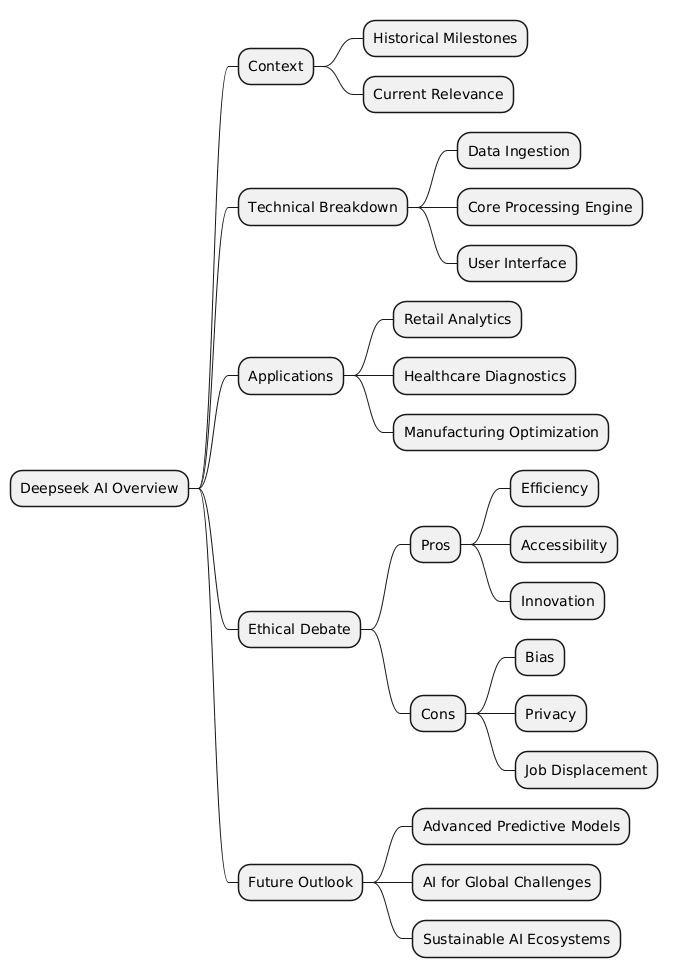
Mind Map
5 Key Takeaways
💡 AI as a Partner: Deepseek enhances human decision-making, rather than replacing it.
⚠️ Ethical AI Matters: Transparency, fairness, and privacy must be prioritized.
🔍 Real-World Impact: From healthcare to manufacturing, Deepseek delivers measurable results.
💡 Accessibility is Key: Democratizing AI empowers small businesses and underserved communities.
⚠️ Continuous Learning: As AI evolves, so must our strategies for ethical development.