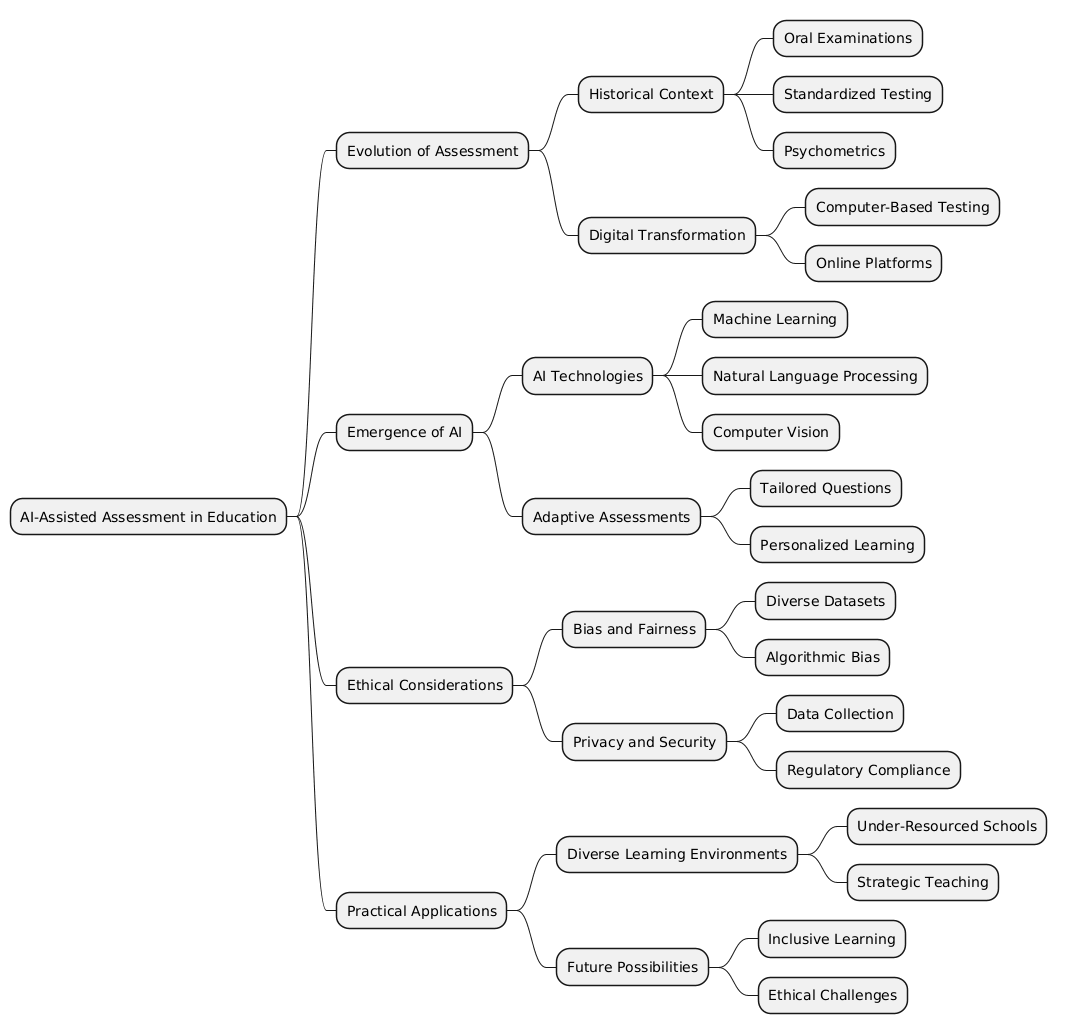
Artificial Intelligence (AI) is revolutionizing educational assessment by transforming how learning is evaluated, personalized, and supported. This article explores the evolution of assessment, from ancient oral examinations to standardized testing, and later to digital platforms that paved the way for AI integration. AI technologies like machine learning, natural language processing (NLP), and computer vision enable adaptive, scalable, and personalized assessments, tailoring evaluations to individual student needs.
The article highlights the ethical challenges of AI-assisted assessments, including bias, fairness, privacy, and data security. It emphasizes the importance of diverse datasets, robust cybersecurity measures, and compliance with regulations like GDPR and FERPA to ensure equitable and transparent use of AI in education.
Practical applications of AI in diverse learning environments are discussed, showcasing its potential to address resource disparities and enhance teaching efficiency. Looking ahead, AI promises to redefine assessments by focusing on higher-order skills, continuous evaluations, and immersive technologies like virtual reality. By addressing ethical and practical challenges, AI can create inclusive, effective, and transformative educational experiences.
Introduction
As we stand on the brink of a new era in education, artificial intelligence (AI) promises to revolutionize the way we assess and foster learning. This article embarks on a journey through the landscape of AI-assisted assessment, exploring its potential to transform educational practices, enhance student experiences, and provide deeper insights into the learning process.
The Evolution of Educational Assessment
Historical Context
Educational assessment has evolved significantly from ancient oral examinations to standardized testing. In the 19th century, standardized tests like the written exams introduced by Horace Mann in 1845 became prevalent, allowing for consistent evaluation across large groups. By the mid-20th century, psychometrics and criterion-referenced testing emerged, emphasizing mastery learning and specific educational objectives.
The Digital Transformation
The late 20th century witnessed the advent of digital technology in assessment. Computer-based testing (CBT) and online platforms like Blackboard and Moodle transformed traditional methods, offering immediate scoring and feedback, enhanced security, and multimedia elements. These innovations paved the way for AI integration, enabling more personalized and adaptive assessments.
The Emergence of AI in Assessment
AI Technologies in Assessment
AI technologies, including machine learning, natural language processing (NLP), and computer vision, are reshaping educational assessment. Machine learning algorithms can predict student performance, while NLP automates essay scoring, analyzing grammar, syntax, and coherence. Computer vision extends assessment capabilities beyond text, evaluating practical skills through visual inputs.
Adaptive Assessments
AI-driven adaptive assessments tailor questions to individual student abilities, ensuring neither overwhelming nor under-challenging learners. For instance, a student struggling with foundational concepts might receive simpler questions, while advanced learners face more complex problems, providing a more accurate measure of their abilities.
Ethical Considerations and Challenges
Bias and Fairness
AI systems, despite their objectivity, can perpetuate biases present in training data. Ensuring fairness requires diverse and representative datasets, along with algorithms designed to detect and correct biases. Educators must remain vigilant in reviewing AI-generated content to maintain equity.
Privacy and Data Security
AI systems rely on large-scale data collection, raising privacy concerns. Compliance with regulations like GDPR and FERPA is essential to protect student data. Institutions must implement robust cybersecurity measures and ensure transparency in data usage.
Practical Applications and Future Possibilities
AI in Diverse Learning Environments
AI-assisted assessments can address educational inequities by providing scalable, high-quality evaluations in under-resourced schools. By automating routine tasks, AI frees educators to focus on more strategic aspects of teaching and learning.
The Future of AI in Education
The future of AI in educational assessment holds immense promise. As technologies advance, they offer opportunities to create more inclusive, personalized, and effective learning experiences. However, ethical and practical challenges must be addressed to ensure AI integration aligns with core educational values.
Conclusion
AI-assisted assessment represents a transformative shift in education, offering unprecedented opportunities to enhance learning evaluation. By addressing challenges and embracing AI’s potential, educators and policymakers can create a future where assessments are more adaptive, equitable, and aligned with the diverse needs of learners.