Generative AI is revolutionizing advertising by automating the creation of visually compelling and targeted ad content. These tools reduce production time, optimize campaigns, and open new doors for creativity in the competitive world of digital marketing. This article explores their use cases, step-by-step application, ethical considerations, and future potential.

Introduction & Context
In the ever-evolving digital landscape, advertising has always been a game of innovation. From the Mad Men era of print ads to the rise of social media campaigns, the industry has consistently adapted to new technologies. Today, generative artificial intelligence (AI) is making waves as the latest transformative force in advertising.
Generative AI tools, powered by advanced machine learning models, are reshaping how marketers create ad content. By automating the generation of visuals, text, and even campaign strategies, these tools promise to save time, reduce costs, and unlock new levels of creativity.
However, this revolution raises important questions about the balance between automation and human creativity, as well as the ethical implications of AI-driven advertising.
Description
At its core, generative AI for advertising leverages algorithms to create tailored ad content from scratch. These tools analyze massive datasets—ranging from consumer behavior to trending visual styles—and generate targeted advertisements that align with specific campaign goals.
One key player in this space is AdCreative AI, a platform designed to streamline the creation of ad visuals and copy. AdCreative AI operates by taking user inputs, such as campaign objectives and audience demographics, and producing a variety of ad formats optimized for platforms like Google Ads, Facebook, and LinkedIn.
The process is powered by natural language processing (NLP) and computer vision technologies, which enable the AI to interpret textual inputs and generate visually appealing ad designs. These outputs are not only aesthetically pleasing but also data-driven, designed to maximize engagement and conversion rates.
Use Cases
Generative AI tools like AdCreative AI are already making a significant impact across industries. Here are three real-world applications:
1. E-commerce Campaigns
E-commerce brands often need to create hundreds of ad variations to target different customer segments. AdCreative AI simplifies this process by generating diverse ad visuals and copy tailored to specific demographics, such as age, gender, or location.
For instance, an online fashion retailer used AdCreative AI to produce seasonal ad campaigns. By inputting details about their summer collection and target audience, the tool generated eye-catching visuals and engaging captions, reducing production time by 70%.
2. Startups and Small Businesses
Small businesses often lack the resources to hire professional designers or copywriters. Generative AI tools level the playing field by providing affordable, high-quality ad creation. A local coffee shop, for example, used AdCreative AI to design Instagram ads promoting a new latte flavor. The AI-generated ads boosted foot traffic by 30% within a month.
3. Social Media Influencers
Influencers rely heavily on visually appealing content to maintain their online presence. Generative AI tools enable them to create personalized ads that align with their brand aesthetic. An influencer in the fitness niche used AdCreative AI to generate promotional content for a protein shake brand, resulting in a 20% increase in affiliate sales.
How to Use Generative AI for Ad Creation
Using AdCreative AI to create ad content is a straightforward process. Here’s a step-by-step guide:
Step 1: Create an Account
Visit AdCreative AI’s website and sign up for an account. The platform offers a free trial with 10 ad credits to get you started.
Step 2: Define Your Campaign Goals
Provide key details about your advertising campaign, such as:
- Target audience (e.g., age, gender, interests)
- Campaign objective (e.g., brand awareness, lead generation)
- Platform preferences (e.g., Google Ads, Facebook)
Step 3: Input Your Brand Details
Upload your brand logo, color palette, and any specific design elements you want to include. This ensures the AI-generated ads align with your brand identity.
Step 4: Generate Ad Content
The AI will produce several ad variations, including visuals and text. You can review these options and select the ones that best fit your campaign.
Step 5: Customize and Optimize
Make any necessary edits to the generated ads. AdCreative AI allows you to tweak visuals, adjust copy, and test different versions to optimize performance.
Step 6: Launch Your Campaign
Download the final ad creatives and upload them to your chosen advertising platforms. Monitor performance metrics to assess the effectiveness of the AI-generated content.
Ethical Debate
While generative AI offers numerous benefits, it also presents ethical challenges that cannot be ignored.
Pros
- Efficiency: AI significantly reduces the time and cost associated with ad creation.
- Personalization: Tools like AdCreative AI enable hyper-targeted advertising, improving engagement rates.
- Accessibility: Small businesses and startups can access professional-quality ad content without hiring expensive agencies.
Cons
- Creativity vs. Automation: Critics argue that AI-generated ads lack the emotional depth and originality of human-created content.
- Bias in AI: Machine learning models can inadvertently perpetuate biases present in their training data, leading to discriminatory or inappropriate ad content.
- Privacy Concerns: The use of consumer data to train AI models raises questions about data security and consent.
Societal Implications
The widespread adoption of generative AI in advertising could reshape the industry, potentially displacing traditional roles like copywriters and graphic designers. However, it also opens up new opportunities for creative collaboration between humans and machines.
Future Directions
The future of generative AI in advertising holds immense potential:
- Improved Creativity
Advancements in AI models will enable the generation of more sophisticated and emotionally resonant ad content. - Integration with AR/VR
Generative AI could play a key role in creating immersive ad experiences for augmented and virtual reality platforms. - Ethical AI Development
Ongoing research into ethical AI practices will help address concerns about bias and data privacy, ensuring responsible use of these technologies. - Custom AI Models
Brands may develop proprietary AI models tailored to their specific needs, enabling even greater personalization and control. - Regulatory Frameworks
Governments and industry bodies are likely to establish guidelines for the ethical use of AI in advertising, balancing innovation with consumer protection.
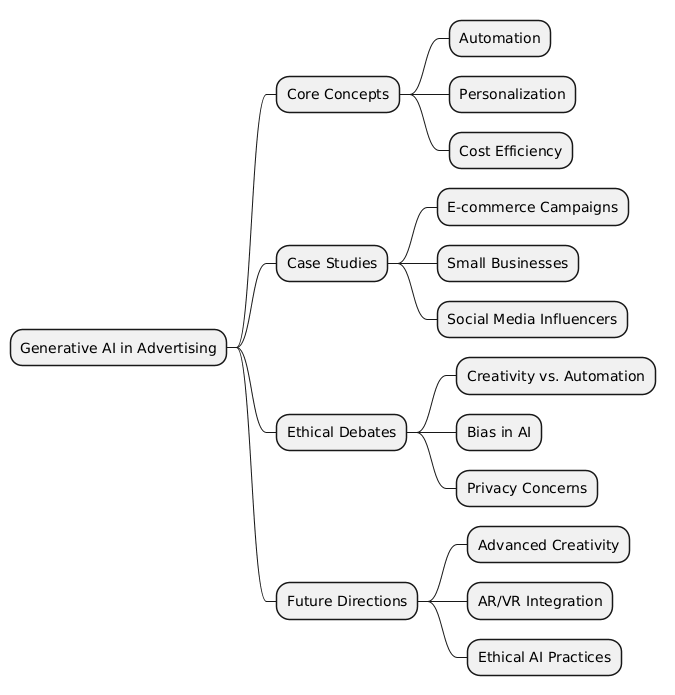
Mind Map
Key Takeaways
💡 Insightful Idea: Generative AI tools like AdCreative AI streamline ad creation, making it faster and more cost-effective.
⚠️ Warning: Ethical concerns, including bias and data privacy, must be addressed to ensure responsible use.
🔍 Key Detail: AI-generated ads can be hyper-targeted, enhancing engagement and conversion rates.
🚀 Future Opportunity: Integration with AR/VR platforms could revolutionize immersive advertising experiences.
🌍 Societal Impact: Generative AI democratizes access to professional-quality ad content, benefiting small businesses and startups.
This article not only highlights the transformative potential of generative AI in advertising but also encourages a thoughtful approach to its ethical and societal implications. By embracing these tools responsibly, the industry can unlock unprecedented opportunities for creativity and innovation.