- Artificial intelligence has transformed website creation, making it faster and more accessible.
- This innovation democratizes web design but raises questions about creativity and ethics.
- Discover its use cases, step-by-step usage guide, and the future of AI-driven web development.
Introduction & Context
In the mid-1990s, creating a website required coding expertise and significant time investment. Fast forward to today, artificial intelligence (AI) is rewriting the rules of web development. The rise of AI-powered tools like Durable signals a new era, where anyone—regardless of technical skills—can create a functional and visually appealing website in minutes.
This technological leap is not just about speed. It represents a democratization of web design, enabling small businesses, freelancers, and non-profits to establish an online presence without hiring expensive developers. But as with all transformative technologies, it comes with its own set of challenges and ethical considerations.
At its core, AI for website creation aims to simplify one of the most complex aspects of digital presence: building a site that is not only functional but also optimized for user experience and search engines. The implications go beyond convenience, touching on issues of creativity, job displacement, and the evolving role of human designers in the digital age.
Description: What Is AI for Website Creation?
AI for website creation refers to platforms that leverage machine learning algorithms to automate the process of building websites. These tools typically include features like:
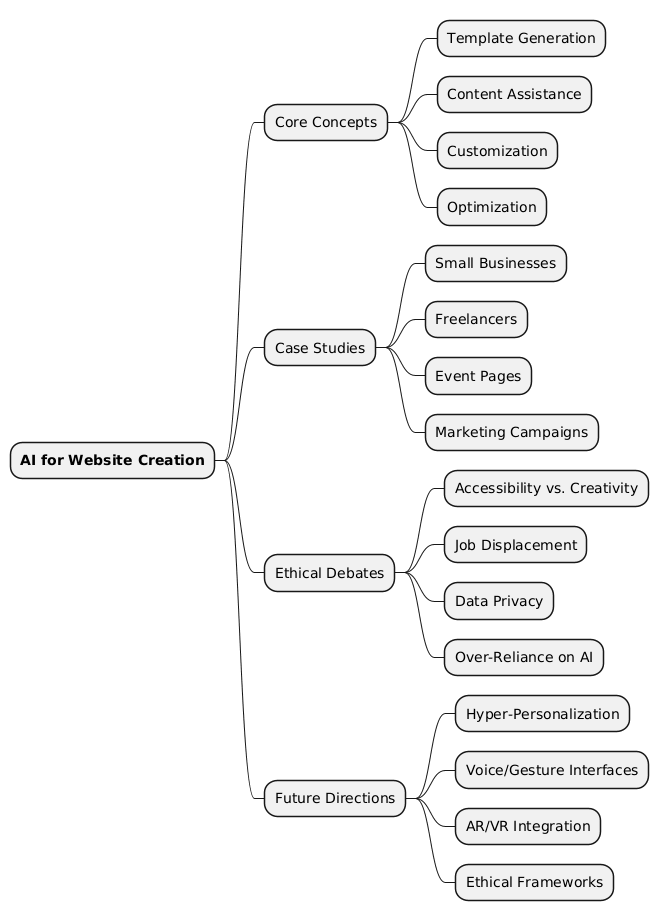
- Template Generation: AI generates a website layout based on user inputs such as industry or purpose.
- Content Assistance: Tools can write copy, suggest images, and even create logos.
- Customization: Users can make adjustments to ensure the website aligns with their brand identity.
- Optimization: Built-in SEO recommendations ensure the site ranks well on search engines.
One standout in this field is Durable, an AI platform that claims to build a website in under a minute. It integrates features like CRM tools, invoice generation, and even text suggestions for marketing campaigns. Durable positions itself as a one-stop shop for entrepreneurs looking to establish an online presence quickly and effectively.
Use Cases: Real-World Applications of AI in Web Design
1. Small Business Websites
- Scenario: A local bakery wants a website to showcase its menu and accept online orders.
- Solution: Using Durable, the bakery owner inputs basic information—name, industry, and preferred style. Within seconds, the platform generates a website complete with a menu page and contact form.
2. Freelancers and Solopreneurs
- Scenario: A freelance graphic designer needs a portfolio site to attract clients.
- Solution: Durable provides a portfolio template where the designer can upload their work. The AI suggests text for the “About Me” and “Services” sections, saving hours of effort.
3. Event Pages
- Scenario: A community group organizing a fundraiser needs a simple event page.
- Solution: Durable generates a single-page website with event details, a donation button, and a map for directions.
4. Landing Pages for Marketing Campaigns
- Scenario: An e-commerce business launches a new product and requires a landing page.
- Solution: Durable creates a visually appealing page optimized for conversions, complete with product descriptions and call-to-action buttons.
These examples illustrate how AI simplifies web development, making it accessible to individuals and organizations that previously lacked the resources or skills.
How to Use AI for Website Creation: A Step-by-Step Guide
Creating a website with AI tools like Durable is straightforward. Here’s how it works:
- Visit the Platform
Go to Durable’s website. - Create an Account
Sign up with your email or social media account. - Input Basic Information
The platform will ask for details like:- Business name
- Industry
- Purpose of the website (e.g., portfolio, e-commerce)
- Choose a Design Style
Select from a range of templates or let the AI suggest one based on your inputs. - Customize Your Site
- Add your logo, images, and text.
- Use the AI’s content suggestions for sections like “About Us” or “Services.”
- Adjust colors and fonts to match your brand identity.
- Preview and Publish
Review the generated website. Once satisfied, click “Publish.” Durable also offers hosting services, so you don’t need to worry about setting up a server. - Enhance Functionality
- Integrate CRM tools for customer management.
- Use the invoice generator for billing.
- Optimize the site for SEO using built-in recommendations.
This process, which used to take weeks, now takes less than an hour, making it a game-changer for non-technical users.
Ethical Debate: The Pros and Cons of AI-Driven Web Design
Advantages
- Accessibility
AI democratizes web design, allowing small businesses and individuals to create professional websites without technical expertise. - Efficiency
Automated tools significantly reduce the time required to build a website. - Cost-Effectiveness
Platforms like Durable eliminate the need for expensive web developers, making it easier for startups to allocate resources elsewhere. - Scalability
AI tools can handle large-scale projects, making them suitable for both small businesses and enterprises.
Challenges
- Creativity vs. Automation
Critics argue that AI-generated websites lack the unique touch of a human designer, leading to generic outcomes. - Job Displacement
As AI tools become more sophisticated, they may reduce demand for web developers and designers. - Data Privacy
AI platforms often require users to input sensitive business information, raising concerns about data security. - Over-Reliance
Dependence on AI tools could stifle innovation and creativity in web design.
Societal Implications
The rise of AI in web design reflects a broader trend of automation across industries. While this brings efficiency, it also necessitates a rethinking of education and workforce development to prepare individuals for a rapidly changing job market.
Future Directions: What’s Next for AI in Web Design?
The future of AI-driven web design is both promising and uncertain. Here are some potential advancements:
- Hyper-Personalization
AI could use user behavior data to create websites tailored to individual preferences, enhancing user experience. - Voice and Gesture Interfaces
Future tools might allow users to build websites through voice commands or gestures, further simplifying the process. - Integration with Emerging Technologies
AI platforms could integrate with augmented reality (AR) and virtual reality (VR) to create immersive web experiences. - Ethical Frameworks
As concerns about creativity and job displacement grow, there may be calls for ethical guidelines governing the use of AI in web design.
While these possibilities are exciting, they also raise questions about the role of humans in a world increasingly dominated by AI.
Mind Map
Key Takeaways
💡 Insightful Idea: AI democratizes web design, enabling anyone to create professional websites.
⚠️ Warning: Over-reliance on AI could stifle creativity and innovation.
🔍 Key Detail: Tools like Durable offer a one-stop solution for website creation, CRM, and marketing.
🚀 Future Opportunity: AI-driven hyper-personalization could revolutionize user experiences.
🌍 Societal Impact: The rise of AI in web design demands a rethinking of workforce development and ethics.
This article captures the transformative potential of AI in website creation, offering a balanced view of its benefits and challenges. From empowering small businesses to reshaping the job market, the implications are profound and far-reaching.