
AI-driven search engines are reshaping how we find and consume information online. With generative search experiences (SGE), platforms like Bing and Google are moving beyond traditional search to deliver conversational, AI-curated insights. This article explores SGE’s transformative impact, practical applications, and the ethical challenges it presents.

Introduction & Context
Search engines have long been the gatekeepers of the internet, guiding users through the vast digital landscape. However, the dawn of artificial intelligence (AI) has brought a seismic shift in how these platforms operate. Enter generative search experiences (SGE), a new paradigm that blends conversational AI with traditional search functionalities.
The concept of SGE emerged from years of innovation in natural language processing (NLP) and machine learning. Companies like Microsoft and Google, armed with billions of dollars in R&D, have integrated cutting-edge AI models into their search engines. Bing, for instance, has partnered with OpenAI to embed ChatGPT-4 directly into its search interface, while Google has introduced its Gemini AI to enhance its search capabilities.
This evolution marks a departure from presenting users with a list of links to offering synthesized, conversational answers. It’s a shift that promises efficiency but also raises questions about accuracy, bias, and the future of information access.
Description
At its core, a generative search experience (SGE) leverages AI to provide direct, contextual answers to user queries. Unlike traditional search engines that rely on keyword matching and ranking algorithms, SGE employs large language models (LLMs) to “understand” and generate human-like responses.
Key Features of SGE:
- Conversational Interaction: Users can engage in a dialogue with the search engine, refining queries and receiving follow-up suggestions.
- Contextual Summaries: Instead of a list of links, SGE delivers a synthesized response, often citing multiple sources.
- Real-Time Internet Access: Unlike older AI models, SGE tools are connected to the web, ensuring up-to-date information.
- Customizable Tones: Platforms like Bing allow users to choose response styles—creative, balanced, or precise.
For example, a query like “What are the best books on AI?” might yield a conversational summary highlighting popular titles, their authors, and where to buy them. This approach eliminates the need for users to sift through multiple links and articles.
Use Cases
The practical applications of SGE are vast and varied. Here are three real-world examples that illustrate its transformative potential:
1. Bing’s Integration with ChatGPT
Microsoft’s Bing has integrated OpenAI’s ChatGPT-4, creating a hybrid search engine that merges traditional search with conversational AI. Users can ask complex, multi-part questions—such as “Compare electric cars under $40,000 with a focus on range and charging time”—and receive detailed, curated answers.
2. Google’s Gemini and SGE Rollout
Google’s Gemini AI powers its experimental SGE interface. For instance, searching “Best smartphones for photography” will generate a summary of top-rated devices, their specifications, and user reviews, all in a single response box. Gemini also cites sources, addressing concerns about transparency.
3. Enterprise Applications: Bing Chat Enterprise
Microsoft has launched Bing Chat Enterprise, a version of SGE tailored for businesses. It offers secure, AI-driven insights for corporate needs, such as generating market analyses or summarizing legal documents. This tool ensures data privacy, a critical requirement for enterprise users.
How to Use Generative Search Experiences
Accessing and using SGE tools is straightforward, especially as platforms like Bing and Google integrate them into their ecosystems. Here’s a step-by-step guide to get started:
Using Bing’s Generative Search:
- Create a Microsoft Account: Sign up at Microsoft.
- Access Bing Chat: Visit Bing and click on the chat icon.
- Select a Tone: Choose between creative, balanced, or precise response styles.
- Ask Questions: Type your query in natural language. For example, “Plan a 3-day trip to Paris with a focus on museums and local cuisine.”
- Refine Results: Use follow-up questions to narrow or expand your search.
Using Google’s SGE (Experimental):
- Sign Up for Google Labs: Access experimental features through Google Labs.
- Enable SGE: Activate the feature in your account settings.
- Search as Usual: Enter queries in the Google search bar.
- Explore Summaries: View AI-generated summaries at the top of the results page.
- Provide Feedback: Help improve SGE by rating its responses.
Ethical Debate
As with any transformative technology, generative search experiences come with their share of ethical dilemmas.
Pros:
- Efficiency: SGE reduces the time spent sifting through search results.
- Accessibility: Simplifies complex information for non-expert users.
- Customization: Tailored responses improve user satisfaction.
Cons:
- Accuracy Concerns: AI models can generate plausible but incorrect information, known as “hallucinations.”
- Bias: The training data for LLMs may reflect societal biases, leading to skewed responses.
- Transparency: While some platforms cite sources, others may not, raising questions about credibility.
Societal Implications:
The shift to SGE could centralize information control, making users increasingly reliant on AI-curated answers. This raises concerns about monopolies in information dissemination and the potential erosion of critical thinking skills.
Future Directions
The future of generative search experiences is both promising and uncertain.
Potential Advancements:
- Improved Accuracy: Enhanced training models could reduce hallucinations and improve reliability.
- Multimodal Capabilities: Integration of text, image, and video responses for richer user experiences.
- Ethical AI Frameworks: Development of guidelines to ensure fairness and transparency.
Unanswered Questions:
- How will SGE platforms monetize their services without compromising user trust?
- What role will governments play in regulating AI-driven search engines?
- Can smaller players compete in a market dominated by tech giants like Microsoft and Google?
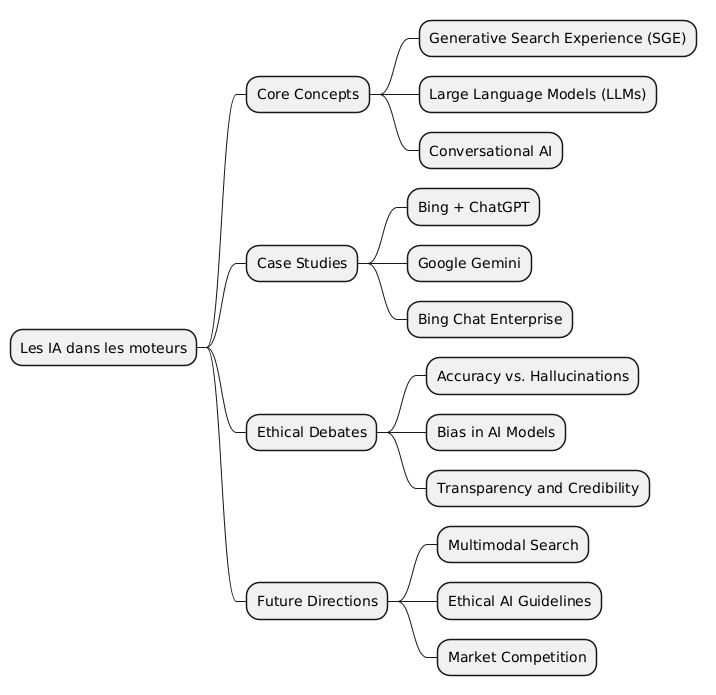
Mind Map
Key Takeaways
💡 Insightful Idea: Generative search experiences transform search engines into conversational partners.
⚠️ Warning: The reliance on AI raises concerns about accuracy and bias.
🔍 Key Detail: Bing and Google lead the charge with integrated AI models.
🚀 Future Opportunity: Multimodal search could redefine how we interact with digital content.
🌍 Societal Impact: SGE could reshape education, research, and how societies access information.
This new era of search engines is not just about finding information—it’s about how we understand and interact with the digital world. As SGE evolves, it will undoubtedly challenge our perceptions of convenience, accuracy, and the role of AI in daily life.