Midjourney is redefining the boundaries of creativity by generating stunning visuals from simple text prompts. This cutting-edge AI tool has become a favorite among artists, marketers, and designers, offering both inspiration and efficiency. While unlocking new creative potential, Midjourney also raises complex ethical questions about authorship, originality, and the future of art.
Introduction & Context
In the rapidly evolving world of artificial intelligence, few tools have captured the imagination of creators like Midjourney. Launched as an experimental AI image generator, Midjourney has quickly become synonymous with the seamless transformation of text into breathtaking visuals. Its rise parallels the broader adoption of AI in creative industries, where tools like ChatGPT have revolutionized text generation and platforms like DALL·E have made image synthesis mainstream.
Midjourney emerged at a pivotal moment when the demand for personalized, high-quality visuals was surging across industries—from advertising to entertainment. Unlike traditional graphic design software, which requires technical expertise, Midjourney democratizes creativity by allowing anyone to create professional-looking images using simple text descriptions.
Yet, this innovation did not arrive without controversy. As AI-generated art gains traction, debates about originality, intellectual property, and the role of human creativity in the age of machines have intensified. Midjourney stands at the center of this cultural and technological crossroads.
Description: What is Midjourney?
Midjourney is an AI-powered tool that generates images based on text prompts, leveraging advanced machine learning algorithms. Built on a foundation of neural networks, it interprets user inputs—often as brief as a single sentence—and produces visually compelling outputs.
The platform operates via Discord, a choice that reflects its roots in tech-savvy communities. Users interact with Midjourney by typing commands like /imagine followed by a descriptive prompt (e.g., “a futuristic cityscape at sunset”). Within moments, the AI generates multiple image variations, each offering a unique interpretation of the input.
What sets Midjourney apart from competitors like DALL·E or Stable Diffusion is its distinct aesthetic. While others aim for hyper-realism, Midjourney often leans into artistic and surreal styles, making it particularly appealing to graphic designers, filmmakers, and digital artists seeking inspiration.
The tool has evolved through several iterations, with each version improving its ability to understand nuanced prompts and deliver higher-quality visuals. Its latest version, Midjourney V6, introduces enhanced realism, better text-to-image alignment, and support for more complex artistic styles.
Use Cases: Real-World Applications of Midjourney
Midjourney’s versatility has made it a go-to tool for a diverse range of applications. Here are three standout examples:
1. Storyboarding for Filmmaking
Creative agencies use Midjourney to visualize concepts during pre-production. By generating quick mockups of scenes, characters, and settings, It accelerates the creative process and communicates ideas more effectively to collaborators. For instance, they used Midjourney to simulate paradoxical visuals, such as “a city floating in the clouds,” which later serve as references for set designers.
2. Marketing Campaigns
Marketers are leveraging Midjourney to create eye-catching visuals for social media and advertising. The tool’s ability to produce high-quality images in minutes allows brands to respond quickly to trends and tailor content to specific audiences. A recent example includes a beverage company using Midjourney to design surreal product visuals, blending elements of nature and technology to captivate viewers.
3. Artistic Inspiration
For individual artists, Midjourney serves as both a muse and a medium. Digital painters and illustrators often use the AI to generate initial concepts, which they refine further in software like Photoshop. This hybrid approach combines the efficiency of AI with the personal touch of human creativity, resulting in unique artworks that push the boundaries of imagination.
How To Use Midjourney
Using Midjourney is straightforward, even for those with no technical background. Here’s a step-by-step guide:
- Create a Discord Account
Visit Discord and sign up for a free account if you don’t already have one. - Join the Midjourney Server
Access the official Midjourney server by following this invite link. - Choose a Channel
Inside the server, navigate to a “newbies” channel. This is where you’ll interact with the AI. - Enter a Prompt
Type/imaginefollowed by your description. For example:/imagine a serene forest with glowing mushrooms at night. - Review Outputs
Midjourney will generate four image variations. You can upscale your favorite or request further iterations. - Download and Use
Once satisfied, download the image for personal or professional use. Note that the tool is freemium, with additional features available in paid plans. - Experiment and Refine
Experiment with different prompts, styles, and keywords to achieve your desired results.
Ethical Debate: The Pros and Cons of Midjourney
Pros
💡 Democratizing Creativity: Midjourney empowers individuals without artistic training to create professional-grade visuals.
🚀 Efficiency: It drastically reduces the time and cost associated with traditional design workflows.
🌍 Accessibility: By operating on Discord, it reaches a broad audience, including hobbyists and professionals alike.
Cons
⚠️ Copyright Concerns: Critics argue that AI-generated art may infringe on the intellectual property of artists whose works are part of training datasets.
🔍 Lack of Human Touch: While efficient, AI lacks the emotional depth and cultural context that human artists bring to their work.
🌍 Job Displacement: The rise of AI tools raises concerns about the future of creative professions, particularly in design and illustration.
The ethical debate extends to questions of authorship. If an image is generated by AI but based on a human prompt, who owns the rights? Current intellectual property laws struggle to address such nuances, leaving creators and legal experts in a gray area.
Future Directions
Midjourney is poised for further advancements, with several exciting possibilities on the horizon:
- Enhanced Realism: Future versions may bridge the gap between artistic interpretation and photorealism, expanding its utility in industries like architecture and gaming.
- Interactive Features: Imagine a version of Midjourney that allows real-time collaboration, enabling teams to co-create visuals during brainstorming sessions.
- Integration with AR/VR: As augmented and virtual reality technologies evolve, Midjourney could generate immersive environments for use in these platforms.
- Ethical AI Frameworks: Developers and policymakers may collaborate to establish guidelines ensuring fair use of training data and equitable distribution of AI-generated content.
While the future is promising, it also demands vigilance. As AI tools like Midjourney continue to evolve, society must navigate the delicate balance between innovation and ethical responsibility.
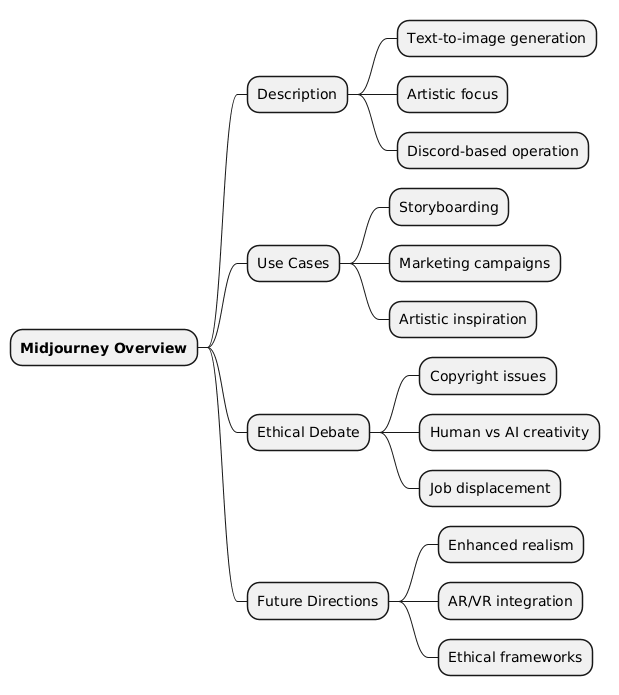
Mind Map
Key Takeaways
- 💡 Insightful Idea: Midjourney democratizes art creation, making high-quality visuals accessible to everyone.
- ⚠️ Warning: Ethical concerns about copyright and job displacement remain unresolved.
- 🔍 Key Detail: Operates via Discord, offering a unique community-driven experience.
- 🚀 Future Opportunity: Potential integration with AR/VR could revolutionize immersive design.
- 🌍 Societal Impact: Midjourney challenges traditional notions of creativity and authorship in the digital age.
This article captures the essence of Midjourney, offering a comprehensive look at its capabilities, applications, and implications. As AI continues to reshape creative industries, tools like Midjourney stand as both a beacon of innovation and a catalyst for critical discussion.