- ChatGPT, a generative AI tool, is transforming how we create and interact with digital content.
- Its applications span industries, from customer service to education, raising both opportunities and ethical questions.
- This article delves into ChatGPT’s mechanics, real-world use cases, ethical debates, and its potential future impact.
Introduction & Context
In November 2022, the world was introduced to ChatGPT, a conversational agent powered by OpenAI’s advanced language model. Its arrival marked a watershed moment for artificial intelligence (AI), making generative AI accessible to millions and sparking a global conversation about the future of technology. While AI tools had been quietly evolving in research labs for decades, ChatGPT brought these advancements into the mainstream, reshaping industries and challenging societal norms.
The journey to ChatGPT was paved with milestones in natural language processing (NLP). Early AI systems were rule-based, relying on rigid programming to generate responses. However, the development of machine learning, and later deep learning, allowed models like GPT (Generative Pre-trained Transformer) to emerge. These models could analyze vast amounts of text data, learning patterns, context, and nuances to generate human-like responses. By the time ChatGPT launched, it was not just a chatbot—it was a tool capable of writing essays, answering complex questions, and even generating code.
Today, ChatGPT is a symbol of both promise and peril. It has democratized access to AI capabilities, empowering individuals and businesses alike. But it also raises questions about ethics, misinformation, and the role of AI in society.
Description: What Is ChatGPT?
At its core, ChatGPT is a conversational AI model built on OpenAI’s GPT architecture. Utilizing a transformer-based neural network, it predicts the next word in a sequence based on the context provided. This predictive capability is what allows ChatGPT to generate coherent and contextually appropriate responses.
Key Features:
- Generative Abilities: ChatGPT can create text ranging from casual conversations to technical articles.
- Context Awareness: It maintains conversational flow by remembering prior inputs during a session.
- Multimodal Capabilities: In its latest iterations, ChatGPT integrates with tools like DALL·E for image generation and plugins for real-time web access.
- Customization: Users can create specialized GPTs tailored to specific needs, such as customer support or creative writing.
ChatGPT functions through reinforcement learning from human feedback (RLHF). This training methodology refines the model’s responses, ensuring they align with human preferences for clarity, relevance, and tone. However, it is not without limitations. The model can occasionally produce incorrect or biased outputs, a reflection of the data it was trained on.
Use Cases: Transforming Industries
ChatGPT’s versatility has led to its adoption across diverse fields. Here are four standout examples:
1. Customer Service and Support
Companies like Shopify and Instacart have integrated ChatGPT into their customer service workflows. By automating responses to frequently asked questions or troubleshooting issues, businesses save time and resources while enhancing customer satisfaction. For instance, a chatbot powered by ChatGPT can guide users through a product return process or recommend solutions based on customer input.
2. Content Creation for Marketing
Platforms like Jasper AI and Copy.ai leverage ChatGPT’s capabilities to assist marketers. These tools generate blog posts, email campaigns, and social media content tailored to specific audiences. A small business, for example, can use ChatGPT to craft engaging Instagram captions or write persuasive product descriptions.
3. Education and Training
Educational institutions and e-learning platforms are using ChatGPT to create interactive learning experiences. Students can ask ChatGPT to explain complex topics, summarize articles, or even simulate debates. Teachers, on the other hand, use it to generate lesson plans or quizzes.
4. Creative Industries
In the world of art and design, ChatGPT collaborates with visual AI tools like MidJourney and DALL·E. A director might use ChatGPT to draft a film script, then pair it with AI-generated storyboards. Similarly, authors employ it to brainstorm plot ideas or refine character dialogues.
How to Use ChatGPT
Getting Started with ChatGPT
- Access the Platform: Visit chat.openai.com and create an account.
- Choose a Plan: Start with the free tier or upgrade to ChatGPT Plus for $20/month, which unlocks GPT-4 capabilities and additional features.
- Interact: Enter your query or task in the chatbox. Be specific for better results (e.g., “Write a 500-word blog post about renewable energy”).
- Refine: If the response isn’t perfect, ask ChatGPT to revise or elaborate.
- Explore Plugins: For advanced users, enable plugins to access real-time data or generate visuals.
Tips for Effective Use:
- Provide clear instructions and context.
- Use structured prompts (e.g., “Act as a travel agent and plan a 7-day trip to Japan”).
- Experiment with tone and style settings to match your needs.
Ethical Debate: The Double-Edged Sword of ChatGPT
ChatGPT’s rise has been accompanied by intense ethical scrutiny. While its benefits are undeniable, its challenges cannot be ignored.
The Pros
- Accessibility: ChatGPT democratizes AI, making advanced tools available to individuals and small businesses.
- Efficiency: It automates repetitive tasks, freeing up human creativity.
- Innovation: By augmenting human capabilities, it fosters innovation across sectors.
The Cons
- Bias and Misinformation: ChatGPT’s outputs reflect the biases of its training data, which can perpetuate stereotypes or spread inaccuracies.
- Job Displacement: Automation threatens roles in customer service, content creation, and other fields.
- Privacy Concerns: The use of personal data to train AI models raises questions about consent and security.
Societal Implications
The widespread adoption of ChatGPT could reshape societal norms. Education systems might rely on AI tutors, while journalism could see an influx of AI-generated content. However, this also risks creating a dependency on AI, diminishing critical thinking skills and human oversight.
Future Directions: What Lies Ahead?
The future of ChatGPT is both exciting and uncertain. OpenAI continues to refine its models, aiming for greater accuracy, creativity, and ethical alignment.
Potential Advancements:
- Improved Multimodality: Integrating text, images, and even video for richer interactions.
- Real-Time Collaboration: Seamless integration with tools like Microsoft Teams or Google Workspace.
- Ethical AI Development: Enhanced transparency and efforts to mitigate biases.
Unanswered Questions:
- How will regulations shape the use of generative AI?
- Can AI truly achieve “understanding,” or will it always mimic human behavior?
- What role will AI play in addressing global challenges like climate change or healthcare?
As ChatGPT evolves, it will undoubtedly continue to challenge our perceptions of technology and its role in society.
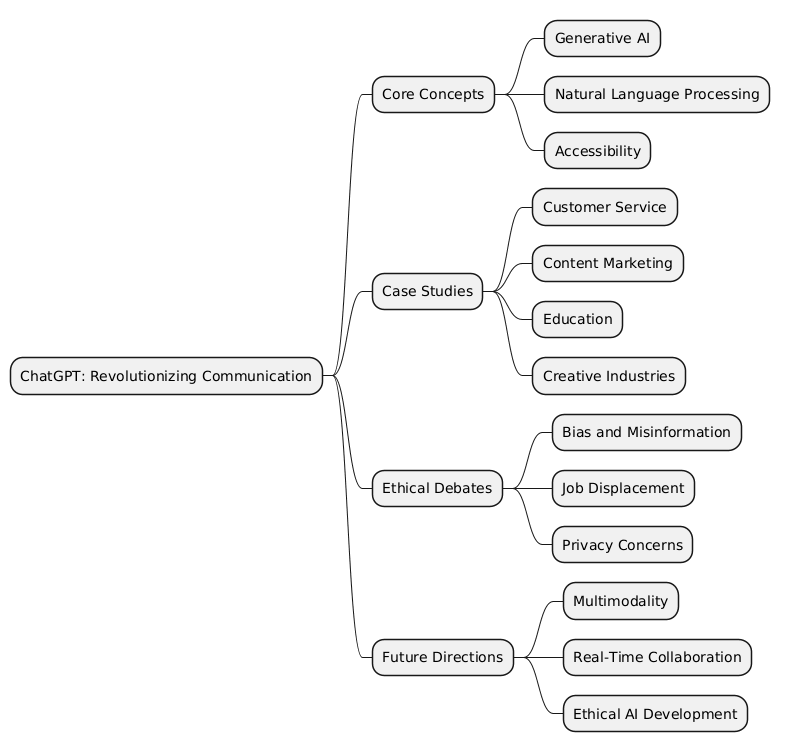
Mind Map
Key Takeaways
💡 Insightful Idea: ChatGPT democratizes access to advanced AI, empowering individuals and businesses.
⚠️ Warning: Ethical concerns, including bias and misinformation, require vigilant oversight.
🔍 Key Detail: Clear and structured prompts yield the best results when using ChatGPT.
🚀 Future Opportunity: Multimodal AI could revolutionize industries from education to healthcare.
🌍 Societal Impact: ChatGPT’s integration into daily life raises questions about dependency and critical thinking.