
- Artificial Intelligence (AI) and Generative AI are redefining petroleum engineering, streamlining operations, and boosting efficiency.
- These technologies are revolutionizing exploration, drilling, and production while addressing sustainability and operational challenges.
- This article delves into the technical mechanisms, real-world applications, ethical considerations, and future possibilities of AI in petroleum engineering.

Introduction & Context
The petroleum industry, for over a century, has been a cornerstone of global energy supply, driving economies and powering modern lifestyles. However, as the world shifts toward sustainability and efficiency, the sector faces mounting pressure to innovate. Enter Artificial Intelligence (AI) and its powerful subset, Generative AI—technologies that promise to redefine the way petroleum engineering operates.
Historically, petroleum engineering relied on manual data analysis, trial-and-error methods, and traditional engineering principles to locate reservoirs, optimize drilling, and manage production. But the emergence of AI has disrupted this status quo. With its ability to process vast datasets, uncover hidden patterns, and simulate complex systems, AI is empowering engineers to make faster, smarter, and more sustainable decisions.
Today, AI is more than a buzzword in petroleum engineering—it’s a necessity. From predicting equipment failures to optimizing reservoir simulations, AI-driven solutions are saving millions of dollars while reducing environmental impacts. Generative AI, in particular, is making waves by designing innovative drilling strategies and creating synthetic data to fill gaps in real-world datasets. This article explores the technical underpinnings, practical applications, and ethical dilemmas of AI in petroleum engineering, offering a glimpse into its transformative potential.
Technical Breakdown
The Mechanics of AI in Petroleum Engineering
At its core, AI in petroleum engineering leverages machine learning (ML), neural networks, and generative algorithms to solve complex challenges. These technologies excel at processing unstructured data, such as seismic imaging, well logs, and production metrics, to generate actionable insights.
Machine Learning: The Predictive Backbone
Machine learning models analyze historical data to predict outcomes like reservoir performance or equipment failures. For instance, supervised learning algorithms can forecast oil production rates based on variables such as reservoir pressure, rock permeability, and well depth. Meanwhile, unsupervised learning techniques, like clustering, group wells with similar characteristics to identify high-performing zones.
Generative AI: Innovating Simulations
Generative AI, powered by neural networks like Generative Adversarial Networks (GANs) or Variational Autoencoders (VAEs), takes innovation a step further. It creates synthetic datasets and simulates reservoir conditions under various scenarios. This capability is particularly useful in regions with limited historical data or in high-stakes drilling operations where experimentation is costly.
Decision Trees and Regression Models
Decision tree algorithms are widely used for classification tasks, such as determining whether a well belongs to a shale, sandstone, or carbonate production zone. Regression models, on the other hand, predict continuous variables like production rates or water cut percentages, helping engineers optimize operations.
Practical Tools and Techniques
- Seismic Data Interpretation: AI algorithms process seismic waves to map subsurface formations, identifying oil and gas reservoirs with higher accuracy.
- Real-Time Drilling Optimization: Sensors embedded in drilling equipment feed data into AI models, which adjust drilling parameters like weight-on-bit and rotary speed to maximize efficiency.
- Predictive Maintenance: AI monitors equipment health, predicting failures before they occur and scheduling maintenance proactively.
Case Studies
1. ExxonMobil: AI for Drilling Optimization
ExxonMobil implemented AI-driven analytics to optimize drilling parameters, such as mud flow rate and rotary speed. By analyzing real-time sensor data, the system reduced drilling time by 30% while minimizing equipment wear. The result? Lower costs and safer operations.
2. Equinor: Generative AI in Reservoir Simulation
Norwegian energy giant Equinor used generative AI to simulate reservoir behavior under various enhanced oil recovery (EOR) techniques. The AI model identified the optimal injection strategy, increasing oil recovery by 12% while reducing water usage by 15%.
3. Shell: AI in Environmental Monitoring
Shell deployed AI-powered sensors to monitor methane emissions across its facilities. By analyzing air quality data in real-time, the system detected leaks early, reducing greenhouse gas emissions and ensuring compliance with environmental regulations.
Ethical Debate
The Promise and Peril of AI in Petroleum Engineering
Pros
- Efficiency Gains: AI reduces operational inefficiencies, cutting costs and boosting productivity.
- Environmental Benefits: By optimizing resource use and minimizing waste, AI contributes to sustainability goals.
- Safety Improvements: Real-time monitoring and predictive analytics enhance worker safety and reduce accident risks.
Cons
- Job Displacement: Automation may render certain roles obsolete, raising concerns about workforce transitions.
- Data Privacy: The use of sensitive geological and operational data poses cybersecurity risks.
- Ethical Dilemmas: Should AI be used to prolong the life of fossil fuel projects in a world striving for decarbonization?
Societal Implications
The integration of AI in petroleum engineering underscores a broader tension between technological progress and environmental responsibility. While AI can make fossil fuel extraction more efficient, critics argue that the focus should shift toward renewable energy technologies. Balancing these competing priorities is a challenge that engineers, policymakers, and corporations must navigate collaboratively.
Future Directions
What Lies Ahead for AI in Petroleum Engineering?
- AI-Driven Sustainability AI will play a pivotal role in transitioning the petroleum industry toward greener practices. From carbon capture optimization to renewable energy integration, the technology offers pathways to reduce the sector’s environmental footprint.
- Quantum Computing The advent of quantum computing could supercharge AI algorithms, enabling even more accurate reservoir simulations and faster data processing.
- Digital Twins The industry is poised to adopt digital twins—virtual replicas of physical assets. These AI-driven models will simulate real-world conditions, enabling predictive maintenance and operational optimization.
- Regulatory Frameworks As AI adoption grows, the need for robust regulatory frameworks will become critical. These frameworks must address data privacy, cybersecurity, and ethical considerations.
- Workforce Evolution The petroleum workforce will need to adapt, with engineers acquiring skills in AI, data analytics, and machine learning. This shift will redefine traditional roles, fostering a new era of tech-savvy petroleum professionals.
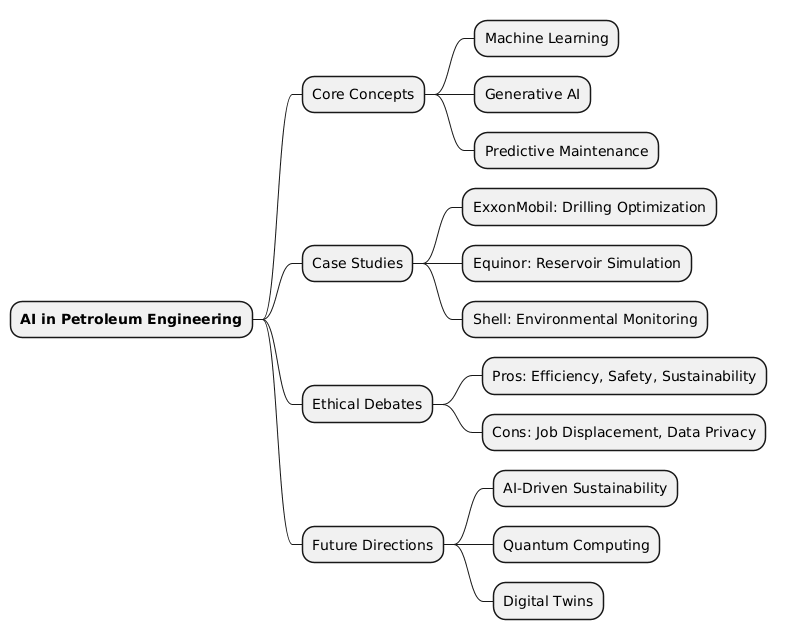
Mind Map
Key Takeaways
- 💡 Insightful Idea: AI and Generative AI are transforming petroleum engineering, offering smarter, more efficient solutions.
- ⚠️ Warning: Ethical dilemmas, such as job displacement and data privacy, require careful consideration.
- 🔍 Key Detail: Generative AI excels in simulating reservoir conditions, filling critical data gaps.
- 🚀 Future Opportunity: Digital twins and quantum computing promise to revolutionize the industry further.
- 🌍 Societal Impact: AI’s role in sustainability could reshape the petroleum sector’s environmental footprint.
By harnessing the power of AI and generative algorithms, petroleum engineering stands on the cusp of a smarter, more sustainable future. However, navigating the ethical and societal challenges will be key to unlocking its full potential.