
Generative AI and synthetic data are revolutionizing machine learning and data science by addressing critical limitations like data scarcity and privacy concerns. These technologies are reshaping industries, from healthcare to finance, while raising profound ethical questions about their use. This article delves into the technical foundations, real-world applications, ethical debates, and the future trajectory of this transformative field.

Introduction & Context
In the sprawling universe of artificial intelligence, data is the lifeblood. Yet, paradoxically, the very resource that fuels AI systems often becomes its bottleneck. Real-world data can be messy, incomplete, or inaccessible due to privacy concerns. Enter synthetic data and generative AI—a duo poised to redefine how we think about data creation and utilization.
The journey to this point has been marked by milestones such as the advent of Generative Adversarial Networks (GANs) in 2014, which enabled machines to generate eerily realistic images. Today, synthetic data is no longer confined to academic experiments; it is a cornerstone of industries ranging from autonomous vehicles to personalized healthcare. But why now? The convergence of computational power, advanced algorithms, and an insatiable demand for data has made synthetic data not just a convenience but a necessity.
At its core, synthetic data offers a solution to one of AI’s most persistent challenges: the need for vast, high-quality datasets. By simulating real-world scenarios, it provides a sandbox for AI systems to learn, adapt, and evolve without the ethical and logistical complications of handling sensitive human data.
Technical Breakdown
The Mechanics of Synthetic Data and Generative AI
At the heart of synthetic data generation lies an array of mathematical models and algorithms, with GANs being the most celebrated. A GAN operates as a creative duel between two neural networks: a generator, which creates data, and a discriminator, which evaluates its authenticity. Over time, this adversarial process produces synthetic data indistinguishable from real-world data.
But GANs are just the tip of the iceberg. Variational Autoencoders (VAEs) and diffusion models offer alternative approaches, each with unique strengths. VAEs, for instance, excel in generating structured data like text or tabular formats, while diffusion models are gaining traction in creating high-resolution images.
Beyond these algorithms, synthetic data generation often involves domain-specific techniques. For example, in healthcare, models simulate patient data while preserving statistical properties crucial for medical research. In autonomous driving, synthetic environments replicate complex traffic scenarios, enabling AI systems to learn under controlled conditions.
Real-World Analogies
Think of synthetic data as a flight simulator for AI. Just as pilots train in virtual cockpits to prepare for real-world challenges, AI systems use synthetic data to hone their skills before deployment. This analogy underscores synthetic data’s dual role as a training ground and a testing environment, ensuring robustness and reliability.
Case Studies
1. Autonomous Vehicles: Navigating the Synthetic Road
The development of self-driving cars demands millions of miles of driving data, capturing every conceivable road condition. Companies like Waymo and Tesla have turned to synthetic data to fill this gap. Virtual environments allow engineers to simulate rare but critical events, such as sudden pedestrian crossings or adverse weather conditions. The result? Safer, more efficient autonomous systems that can adapt to real-world unpredictability.
2. Healthcare: Synthetic Patients for Real Progress
In the healthcare sector, synthetic data is transforming patient privacy and clinical research. For instance, synthetic patient records enable researchers to study rare diseases without exposing sensitive information. This approach has been pivotal during the COVID-19 pandemic, where synthetic data accelerated vaccine development by modeling virus spread and immune responses.
3. Financial Services: Fighting Fraud with Fake Data
Fraud detection systems thrive on diverse datasets, but real-world financial data is often limited and sensitive. Synthetic data bridges this gap by creating realistic transaction patterns, enabling banks to train fraud detection algorithms without compromising customer privacy. Companies like Mastercard have already integrated synthetic data into their fraud prevention strategies.
Ethical Debate
The Double-Edged Sword of Synthetic Data
While synthetic data offers undeniable benefits, it also raises significant ethical concerns. On one hand, it mitigates privacy risks by replacing real data with synthetic counterparts. On the other, poorly generated synthetic data can introduce biases, perpetuating systemic inequalities.
For example, if a synthetic dataset mirrors the biases of its real-world counterpart, it risks amplifying those biases in AI systems. Moreover, the misuse of synthetic data in deepfake technology highlights the darker side of generative AI. The ability to create hyper-realistic fake content poses threats to privacy, security, and societal trust.
Societal Implications
The ethical challenges extend beyond technical considerations. As synthetic data becomes mainstream, it forces us to reconsider traditional notions of authenticity and ownership. Who owns synthetic data? And what happens when synthetic datasets outnumber real ones, potentially skewing our understanding of reality?
Future Directions
What Lies Ahead for Synthetic Data and Generative AI?
The future of synthetic data is as dynamic as the technology itself. Researchers are exploring hybrid models that combine real and synthetic data to maximize accuracy while minimizing bias. Advances in explainable AI aim to make synthetic data generation more transparent, fostering trust and accountability.
Emerging applications are equally exciting. Imagine personalized education systems driven by synthetic student data or climate models enhanced by synthetic environmental data. The possibilities are limited only by our imagination—and our ability to address the accompanying ethical dilemmas.
Unanswered Questions
Despite its promise, synthetic data leaves several questions unanswered. How do we ensure its quality and reliability? Can we develop universal standards for synthetic data generation and evaluation? And most importantly, how do we balance innovation with ethical responsibility?
Mind Map
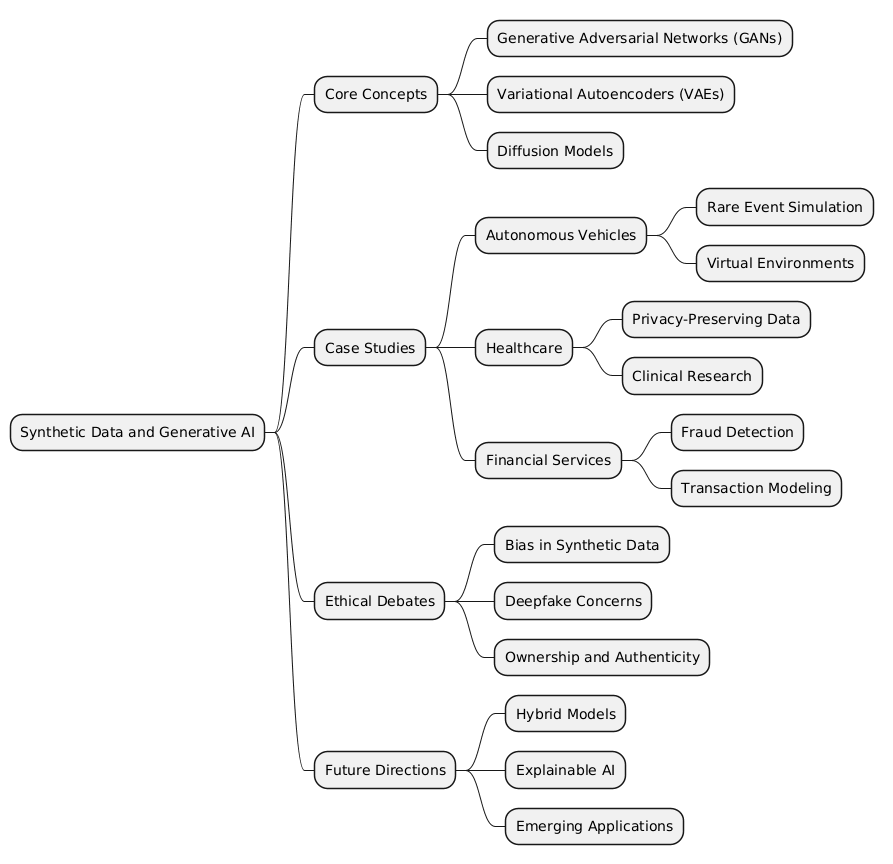
Key Takeaways
💡 Insightful Idea: Synthetic data democratizes AI by providing high-quality datasets without compromising privacy.
⚠️ Warning or Challenge: Bias in synthetic data can perpetuate systemic inequalities if not addressed.
🔍 Key Detail or Discovery: Generative AI techniques like GANs and VAEs are the engines behind synthetic data.
🚀 Future Opportunity: Hybrid models combining real and synthetic data could redefine AI training paradigms.
🌍 Societal Impact: Synthetic data forces us to rethink authenticity, ownership, and the ethical boundaries of AI.
This comprehensive exploration of synthetic data and generative AI underscores their transformative potential while highlighting the ethical and technical challenges that lie ahead. As these technologies continue to evolve, they promise to reshape not only AI but the very fabric of our digital society.