- Generative AI is transforming industries by enabling machines to create content, solve problems, and enhance productivity.
- This article explores the technology’s potential, risks, and real-world applications, offering a roadmap for CEOs to navigate this fast-evolving domain.
- From revolutionizing workflows to raising ethical dilemmas, generative AI presents both opportunities and challenges that demand strategic leadership.

Introduction & Context
In November 2022, ChatGPT burst onto the scene, captivating the world with its ability to generate human-like text. Within just two months, it amassed over 100 million users, becoming the fastest-growing app in history. Unlike previous AI technologies, which often required specialized knowledge, generative AI democratized access to advanced machine learning. Nearly anyone with an internet connection could now harness its power.
But this isn’t just about chatbots. Generative AI represents a paradigm shift, enabling machines to create text, images, audio, video, and even software code. Its applications span industries, from marketing and customer service to drug discovery and software engineering. As McKinsey’s recent report highlights, CEOs face a pressing question: Is generative AI merely a fleeting trend, or is it the key to unlocking unprecedented business value?
This article unpacks the technology’s core concepts, real-world applications, ethical challenges, and future implications. For leaders navigating this transformative era, understanding generative AI is no longer optional—it’s essential.
Technical Breakdown
What Is Generative AI?
At its core, generative AI refers to systems that can produce new content, whether it’s text, images, or even music. These systems are powered by foundation models, such as OpenAI’s GPT-4 or Google’s PaLM, which are trained on massive datasets of unstructured information.
The magic lies in a technology called transformers. Think of transformers as highly sophisticated pattern detectors. They analyze relationships between words, pixels, or sounds to predict what comes next. For instance, when you ask ChatGPT a question, it predicts the most likely sequence of words to form a coherent answer.
But foundation models aren’t limited to one task. Unlike earlier AI, which was narrow and specialized, these models are versatile. A single model can summarize a technical report, generate marketing copy, and even draft software code.
Real-World Analogy:
Imagine a Swiss Army knife that not only has multiple tools but learns new ones as it encounters different challenges. This adaptability makes generative AI a game-changer—but also introduces risks like inaccuracy and bias.
Case Studies
Case 1: Revolutionizing Software Engineering
One of the most immediate applications of generative AI is in software development. Tools like GitHub Copilot, powered by OpenAI’s Codex, allow developers to write code faster. Engineers can describe what they need in plain English, and the AI generates code snippets on the fly.
McKinsey’s research shows that such tools can boost coding productivity by up to 50%. However, they also highlight a critical caveat: the AI-generated code isn’t always perfect. Experienced developers are still needed to debug and refine the output.
Case 2: Enhancing Customer Support
Companies in specialized industries like finance and healthcare are fine-tuning generative AI models to handle customer inquiries. For example, a bank might train a chatbot on its proprietary data to answer client questions about mortgages or investment options.
This approach not only improves response times but also frees up human agents to focus on complex cases. However, fine-tuning requires significant investment in data cleaning, labeling, and integration with existing systems.
Case 3: Accelerating Drug Discovery
In the pharmaceutical sector, generative AI is being used to analyze microscopy images and predict how different drugs interact with cells. By training models on millions of images, researchers can identify promising drug candidates faster than ever before.
This capability could revolutionize R&D, reducing the time and cost of bringing new treatments to market. But building such models from scratch demands substantial resources, including PhD-level expertise and cutting-edge computing infrastructure.
Ethical Debate
The Risks of Generative AI
While the potential benefits are immense, generative AI comes with significant risks:
- Bias and Fairness: Foundation models are trained on internet-scale data, which often contains biases. Left unchecked, these biases can perpetuate stereotypes or lead to unfair outcomes.
- Intellectual Property: AI-generated content can inadvertently infringe on copyrights or trademarks, raising legal and ethical questions.
- Misinformation: Generative AI can produce “hallucinations”—plausible but false information. This is particularly dangerous in high-stakes domains like healthcare or law.
- Environmental Impact: Training large models consumes vast amounts of energy. For instance, training a single large language model can emit as much CO2 as five cars over their lifetimes.
Balancing Risks and Rewards
To mitigate these risks, companies must adopt robust governance frameworks. This includes:
- Implementing human-in-the-loop systems to oversee AI outputs.
- Conducting regular audits to identify and address biases.
- Investing in energy-efficient AI technologies.
Future Directions
What’s Next for Generative AI?
The field is evolving at breakneck speed. Here are some trends to watch:
- Smaller, More Efficient Models: Researchers are developing models that require less computational power, making them accessible to smaller organizations.
- Domain-Specific AI: Custom models tailored to specific industries, like medicine or finance, will become more prevalent.
- Regulation and Standards: Governments and industry bodies are working to establish guidelines for responsible AI use.
- Integration with Traditional AI: Generative AI will increasingly complement other AI systems, creating hybrid solutions that are greater than the sum of their parts.
Speculative Outlook
Imagine a future where generative AI is seamlessly embedded into everyday tools. Your email drafts itself. Your financial software explains anomalies in plain language. Your customer service chatbot remembers past interactions and adapts its tone to match your preferences.
But this future won’t materialize without addressing the challenges outlined above. CEOs must lead the charge, balancing innovation with responsibility.
Mind Map
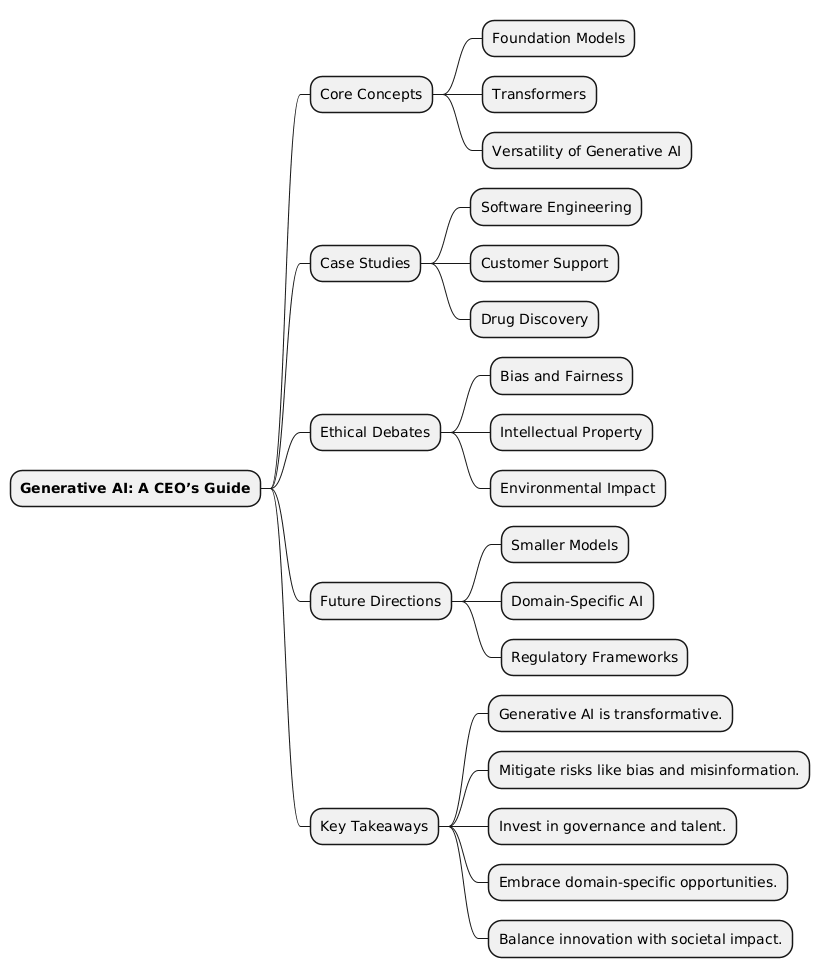
Key Takeaways
- 💡 Generative AI is transformative: It can revolutionize workflows across industries, from coding to customer service.
- ⚠️ Mitigate risks: Address biases, intellectual property issues, and environmental concerns.
- 🔍 Invest in governance: Establish ethical guidelines and oversight mechanisms.
- 🚀 Embrace domain-specific opportunities: Tailor AI solutions to your industry for maximum impact.
- 🌍 Balance innovation with societal impact: Lead responsibly to ensure AI benefits everyone.