
AI is reshaping the legal landscape, enabling lawyers to analyze contracts, predict case outcomes, and streamline compliance faster than ever. Adam Jabbar’s “DeepSeek for Lawyers” explores this transformation, introducing DeepSeek-R1, an AI tool designed for legal reasoning. This article delves into the technology, its societal impact, and the ethical challenges it poses.

Section 1: Context – The Legal Profession Meets AI
The legal industry is no stranger to innovation, but the rise of artificial intelligence (AI) marks a paradigm shift. Historically, lawyers relied on manual research, combing through case law and drafting contracts—a process both time-consuming and prone to human error. Over the last decade, platforms like LexisNexis and Westlaw began digitizing legal research, but these tools only scratched the surface of what AI could achieve.
Enter DeepSeek-R1, an open-source AI model highlighted in Adam Jabbar’s book, DeepSeek for Lawyers: Unlocking AI-Powered Legal Practice. Unlike generic AI models, DeepSeek-R1 specializes in “deep reasoning,” a capability crucial for legal professionals handling complex cases. Jabbar positions this tool as a game-changer, emphasizing its ability to analyze contracts, compare case law, and even draft legal arguments.
Why now? The legal profession faces mounting pressure to deliver faster, more cost-effective services. Clients demand efficiency, and AI promises to meet this demand by automating repetitive tasks, allowing lawyers to focus on strategy and advocacy. However, as Jabbar notes, the adoption of AI isn’t just about efficiency—it’s about staying competitive in a rapidly evolving industry.
Section 2: Technical Breakdown – How DeepSeek Works
At its core, DeepSeek-R1 is built on reinforcement learning (RLHF) and natural language processing (NLP). These technologies enable the AI to “think” through legal problems rather than merely predict text. Let’s break this down with relatable analogies:
- Reinforcement Learning (RLHF):
Imagine teaching a junior associate to analyze contracts. Over time, you provide feedback, correcting errors and rewarding accurate insights. DeepSeek-R1 undergoes a similar process, continuously improving its reasoning skills by learning from user interactions. - Natural Language Processing (NLP):
Think of NLP as the AI’s ability to “read and write” in legalese. It can parse dense legal documents, extract key clauses, and even rewrite them for clarity—all in seconds.
DeepSeek’s standout feature is its offline deployment capability. Unlike cloud-based AI models, which pose data security risks, DeepSeek can be installed locally. This ensures compliance with attorney-client privilege and data protection laws like GDPR. However, Jabbar warns that the tool isn’t flawless. Its legal research capabilities may lag behind proprietary platforms like Westlaw, and it occasionally generates inaccurate case law—a phenomenon known as “AI hallucination.”
Section 3: Case Studies – AI in Action
1. Contract Analysis at Lightning Speed
A corporate lawyer at a mid-sized firm used DeepSeek to review a 50-page supplier contract. Within minutes, the AI flagged vague clauses and suggested revisions to strengthen the client’s position. The lawyer reported saving over 10 hours of manual review, allowing them to focus on negotiating terms.
2. Litigation Strategy for High-Stakes Cases
In a fraud case, a litigation attorney leveraged DeepSeek to analyze opposing arguments. The AI identified potential counterarguments and provided case law to support the attorney’s rebuttals. This not only enhanced the lawyer’s confidence in court but also contributed to a favorable settlement for the client.
3. Regulatory Compliance for a Fintech Startup
A fintech startup expanding into Europe used DeepSeek to audit its data policies for GDPR compliance. The AI flagged several vulnerabilities, enabling the company to address them before regulatory fines became an issue. According to the startup’s legal counsel, this proactive approach saved the company millions in potential penalties.
Section 4: Ethical Debate – The Double-Edged Sword of AI
While AI offers undeniable benefits, it also raises ethical and regulatory concerns:
Pros
💡 Efficiency Gains: AI reduces the time spent on routine tasks, allowing lawyers to focus on strategy.
💡 Cost-Effectiveness: Small firms can compete with larger counterparts by leveraging AI for legal research and drafting.
💡 Accessibility: AI democratizes access to legal services, enabling individuals and small businesses to navigate complex legal landscapes.
Cons
⚠️ Data Security Risks: Cloud-based AI tools may expose sensitive client information.
⚠️ Bias in AI Models: If trained on biased datasets, AI could perpetuate discriminatory practices in hiring or sentencing.
⚠️ Over-Reliance on AI: Lawyers must verify AI-generated outputs to avoid inaccuracies that could harm clients.
Jabbar emphasizes the importance of human oversight. AI should augment, not replace, legal expertise. As he puts it, “AI is a tool, not a substitute for judgment.”
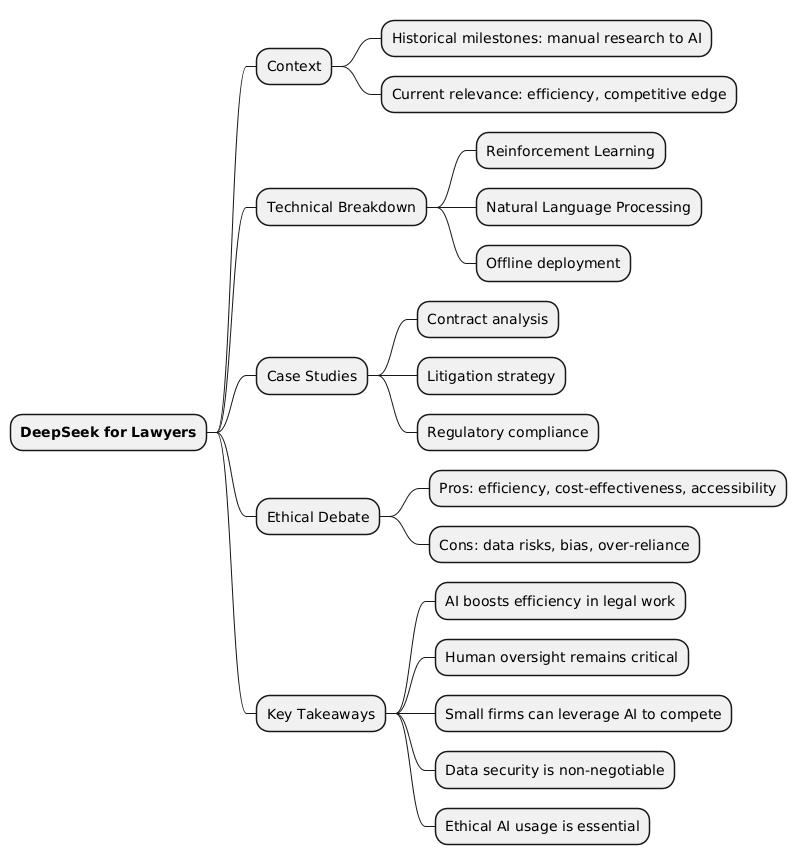
Mind Map
5 Key Takeaways
- 💡 AI boosts efficiency: Tools like DeepSeek-R1 save lawyers hours on research and drafting.
- ⚠️ Human oversight is critical: AI can hallucinate, requiring lawyers to verify outputs.
- 💡 Leveling the playing field: Small firms can compete with AI-driven efficiency.
- ⚠️ Data security is paramount: Offline deployment ensures client confidentiality.
- 🔍 Ethical AI usage: Lawyers must address biases and ensure compliance with regulations.