Generative AI is not just a technological marvel; it’s a transformative force reshaping industries, from healthcare to marketing. By leveraging cutting-edge algorithms like GANs and NLP, it enables businesses to innovate at an unprecedented pace. However, the ethical and societal implications of this technology demand urgent attention, as organizations navigate its promises and perils.

Section 1: Context – The Evolution of Generative AI
The journey of artificial intelligence (AI) has been one of relentless innovation, marked by milestones that have fundamentally altered how humans interact with technology. From the deterministic algorithms of Traditional AI to the creative leaps enabled by Generative AI, the field has evolved from rule-based problem-solving to systems capable of learning and creating autonomously.
Generative AI represents a paradigm shift. Unlike its predecessors, which relied on predefined rules, Generative AI thrives on vast datasets and advanced learning techniques. Its ability to generate novel content—be it text, images, or even molecular structures—has unlocked possibilities across sectors. For instance, in 2023, OpenAI’s ChatGPT-4 showcased how natural language processing (NLP) could mimic human conversation, while Google’s DeepMind demonstrated AI’s potential in protein folding for drug discovery.
Today, Generative AI is at the center of a technological renaissance. As businesses grapple with the challenges of digital transformation, this technology offers a strategic advantage, enabling innovation, efficiency, and personalization. However, its rapid adoption has also raised questions about ethics, bias, and accountability, making it a double-edged sword in the digital age.
Section 2: Technical Breakdown – How Generative AI Works
At its core, Generative AI is powered by advanced machine learning models like Generative Adversarial Networks (GANs), transformers, and transfer learning techniques. These models are the engines behind its creative capabilities.
GANs: The Creative Duo
Imagine a painter and a critic working together. The painter (generator) creates an artwork, while the critic (discriminator) evaluates its quality. Over time, the painter improves, producing increasingly realistic pieces. This is the essence of GANs, which consist of two neural networks working in tandem to generate high-quality outputs, whether it’s lifelike images or synthetic medical data.
NLP and Transformers: Teaching AI to Speak
Natural Language Processing (NLP) enables machines to understand and generate human language. Transformers, like those used in GPT models, revolutionized NLP by processing entire texts simultaneously rather than sequentially. This allows for nuanced understanding and generation of content, from drafting emails to composing poetry.
Real-World Analogy: Data as the New Canvas
Think of Generative AI as a master artist whose canvas is data. The richer and more diverse the dataset, the more intricate and accurate the creations. For instance, training an AI model on millions of medical images enables it to generate synthetic data that aids in diagnosing rare diseases.
Section 3: Case Studies – Generative AI in Action
1. Healthcare: Accelerating Drug Discovery
Generative AI is revolutionizing healthcare by creating synthetic data for training diagnostic models and accelerating drug discovery. For example, DeepMind’s AlphaFold used AI to predict protein structures with high accuracy, a breakthrough that could expedite the development of life-saving drugs.
2. Marketing: Personalization at Scale
Companies like Heinz and Dove have leveraged Generative AI to create personalized marketing campaigns. By analyzing customer data, these AI systems generate tailored content that resonates with diverse audiences, enhancing engagement and brand loyalty.
3. Retail: Enhancing Customer Experience
Retail giants are using AI to transform customer interactions. For instance, a fashion retailer might analyze a customer’s purchase history and browsing behavior to recommend personalized outfits, creating a curated shopping experience.
Section 4: Ethical Debate – Navigating the Double-Edged Sword
While Generative AI offers immense potential, it also poses ethical dilemmas that cannot be ignored.
Pros:
- Innovation: Enables breakthroughs in fields like healthcare and renewable energy.
- Efficiency: Automates repetitive tasks, freeing humans for creative work.
- Personalization: Enhances user experience through tailored solutions.
Cons:
- Bias: AI models can perpetuate societal biases present in training data.
- Transparency: The “black box” nature of AI makes it difficult to understand decision-making processes.
- Accountability: Determining liability for AI-generated errors remains a legal gray area.
Data privacy is another pressing concern. Regulations like GDPR and CCPA aim to protect user data, but compliance remains a challenge for businesses. Moreover, the environmental impact of training large AI models—requiring significant computational power—raises questions about sustainability.
Data-Backed Argument:
A 2023 study by Stanford University highlighted that while AI increased efficiency by 30% in content creation, it also amplified biases in 20% of cases. This underscores the need for robust ethical frameworks and continuous monitoring.
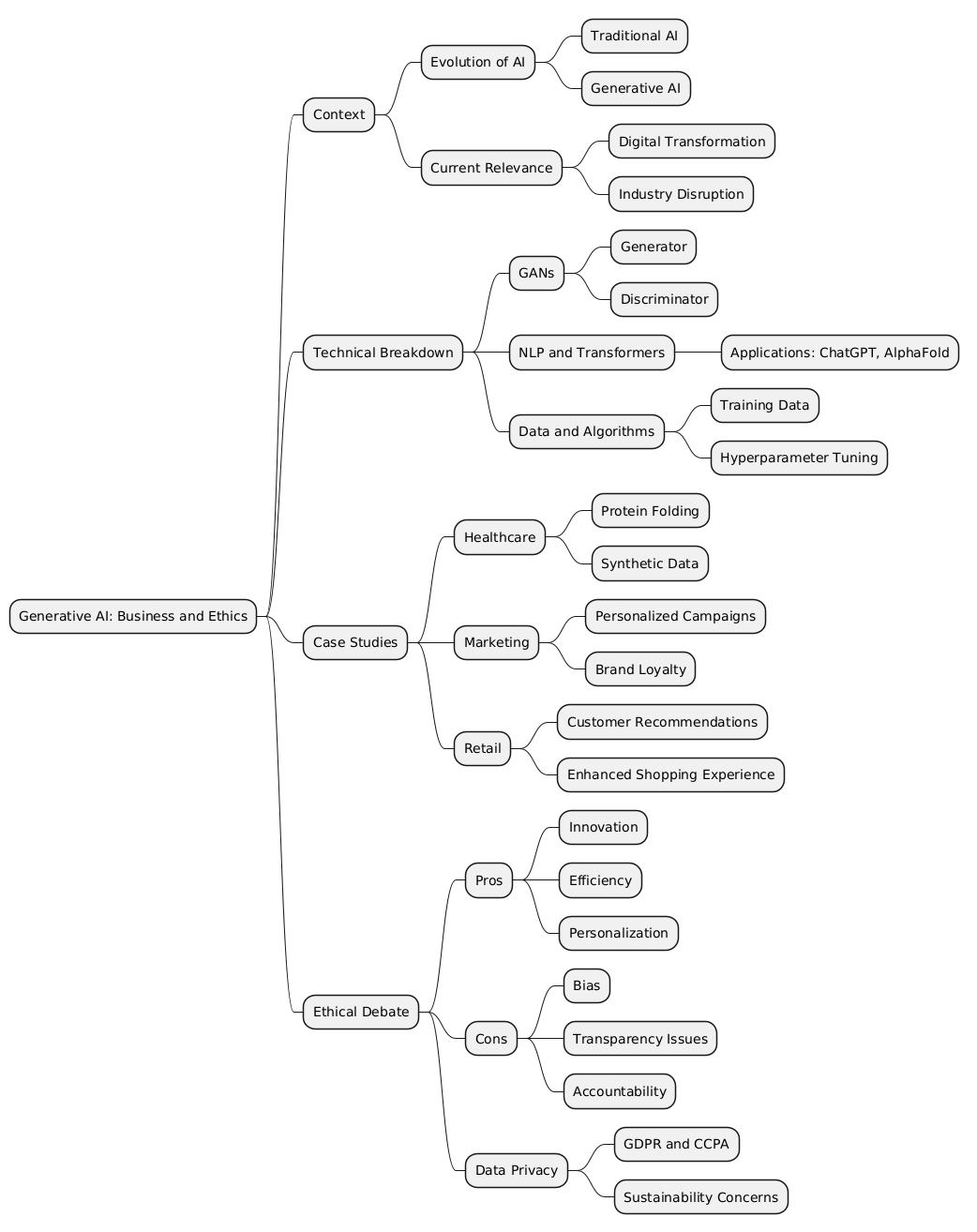
Mind Map
Key Takeaways:
- 💡 Generative AI Drives Innovation: From healthcare to marketing, its applications are reshaping industries.
- ⚠️ Ethical Challenges Persist: Bias, transparency, and accountability require urgent attention.
- 🔍 Data Quality is Crucial: The effectiveness of AI hinges on the richness and diversity of training data.
- 💡 Collaboration is Key: Partnerships between technologists, ethicists, and policymakers can guide responsible AI use.
- ⚠️ Prepare for Regulation: Businesses must adapt to evolving legal frameworks to ensure compliance and sustainability.