Generative AI is reshaping industries, redefining leadership, and challenging traditional roles in organizations. This article explores its historical roots, technical underpinnings, and societal implications while examining case studies that highlight its transformative potential. As organizations adapt to this revolutionary technology, they must also navigate ethical challenges and rethink their approach to governance and leadership.

Section 1: Context – The Evolution of Human-Machine Collaboration
In 1776, Adam Smith extolled the virtues of division of labor, a revolutionary concept that spurred the first industrial revolution. Fast-forward to the late 20th century, and the digital revolution transformed workplaces, replacing typewriters with computers and clerks with databases. Now, we stand on the precipice of a new era: the Productivity Revolution driven by Generative AI.
Generative AI, powered by large language models (LLMs) like OpenAI’s GPT-4 and Google’s Gemini Ultra, is not just automating tasks but creating new possibilities. From drafting legal documents to designing innovative products, these systems are democratizing expertise. Yet, as Arthur J. O’Connor notes in his book, Organizing for Generative AI and the Productivity Revolution, this technology demands a fundamental rethinking of organizational roles and governance.
Unlike the digital revolution that required humans to adapt to machines, this new wave flips the script. Machines are now learning to interact with humans, understanding language, context, and even emotions. This shift has profound implications not just for productivity but also for leadership, ethics, and societal norms.
Section 2: Technical Breakdown – How Generative AI Works
Generative AI operates on the principle of machine learning, specifically a subset known as deep learning. At its core are artificial neural networks designed to mimic the human brain’s ability to recognize patterns and make decisions.
Algorithms and Tools
- Transformer Models: Introduced in 2017, transformers revolutionized natural language processing by enabling models to understand context better. These models use mechanisms like “attention” to focus on relevant parts of input data, much like how a reader skims for key points in a text.
- Analogy: Imagine reading a novel and focusing only on the dialogue to understand the plot. Transformers do this but at a massive scale.
- Fine-Tuning and RAG: Generative AI models are pre-trained on vast datasets and then fine-tuned for specific tasks. Retrieval-Augmented Generation (RAG) combines generative capabilities with real-time data retrieval, ensuring outputs are both creative and accurate.
- Real-World Example: A customer service bot fine-tuned to handle queries about a specific product line, retrieving real-time inventory data to provide accurate answers.
- AutoML and LLM Ops: AutoML automates the creation of machine learning models, while LLM Ops focuses on deploying and managing large language models in production environments.
- Analogy: Think of AutoML as a self-driving car for data science, and LLM Ops as the pit crew ensuring it runs smoothly during a race.
Real-World Impact
Generative AI’s ability to create content, analyze vast datasets, and simulate scenarios is transforming industries. For instance, in healthcare, it can analyze medical imaging data to detect diseases early, while in finance, it predicts market trends with unprecedented accuracy.
Section 3: Case Studies – Real-World Applications
1. Healthcare: IBM Watson Health and Zebra Medical Vision
IBM Watson Health uses AI to provide personalized treatment plans by analyzing vast datasets, including patient histories and medical research. Similarly, Zebra Medical Vision employs AI to detect diseases like cancer and cardiovascular conditions through medical imaging. These innovations not only improve diagnostic accuracy but also reduce the workload on healthcare professionals.
2. Finance: JPMorgan Chase’s COIN Platform
JPMorgan Chase developed the COIN platform to review legal documents. What once required 360,000 hours of manual work annually is now accomplished in seconds. This has freed up legal teams to focus on more complex tasks, showcasing the potential of AI to enhance productivity.
3. Retail: Walmart’s AI-Powered Logistics
Walmart uses AI to optimize inventory management, ensuring the right products are available at the right time. This not only improves customer satisfaction but also reduces waste, aligning with sustainability goals.
Section 4: Ethical Debate – Navigating the Pros and Cons
Pros
- Increased Productivity: Studies show that generative AI can boost productivity by up to 40% in tasks like software coding and business writing.
- Democratization of Expertise: Tools like ChatGPT enable non-experts to perform tasks that once required specialized knowledge.
- Innovation Acceleration: Generative AI is expediting drug discovery and product design, potentially saving lives and driving economic growth.
Cons
- Bias and Discrimination: Models trained on biased data can perpetuate inequalities, as seen in hiring algorithms that favor certain demographics.
- Job Displacement: While AI creates new roles, it also automates many existing ones, leading to economic and social disruptions.
- Privacy Concerns: The vast amounts of data required for training raise questions about consent and security.
Balancing Act
Organizations must adopt robust governance frameworks to mitigate risks. This includes ensuring data quality, implementing ethical guidelines, and fostering a culture of transparency and accountability.
Closure: Preparing for the Future
As we embrace this technology, the focus should not solely be on what generative AI can do but on what it should do. Responsible AI is not just a buzzword; it’s a necessity. Leaders must prioritize ethical considerations, invest in upskilling their workforce, and foster a culture of continuous learning.
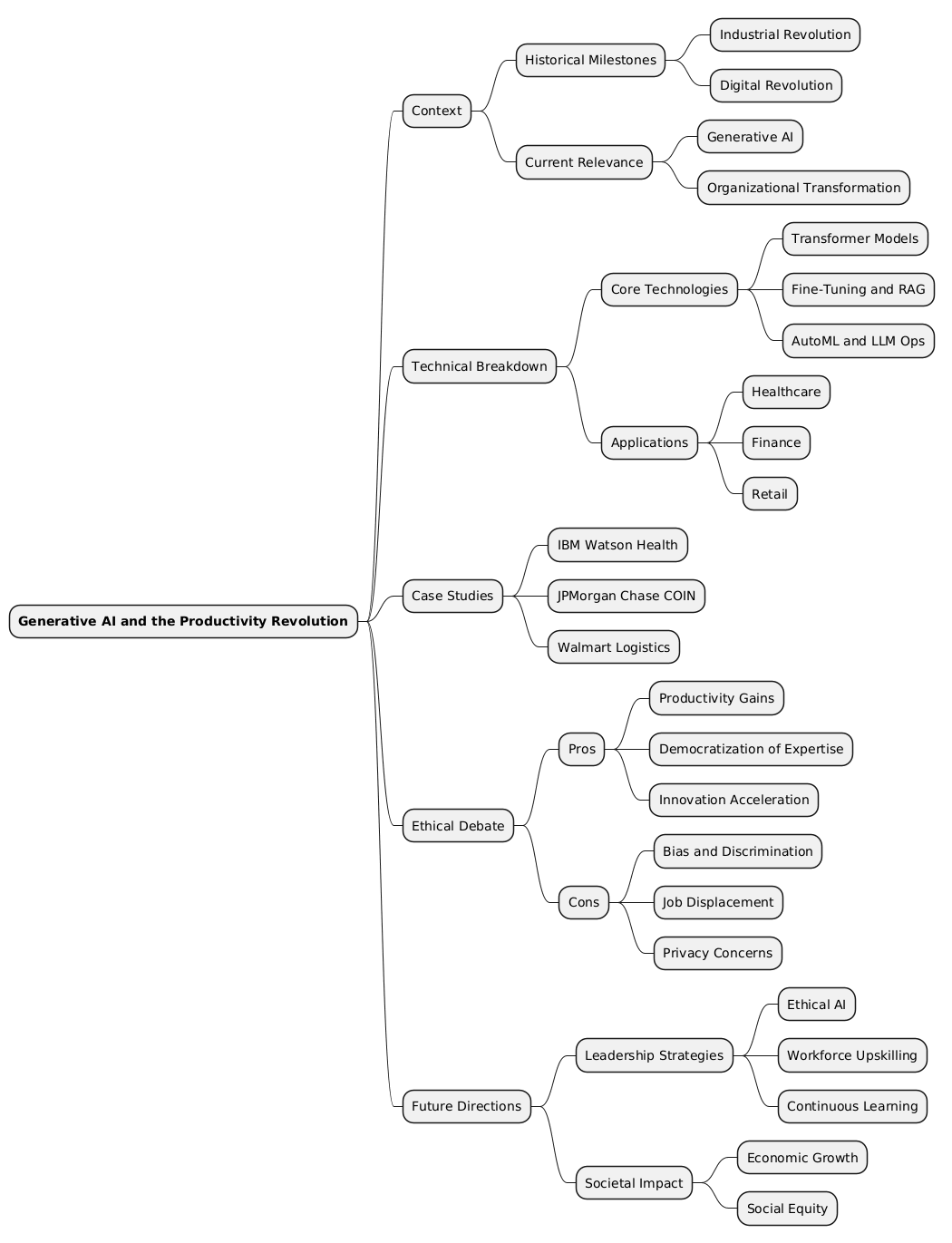
Mind Map
Key Takeaways
💡 Empowerment Through AI: Generative AI democratizes expertise, enabling individuals to perform tasks beyond their traditional skill sets.
⚠️ Ethical Vigilance: Bias, privacy, and job displacement are critical concerns that require proactive governance.
🔍 Leadership Redefined: Emotional intelligence and adaptability are as crucial as technical skills in the AI era.
💡 Data as a Strategic Asset: Quality data is the foundation of effective AI implementation.
⚠️ Continuous Learning: Organizations must foster a culture of innovation and adaptability to thrive.