Artificial Intelligence (AI) is undergoing an unprecedented revolution, transforming businesses, industries, and society as a whole. This article explores how organizations can transition from basic AI usage to advanced value creation strategies through generative models and autonomous agents. It delves into concepts like foundational models, the shift from +AI to AI+, and the democratization of AI via open source, while providing actionable strategies to maximize AI’s impact while managing its risks.

AI: A Revolution Comparable to the Netscape Moment
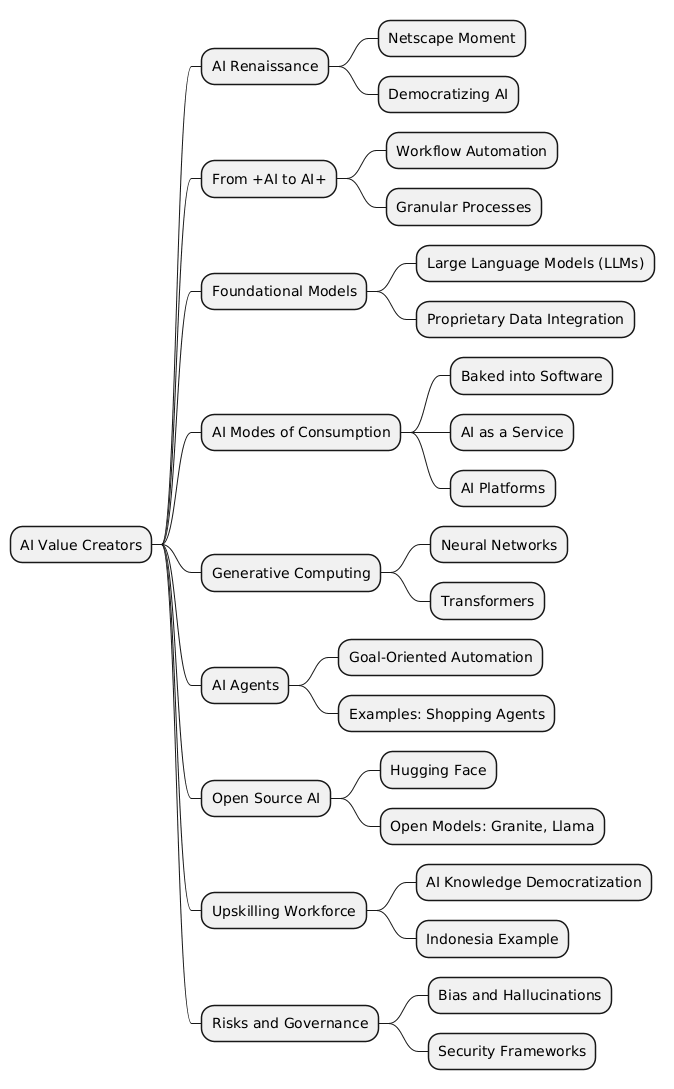
AI is at a pivotal moment, likened to the democratization of the internet in 1994 when Netscape made the web accessible to the masses. Similarly, generative AI is democratizing access to advanced technologies, enabling businesses, governments, and individuals to innovate and improve efficiency.
From +AI to AI+: A Necessary Transformation
The transition from +AI (adding AI to existing processes) to AI+ (placing AI at the core of operations) is crucial for maximizing its potential. This requires rethinking workflows, identifying repetitive tasks to automate, and allowing AI to become the central engine of business processes.
Example: An e-commerce company using AI+ might analyze customer sentiment, predict inventory needs, and personalize marketing campaigns—all seamlessly integrated into its operations.
Foundational Models: The Pillars of Generative AI
Foundational models, such as large language models (LLMs), are the backbone of generative AI. These models, trained on massive datasets, can be adapted to various tasks. Customizing them with proprietary enterprise data unlocks a competitive edge.
Key Insight: Less than 1% of enterprise data is currently represented in LLMs, offering a major opportunity for organizations to leverage their proprietary data for differentiation.
Becoming an AI Value Creator
There are three primary modes of AI consumption:
- AI baked into software: Using ready-made tools like Grammarly or Photoshop.
- AI as a service: Accessing third-party models via APIs.
- AI platforms: Building and customizing models tailored to organizational needs.
The ultimate goal is to become an AI Value Creator—leveraging proprietary data to develop unique solutions and accrue long-term value.
Example: A cosmetics company could use its historical data to create a private AI model, optimizing product formulations and accelerating research.
Generative Computing: A New Paradigm
Generative computing is emerging as a new cornerstone alongside classical and quantum computing. This approach uses neural networks to transform inputs into outputs without predefined rules, enabling tasks like language translation, image generation, and complex decision-making.
Transformer Technology: The breakthrough behind modern LLMs, transformers analyze contextual relationships between words, allowing for nuanced understanding and generation.
AI Agents: Goal-Oriented Automation
AI agents represent a major evolution in automation. Unlike task-oriented workflows, agents are goal-oriented, autonomously planning and executing actions to achieve defined outcomes.
Example: A shopping agent can navigate websites, compare prices, and complete purchases autonomously, simplifying processes for users.
Democratizing AI Through Open Source
The democratization of AI relies on open-source models, ensuring transparency, collaboration, and innovation. Platforms like Hugging Face host millions of models and datasets for public use.
Key Insight: Open models such as Granite and Llama allow businesses to customize solutions without relying on proprietary systems.
Upskilling for the AI Era
Investing in employee training is essential to harness AI’s potential. This includes educating teams about its capabilities, risks, and responsible usage. Democratizing AI knowledge across all organizational levels is a key success factor.
Example: A nationwide training initiative in Indonesia introduced 500,000 students to next-generation technologies, fostering a culture of innovation.
Navigating AI Risks
While AI offers immense opportunities, it also presents risks, such as bias, hallucinations, and security vulnerabilities. Strong governance frameworks are crucial to ensure ethical, transparent, and accountable AI systems.
Conclusion
This article highlights strategies for navigating the AI era responsibly and effectively. By transitioning to AI+, leveraging foundational models, and fostering a culture of training and innovation, businesses can unlock unprecedented potential while minimizing risks.