
Generative Artificial Intelligence (GenAI) is transforming the financial technology (FinTech) sector by enabling smarter decision-making, automating complex processes, and enhancing customer experiences. This article explores how GenAI—powered by models like Generative Adversarial Networks (GANs), Transformers, and Variational Autoencoders (VAEs)—is reshaping banking, fraud detection, risk management, and personalized financial services.
We cover:
- Fundamentals of Generative AI (how it differs from traditional AI).
- Key applications in FinTech (credit scoring, chatbots, algorithmic trading).
- Ethical and regulatory challenges (bias, privacy, explainability).
- Future trends (synthetic data, hyper-personalization, regulatory compliance).
Real-world examples from JPMorgan, Stripe, and Revolut illustrate GenAI’s impact. Finally, we conclude with a mind map summarizing key insights.

1. Introduction: The Rise of Generative AI in Finance
Generative AI refers to algorithms that create new data (text, images, transactions) rather than just analyzing existing datasets. Unlike traditional AI (e.g., logistic regression for fraud detection), GenAI can:
- Simulate financial scenarios (e.g., synthetic market data for stress testing).
- Generate human-like interactions (e.g., AI-powered customer support).
- Detect anomalies (e.g., deepfake fraud in digital payments).
Example:
- ChatGPT in Banking: Bank of America’s Erica chatbot uses GPT-4 to answer customer queries, analyze spending habits, and suggest savings plans.
2. How Generative AI Works: Core Concepts
2.1. Key Models in FinTech
| Model | Use Case | Example |
|---|---|---|
| GANs | Fraud detection (generating synthetic fraud patterns) | Mastercard’s Decision Intelligence |
| Transformers | Customer service (chatbots, document analysis) | BloombergGPT for financial reports |
| VAEs | Credit risk modeling (generating alternative credit histories) | Upstart’s AI lending platform |
2.2. Data Requirements
GenAI needs:
- Structured data (transaction logs).
- Unstructured data (emails, contracts).
- Real-time feeds (market prices, news).
Example:
- Revolut uses GANs to simulate money laundering patterns and improve detection.
3. Applications in FinTech
3.1. Fraud Detection & AML
- Problem: Traditional rule-based systems miss evolving fraud tactics.
- Solution: GANs generate synthetic fraud data to train better detectors.
- Case Study: PayPal’s FraudNet reduces false positives by 30%.
3.2. Personalized Banking
- AI Robo-Advisors (e.g., Betterment) generate custom portfolios.
- Dynamic Pricing: AI adjusts loan rates in real-time (e.g., SoFi).
3.3. Algorithmic Trading
- GenAI predicts market movements using synthetic scenarios.
- Example: Citadel’s AI hedge fund outperforms human traders.
4. Challenges & Ethical Risks
| Challenge | Impact | Mitigation |
|---|---|---|
| Bias in AI models | Unfair loan rejections | Explainable AI (XAI) audits |
| Data Privacy | GDPR compliance risks | Federated learning |
| Regulatory Uncertainty | Legal risks (e.g., deepfake fraud) | EU AI Act compliance |
Example:
- ZestFinance uses fairness-aware AI to reduce bias in credit scoring.
5. The Future of GenAI in Finance
- Synthetic Data: Banks like Goldman Sachs simulate crises for stress tests.
- Hyper-Personalization: AI-generated financial plans (e.g., Mint).
- Quantum AI: Faster risk modeling (e.g., JPMorgan’s quantum experiments).
Mind Map
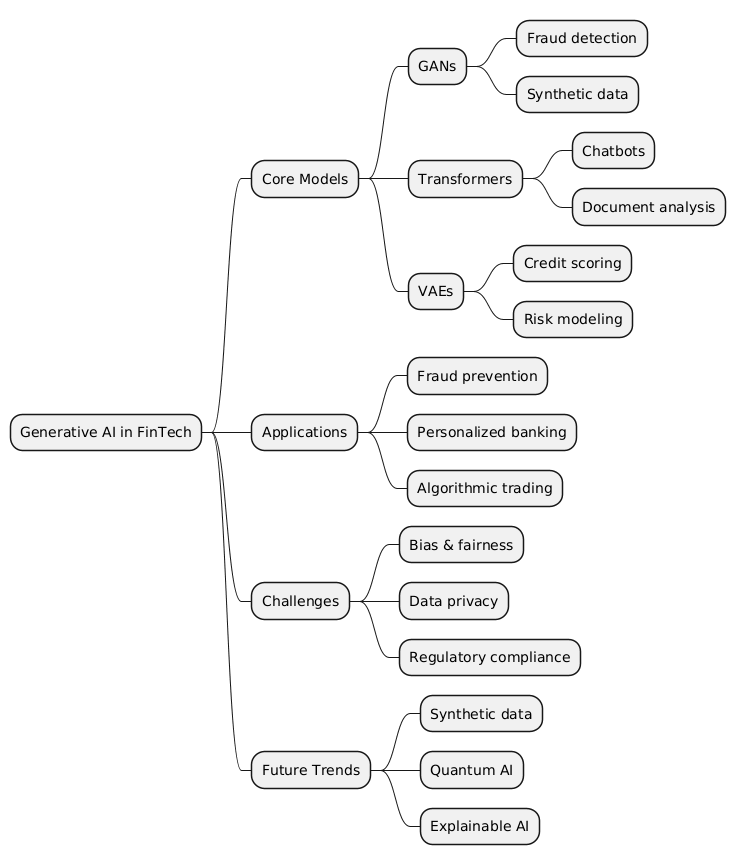
Conclusion
GenAI is revolutionizing FinTech but requires responsible AI governance. It’s not just a tool—it’s a paradigm shift in finance. Companies adopting it responsibly will lead the next wave of FinTech innovation.
Hi Dear, are you truly visiting this web site daily, if so then you will absolutely take
fastidious experience.
Thank you for your feedback