DALL·E, an AI image generator by OpenAI, is revolutionizing creative industries by transforming text into vivid, unique visuals. Its impact spans art, marketing, and accessibility, raising ethical questions about authenticity and copyright. This article delves into DALL·E’s workings, use cases, and its potential to reshape the future of creativity.

Introduction & Context
In November 2022, OpenAI unveiled DALL·E, a groundbreaking tool capable of generating stunning images from textual descriptions. Unlike traditional image creation, DALL·E democratized artistic expression, allowing users—regardless of artistic skill—to create visuals by simply typing a prompt.
But DALL·E is not just a tool; it’s a cultural phenomenon. It represents the convergence of artificial intelligence and human creativity, a marriage of machine learning algorithms and the human imagination. This innovation comes at a time when visual storytelling dominates industries from advertising to education.
Yet, DALL·E’s emergence also stirs debate. Is it a tool for liberation, empowering creators globally? Or is it a disruptor, threatening traditional artistic jobs and raising ethical concerns about originality?
Description
At its core, DALL·E is an AI model designed to generate images from textual prompts. Developed by OpenAI, it builds upon the GPT (Generative Pre-trained Transformer) architecture, which processes language inputs.
Here’s how it works:
- Text Input: Users provide a description, such as “a futuristic cityscape at sunset.”
- Neural Network Processing: DALL·E interprets the text using natural language processing (NLP).
- Image Generation: The model generates multiple image variations, offering users options to refine or select.
DALL·E’s capabilities extend beyond basic image creation. It can:
- Combine unrelated concepts (e.g., “a cat in a spacesuit”).
- Generate photorealistic or artistic styles.
- Edit existing images, allowing users to insert or alter elements seamlessly.
What sets DALL·E apart is its accessibility. Integrated into platforms like ChatGPT (Pro version), it simplifies complex AI processes into user-friendly experiences.
Use Cases
1. Marketing and Advertising
DALL·E is a game-changer for marketers. Imagine a startup needing a unique campaign visual but lacking the budget for professional designers. With DALL·E, they can generate tailored, high-quality imagery in minutes.
Example: A craft beer company used DALL·E to create surreal, eye-catching label designs featuring “a dragon made of hops.” The result? Viral marketing success and increased sales.
2. Education and Accessibility
Educators are leveraging DALL·E to create custom illustrations for teaching materials. From historical reenactments to scientific diagrams, the tool makes learning more engaging.
Example: A biology teacher used DALL·E to generate visuals of “a cross-section of a plant cell with futuristic design elements,” captivating students and enhancing understanding.
3. Art and Personal Projects
Artists use DALL·E as a collaborator, not a competitor. It serves as a brainstorming tool, offering visual ideas that artists can refine.
Example: A graphic designer created a series of surreal landscapes using DALL·E, then added personal touches in Photoshop, resulting in a gallery exhibition.
4. E-commerce and Retail
Retailers employ DALL·E to visualize product concepts or create lifestyle images without expensive photoshoots.
Example: An online furniture store generated “a cozy living room with Scandinavian furniture and a fireplace” for its website, boosting customer engagement.
How To Use DALL·E
Getting started with DALL·E is straightforward:
- Access the Tool:
Visit OpenAI’s website or use it via ChatGPT (Pro version). - Create an Account:
Sign up for an OpenAI account. A free tier offers limited credits; the Pro version unlocks additional features like higher-resolution images. - Input Your Prompt:
Be as detailed as possible. For example, “a futuristic robot chef cooking spaghetti in a neon-lit kitchen.” - Generate Images:
DALL·E produces multiple variations. Users can refine prompts or choose from the results. - Download and Use:
Once satisfied, download the image. Note that usage rights may vary between free and paid versions. - Explore Advanced Features:
- Inpainting: Edit specific parts of an image.
- Outpainting: Extend the canvas of an existing image.
- Custom Styles: Apply filters or artistic styles.
Ethical Debate
DALL·E’s rise brings ethical dilemmas to the forefront:
Pros
- Accessibility: Democratizes creativity, enabling anyone to produce art.
- Efficiency: Reduces costs and time for visual content creation.
- Innovation: Sparks new forms of artistic expression.
Cons
- Job Displacement: Threatens traditional roles in design and illustration.
- Copyright Issues: Raises questions about ownership of AI-generated images.
- Bias in AI: Reflects societal biases present in training data, potentially perpetuating stereotypes.
Societal Implications
DALL·E challenges our definition of art and creativity. If a machine can generate masterpieces, what does that mean for human artists? Moreover, as AI-generated content floods the internet, distinguishing between real and synthetic visuals becomes increasingly complex.
Future Directions
The journey of DALL·E is just beginning. Here’s what the future might hold:
- Improved Realism: Enhanced algorithms could produce indistinguishable photorealistic images.
- Industry Integration: Expect deeper integrations into e-commerce, gaming, and virtual reality platforms.
- Ethical Frameworks: Policymakers and tech leaders must establish guidelines for AI usage, addressing copyright and bias.
- Collaborative AI: Future versions may allow real-time collaboration between users and AI, blending human intuition with machine precision.
- Expanded Accessibility: OpenAI aims to make DALL·E available across diverse languages and cultures, broadening its impact globally.
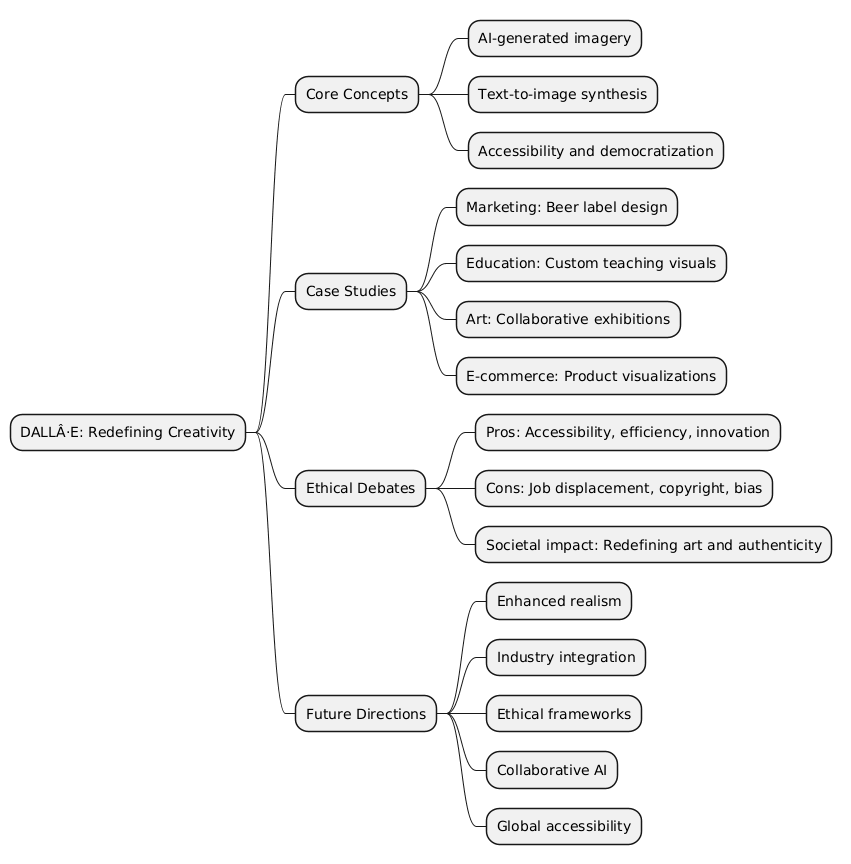
Mind Map
Key Takeaways
💡 Insightful Idea: DALL·E bridges technology and creativity, enabling anyone to produce unique visuals.
⚠️ Warning: Ethical challenges like job displacement and copyright disputes require urgent attention.
🔍 Key Detail: DALL·E’s ability to combine unrelated concepts makes it a versatile tool for innovation.
🚀 Future Opportunity: Deeper integration into industries like gaming and virtual reality could redefine digital experiences.
🌍 Societal Impact: By democratizing art, DALL·E challenges traditional notions of creativity and ownership.
DALL·E is more than a technological marvel; it’s a mirror reflecting our evolving relationship with creativity, ethics, and innovation. As we embrace its potential, we must also navigate its challenges responsibly.