Otter AI is redefining how we capture and utilize conversations through cutting-edge transcription technology. By integrating AI into meetings and collaborative projects, it tackles inefficiencies and enhances productivity. This article unpacks its features, use cases, ethical implications, and future potential.
Introduction & Context
In an era where digital communication dominates professional and personal interactions, the ability to document and analyze conversations has become a cornerstone of productivity. Enter Otter AI, a platform that leverages artificial intelligence to transcribe spoken words into text with remarkable accuracy.
Launched amidst the growing demand for remote collaboration tools, Otter AI has emerged as a game-changer. Its relevance has only grown with the rise of hybrid work environments, where meetings are often virtual and the need for precise documentation is paramount. By bridging the gap between spoken communication and actionable insights, Otter AI positions itself at the intersection of technology, accessibility, and efficiency.
The platform’s trajectory mirrors the broader evolution of AI in daily life. From early speech-to-text applications to advanced conversational AI, Otter AI represents a leap forward in how we process and utilize language data. Its integration with platforms like Zoom and Microsoft Teams underscores its adaptability and relevance in a fast-evolving tech landscape.
Description
Otter AI is a cloud-based transcription service designed to convert spoken language into written text in real time. It uses advanced natural language processing (NLP) and machine learning algorithms to achieve high levels of accuracy, even in complex conversations involving multiple speakers.
Key features include:
- Real-Time Transcription: Otter AI captures conversations as they happen, providing live transcripts that participants can follow during meetings.
- Speaker Identification: The platform distinguishes between different speakers, labeling their contributions for clarity.
- Searchable Archives: Transcriptions are stored in an organized manner, allowing users to search for specific keywords or phrases.
- Integration Capabilities: Otter AI seamlessly integrates with popular communication tools like Zoom, Microsoft Teams, and Google Meet, enabling automatic transcription during virtual meetings.
- Collaboration Tools: Users can highlight key points, add comments, and share transcripts with team members, fostering a collaborative environment.
- Mobile and Desktop Accessibility: The platform is accessible via apps for iOS, Android, and web browsers, ensuring flexibility for users on the go.
These features position Otter AI as a versatile tool for individuals and organizations looking to streamline communication processes and improve documentation accuracy.
Use Cases
Otter AI’s applications span various industries and scenarios. Here are three real-world examples that highlight its versatility:
- Corporate Meetings: Companies use Otter AI to transcribe internal meetings, ensuring that no key point is missed. For instance, during a strategy session, team members can focus on discussions without worrying about taking notes. The transcript, complete with speaker identification, serves as a reliable reference for follow-up actions.
- Education: In academic settings, Otter AI aids students and educators by transcribing lectures and group discussions. A university professor might use Otter AI to provide students with detailed lecture notes, while students with accessibility needs benefit from having text-based resources.
- Content Creation: Journalists, podcasters, and content creators leverage Otter AI to transcribe interviews and brainstorming sessions. This accelerates the content production process, allowing creators to focus on storytelling rather than manual transcription.
Each of these use cases underscores Otter AI’s ability to adapt to diverse needs, making it an indispensable tool for professionals across sectors.
How to Use Otter AI
Using Otter AI is straightforward. Here’s a step-by-step guide:
- Sign Up:
- Visit Otter AI’s website and create an account.
- Choose between the free version or a premium plan for additional features.
- Set Up Integration:
- Link Otter AI to your preferred communication tools (e.g., Zoom, Microsoft Teams).
- Enable automatic transcription for scheduled meetings.
- Start Recording:
- Open the Otter AI app or web interface.
- Click on “Record” to begin transcribing live conversations or upload pre-recorded audio/video files.
- Real-Time Interaction:
- During transcription, participants can view live captions, highlight important points, and add comments.
- Review and Edit:
- After the session, access the transcript in your Otter AI dashboard.
- Edit for accuracy, tag speakers, and add supplementary notes.
- Share and Collaborate:
- Share the transcript with team members via email or direct links.
- Export the transcript in various formats (e.g., PDF, DOCX) for external use.
Otter AI’s intuitive design ensures that both tech-savvy users and beginners can maximize its potential.
Ethical Debate
As with any transformative technology, Otter AI raises ethical questions that merit careful consideration.
Pros:
- Accessibility: Otter AI empowers individuals with hearing impairments by providing real-time text alternatives to audio content.
- Productivity Boost: By automating transcription, the platform saves time and resources, allowing users to focus on higher-value tasks.
- Data-Driven Insights: The ability to analyze conversations fosters informed decision-making.
Cons:
- Privacy Concerns: Recording and storing conversations may raise concerns about data security and consent.
- Potential Misuse: In sensitive environments, unauthorized transcription could lead to ethical and legal challenges.
- Job Displacement: As transcription becomes automated, traditional roles in this field may face obsolescence.
Societal Implications:
Otter AI exemplifies the dual-edged nature of AI innovation. While it democratizes access to transcription and collaboration tools, it also necessitates robust policies to safeguard user data and address potential misuse.
Future Directions
The future of Otter AI is rife with possibilities. Potential advancements include:
- Enhanced Multilingual Support: Expanding language capabilities to cater to global audiences.
- Deeper Integration: Embedding Otter AI into more enterprise tools, creating a unified ecosystem for communication and documentation.
- AI-Driven Insights: Leveraging AI to provide actionable recommendations based on conversation analysis, such as sentiment tracking or meeting highlights.
- Ethical AI Frameworks: Collaborating with policymakers to establish guidelines that balance innovation with user privacy and security.
- Voice-to-Action Features: Enabling direct actions from transcripts, such as scheduling follow-ups or generating task lists.
As AI continues to evolve, Otter AI is poised to remain at the forefront of the transcription and collaboration landscape.
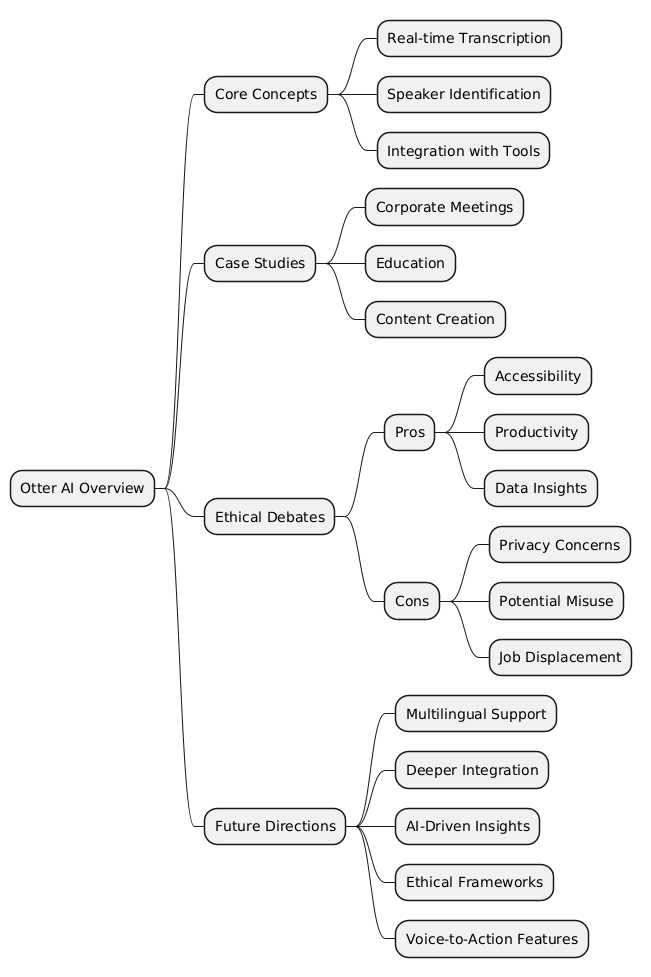
Mind Map
Key Takeaways
💡 Insightful Idea: Otter AI transforms conversations into actionable insights through real-time transcription and advanced collaboration tools.
⚠️ Warning or Challenge: Ethical concerns around data privacy and unauthorized use must be addressed.
🔍 Key Detail: Otter AI’s speaker identification and searchable archives enhance its utility across industries.
🚀 Future Opportunity: Advancements in multilingual support and AI-driven insights could redefine global communication.
🌍 Societal Impact: Otter AI bridges accessibility gaps, empowering users with diverse needs.
Otter AI exemplifies the transformative power of AI in modern workflows. By addressing its challenges and harnessing its potential, we can unlock a future where technology amplifies human capabilities while safeguarding ethical principles.