HeyGen is redefining global communication by enabling seamless multilingual video creation with AI avatars. This innovation holds transformative potential for industries like education, marketing, and entertainment. Explore its applications, ethical dilemmas, and the future of AI-driven content creation.
Introduction & Context
In a world increasingly driven by digital communication, the demand for personalized, engaging, and accessible content has skyrocketed. Enter HeyGen, an AI-powered platform that transforms text into lifelike video avatars capable of speaking in multiple languages. This technology is not just a tool; it’s a glimpse into the future of global interaction, where language barriers dissolve and content becomes universally accessible.
The journey to HeyGen’s creation is rooted in the broader evolution of generative AI. From early text-based models like GPT-3 to image generators like DALL·E, the leap to video avatars represents the next frontier. HeyGen is part of a growing ecosystem of tools that democratize content creation, making high-quality video production accessible to individuals and businesses alike.
Today, HeyGen stands at the intersection of technology and creativity, offering a solution to one of the most pressing challenges of our time: how to communicate effectively in a globalized yet diverse world.
Description: What is HeyGen?
HeyGen is an AI-driven platform designed to create video avatars from text inputs. At its core, it merges natural language processing (NLP) and advanced video synthesis to generate realistic human-like avatars. These avatars can speak multiple languages, adapt to various accents, and even mimic mouth movements in the target language.
The platform’s standout feature is its ability to translate and localize videos seamlessly. Imagine recording a video in French and instantly converting it into English, Spanish, or Mandarin, complete with synchronized lip movements and accurate pronunciation. HeyGen achieves this by integrating voice cloning technology and machine learning algorithms trained on diverse datasets.
Key features of HeyGen include:
- Multilingual Support: Over 40 languages with native-like fluency.
- Customizable Avatars: Users can select or upload avatars tailored to their brand or personal style.
- Ease of Use: A user-friendly interface that simplifies video editing and translation.
- Scalability: Ideal for individuals, small businesses, and large corporations.
By combining these capabilities, HeyGen is more than a tool; it’s a bridge connecting people across linguistic and cultural divides.
Use Cases: Real-World Applications of HeyGen
1. Corporate Training and E-learning
One of HeyGen’s most impactful applications lies in education and corporate training. Companies can create training modules in English and effortlessly localize them for international teams. For instance, a multinational corporation could use HeyGen to deliver compliance training in German, Japanese, and Portuguese without hiring separate translators or voice actors.
2. Marketing and Advertising
In marketing, personalization is king. HeyGen enables brands to produce localized advertisements for different markets, ensuring cultural relevance and linguistic accuracy. A French skincare brand, for example, could create a single campaign and adapt it for audiences in Brazil, China, and the U.S., maintaining a consistent brand voice.
3. Healthcare Communication
HeyGen’s potential in healthcare is profound. Hospitals and clinics can use the platform to create instructional videos for patients in multiple languages, improving accessibility and understanding. Imagine a video explaining post-surgery care, available in Hindi, Swahili, and Russian, ensuring no patient is left behind.
4. Social Media Content
Content creators on platforms like YouTube and TikTok are leveraging HeyGen to expand their reach. By translating their videos into multiple languages, creators can tap into new audiences and grow their global footprint.
How to Use HeyGen
HeyGen’s intuitive design ensures that even non-technical users can create professional-quality videos. Here’s a step-by-step guide:
- Access the Platform: Visit HeyGen’s official website and create an account.
- Upload Your Video or Script: Users can either upload a pre-recorded video or input a script they want the avatar to deliver.
- Select an Avatar: Choose from HeyGen’s library of avatars or upload a custom avatar to align with your branding.
- Choose the Target Language: Select the language and accent for your video. HeyGen supports over 40 languages, ensuring global reach.
- Generate the Video: Click “Generate,” and HeyGen will process the input, creating a video with synchronized lip movements and accurate voice translation.
- Review and Edit: Use HeyGen’s editing tools to fine-tune the video. Adjust the script, avatar expressions, or voice tone as needed.
- Download and Share: Once satisfied, download the video or share it directly on social media platforms.
By following these steps, users can create compelling, multilingual video content in minutes, revolutionizing how they communicate with their audience.
Ethical Debate: Pros and Cons of HeyGen
Pros
- Global Accessibility: HeyGen democratizes video creation, making it accessible to individuals and small businesses.
- Cost Efficiency: Eliminates the need for expensive translation services, voice actors, and video editing teams.
- Cultural Sensitivity: By localizing content, HeyGen ensures messages resonate with diverse audiences.
- Enhanced Communication: Breaks down language barriers in education, healthcare, and public services.
Cons
- Job Displacement: Critics argue that tools like HeyGen could reduce demand for translators and voice actors.
- Ethical Concerns: The use of AI-generated avatars raises questions about authenticity and transparency. Should audiences be informed when they’re interacting with an AI avatar?
- Data Privacy: As with any AI platform, concerns about data security and misuse of personal information persist.
- Cultural Nuances: While HeyGen excels at translation, it may struggle with culturally specific idioms or context.
Societal Implications
The societal impact of HeyGen is twofold. On one hand, it empowers creators and businesses to communicate globally. On the other, it challenges traditional industries and raises ethical questions about AI’s role in human interaction.
Future Directions
HeyGen’s journey is just beginning. The platform’s potential for growth and innovation is immense. Here are some possibilities:
- Enhanced Realism: Future iterations of HeyGen could feature avatars with even more lifelike expressions and gestures, blurring the line between AI and reality.
- Integration with AR/VR: Imagine HeyGen avatars embedded in virtual reality environments, guiding users through immersive experiences.
- Real-Time Translation: The next frontier could be real-time video translation, enabling live multilingual communication during virtual meetings or events.
- Ethical Frameworks: As the technology evolves, so too must the ethical guidelines governing its use. Transparency and accountability will be crucial.
- Industry-Specific Solutions: Customized versions of HeyGen tailored to industries like legal, medical, or entertainment could further expand its reach and utility.
The future of HeyGen is not just about technology; it’s about reimagining how we connect, communicate, and collaborate in a globalized world.
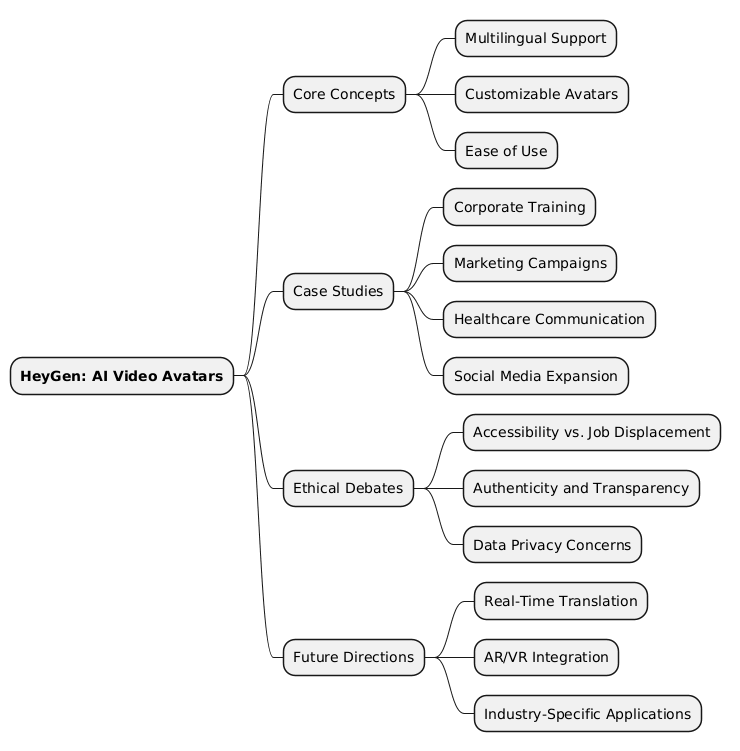
Mind Map
Key Takeaways
- 💡 Insightful Idea: HeyGen bridges global communication gaps with AI-driven multilingual video avatars.
- ⚠️ Warning: Ethical concerns, such as job displacement and data privacy, must be addressed.
- 🔍 Key Detail: HeyGen supports over 40 languages, enabling seamless localization.
- 🚀 Future Opportunity: Real-time translation and AR/VR integration could redefine digital interaction.
- 🌍 Societal Impact: HeyGen democratizes content creation, fostering inclusivity and global collaboration.
HeyGen is not just a technological innovation; it’s a paradigm shift in how we perceive and produce content. As we navigate its possibilities and challenges, one thing is clear: the future of communication is here, and it speaks every language.