Mistral AI, a French-born generative AI platform, is emerging as a key player in the global AI race. By offering open-source models like Mistral 7B and Mixtral 8x7B, it aims to democratize access to advanced AI technologies. This article explores its development, use cases, ethical considerations, and future potential.
Introduction & Context
The rise of generative AI has been dominated by American companies like OpenAI and Meta, but Europe is entering the fray with its own contender: Mistral AI. Founded in 2023 by a team of French engineers and researchers, Mistral AI has quickly gained attention for its focus on open-source language models and its ambition to create an ethical, accessible alternative to proprietary systems.
In less than a year, Mistral AI has raised €385 million in funding, achieving “unicorn” status with a valuation nearing €2 billion. Its partnership with Google Cloud and its rapid development of advanced models like Mistral 7B mark it as a serious challenger in the global AI ecosystem. But what sets Mistral apart is not just its technology—it’s the vision of creating AI tools that are not only powerful but also transparent and customizable.
This article delves into what makes Mistral AI unique, its practical applications, ethical considerations, and its potential to shape the future of AI.
Description
At its core, Mistral AI is a generative AI platform specializing in large language models (LLMs). Its flagship offerings include:
- Mistral 7B: A 7-billion-parameter open-source language model designed for general-purpose tasks. Despite its relatively compact size, Mistral 7B delivers performance on par with larger, more resource-intensive models like OpenAI’s GPT-3.
- Mixtral 8x7B: A modular model combining multiple instances of Mistral 7B, optimized for specific tasks through fine-tuning.
Both models are built on transformer architecture, the same foundational technology behind GPT models. However, Mistral AI emphasizes efficiency and accessibility. By open-sourcing its models, it allows developers, researchers, and businesses to adapt the technology to their specific needs without being locked into a proprietary ecosystem.
Mistral AI also integrates seamlessly with platforms like Hugging Face, making it easy for users to test and deploy its models. Its API capabilities enable everything from text generation and summarization to complex data analysis.
Use Cases
Mistral AI’s versatility is evident in its wide range of applications. Here are three real-world examples:
- Customer Service Automation
A European e-commerce company used Mistral 7B to develop a multilingual chatbot capable of handling customer queries in over 20 languages. The open-source nature of the model allowed the company to fine-tune it for industry-specific terminology, reducing customer service response times by 40%. - Creative Industries
A digital marketing agency leveraged Mixtral 8x7B to generate personalized ad copy and social media content. The model’s ability to analyze and mimic brand tone resulted in a 25% increase in engagement rates across campaigns. - Academic Research
Researchers in France utilized Mistral 7B for natural language processing tasks, such as analyzing historical texts. The model’s open-source framework enabled them to customize it for niche linguistic datasets, advancing their research without incurring high licensing costs.
How To Use Mistral AI
Getting started with Mistral AI is straightforward, particularly for developers familiar with platforms like Hugging Face. Follow these steps:
- Access the Platform
Visit Mistral AI’s official website or its Hugging Face page to explore available models. - Choose a Model
Select either Mistral 7B or Mixtral 8x7B based on your project requirements. Mistral 7B is ideal for general tasks, while Mixtral offers specialized capabilities. - Test the Model
Use Hugging Face’s interface to input sample prompts and evaluate the model’s performance. This step helps you understand its capabilities before full-scale deployment. - Download or Integrate
Download the model for local use or integrate it into your application via Mistral AI’s API. Detailed documentation is available for both options. - Fine-Tune (Optional)
For specialized applications, fine-tune the model using your dataset. Mistral AI provides tools and guidelines to simplify this process. - Deploy and Monitor
Once integrated, continuously monitor performance metrics to ensure the model meets your expectations. Mistral AI’s open-source nature makes it easy to iterate and improve.
Ethical Debate
Mistral AI’s open-source approach brings both opportunities and challenges. Here’s a balanced look at the ethical considerations:
Pros:
- Transparency: Open-source models allow for greater scrutiny, reducing the risk of hidden biases or unethical practices.
- Accessibility: By democratizing advanced AI, Mistral AI empowers smaller organizations and individual developers.
- Customization: Users can fine-tune models for specific needs, promoting innovation across industries.
Cons:
- Misuse Risks: Open access increases the potential for malicious applications, such as generating fake news or deepfakes.
- Data Privacy: The use of open-source models in sensitive applications raises questions about data security and compliance.
- Economic Disruption: Like other generative AI technologies, Mistral AI could displace jobs in sectors reliant on manual content creation.
Societal Implications:
The widespread adoption of Mistral AI could democratize technology but also exacerbate existing inequalities. Policymakers will need to address these challenges through regulations and ethical guidelines.
Future Directions
Mistral AI’s journey is just beginning, and its future holds immense potential. Here are some areas to watch:
- Scaling Up
The development of larger, more specialized models could expand Mistral AI’s capabilities, making it competitive with GPT-4 and beyond. - Industry-Specific Solutions
Mistral AI could collaborate with sectors like healthcare, finance, and education to create tailored AI tools. - Global Expansion
Partnerships with international organizations could extend Mistral AI’s reach, establishing it as a global leader in generative AI. - Ethical AI Leadership
By setting benchmarks for transparency and ethical use, Mistral AI could influence global standards for AI governance. - Integration with Emerging Technologies
Combining Mistral AI with quantum computing or edge AI could unlock new possibilities, from real-time data processing to enhanced cybersecurity.
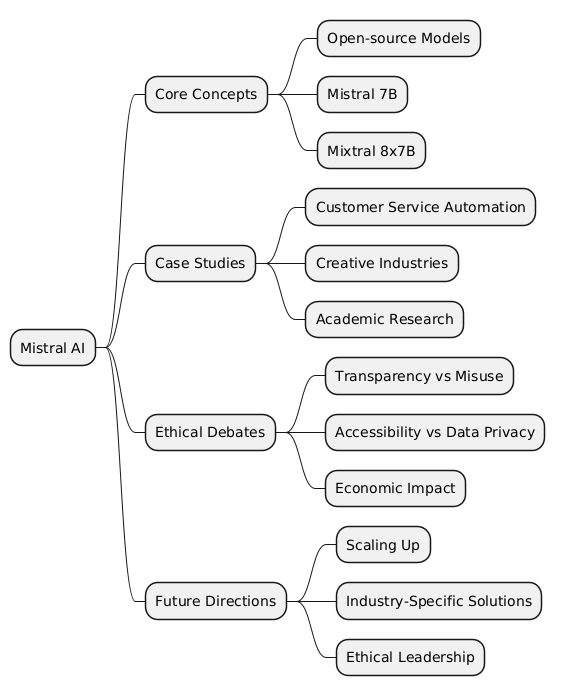
Mind Map
Key Takeaways
💡 Insightful Idea: Mistral AI’s open-source models democratize access to advanced AI, fostering innovation across industries.
⚠️ Warning or Challenge: Open access increases the risk of misuse, requiring robust ethical guidelines.
🔍 Key Detail: Mistral AI’s collaboration with platforms like Hugging Face simplifies model deployment and customization.
🚀 Future Opportunity: Scaling up to larger models could position Mistral AI as a global leader in generative AI.
🌍 Societal Impact: By promoting transparency and accessibility, Mistral AI could reshape the global AI landscape.
This article provides a comprehensive look at Mistral AI, showcasing its potential to revolutionize the field of generative AI while addressing the ethical and societal challenges it presents.