The core theme of this article explores the transformative power of digital and AI technologies in reshaping modern enterprises. It highlights the profound societal and technological impacts these advancements have on industries worldwide. The article delves into key takeaways, including the technical frameworks, ethical considerations, and future implications of embracing AI-driven transformations.

Introduction & Context
In the rapidly evolving landscape of technology, the integration of AI and digital tools in business operations marks a pivotal era. This transformation is not just a trend but a fundamental shift in how companies operate, compete, and deliver value. Historically, businesses relied on manual processes and intuition-driven decision-making. However, the advent of AI and digital technologies has ushered in a new paradigm where data-driven insights and automated processes redefine efficiency and innovation.
The relevance of this transformation is underscored by the increasing complexity of global markets and consumer demands. As companies strive to outpace competitors, the adoption of AI becomes crucial. This article explores the technical underpinnings, real-world applications, ethical considerations, and future directions of this digital revolution.
Technical Breakdown
At the heart of digital transformation lies a suite of technologies that empower businesses to harness data and automate processes. Key among these is AI, which leverages algorithms to analyze vast datasets, uncover patterns, and make predictions. This capability is akin to having a digital oracle, offering insights that were previously unimaginable.
Consider the analogy of a chef using a recipe book. Traditional methods involve following recipes step-by-step. In contrast, AI acts like a master chef, intuitively adjusting ingredients to suit taste preferences based on past experiences. Similarly, AI algorithms learn from historical data to optimize business processes, enhance customer experiences, and predict future trends.
Technical frameworks supporting this transformation include cloud computing, which provides scalable infrastructure, and machine learning models that refine their accuracy over time. These tools collectively form the backbone of modern digital strategies, enabling businesses to react swiftly to market changes and consumer needs.
Case Studies
Real-world applications of AI in business are as diverse as they are impactful. One notable example is Freeport-McMoRan, a leading mining company that leveraged AI to optimize its copper production processes. By implementing machine learning models, the company increased throughput and recovery rates, achieving significant cost savings without additional capital investment. This case exemplifies how AI can drive operational efficiency and unlock new revenue streams.
Another compelling example is DBS Bank, which transformed its operations to become a digital-first financial institution. By integrating AI into customer service and risk management, DBS enhanced its customer experience and streamlined its decision-making processes. This transformation not only improved customer satisfaction but also positioned DBS as a leader in digital banking.
These case studies highlight the successes and challenges of implementing AI at scale. They underscore the importance of aligning technology with business goals and the need for continuous iteration and improvement.
Ethical Debate
The integration of AI in business raises important ethical questions. On one hand, AI offers unprecedented opportunities for efficiency and innovation. On the other, it poses risks related to privacy, bias, and job displacement. For instance, AI systems can inadvertently perpetuate biases present in training data, leading to unfair outcomes.
A balanced approach is essential. Companies must implement robust governance frameworks to ensure transparency and accountability in AI systems. This includes regular audits, bias detection mechanisms, and clear communication with stakeholders about how AI is used.
Furthermore, the societal implications of AI extend beyond business. As AI systems become more prevalent, they influence societal norms and expectations. It is crucial for policymakers, businesses, and communities to collaborate in shaping a future where AI benefits all members of society.
Future Directions
Looking ahead, the potential of AI and digital technologies is vast. Future advancements may include more sophisticated AI models capable of understanding and responding to complex human emotions, leading to more personalized customer interactions. Additionally, the integration of AI with emerging technologies like quantum computing could unlock new levels of computational power, further accelerating innovation.
Unanswered questions remain, such as how to effectively scale AI across diverse industries and ensure equitable access to its benefits. As businesses continue to navigate this transformation, they must remain agile, continuously adapting to technological advancements and societal shifts.
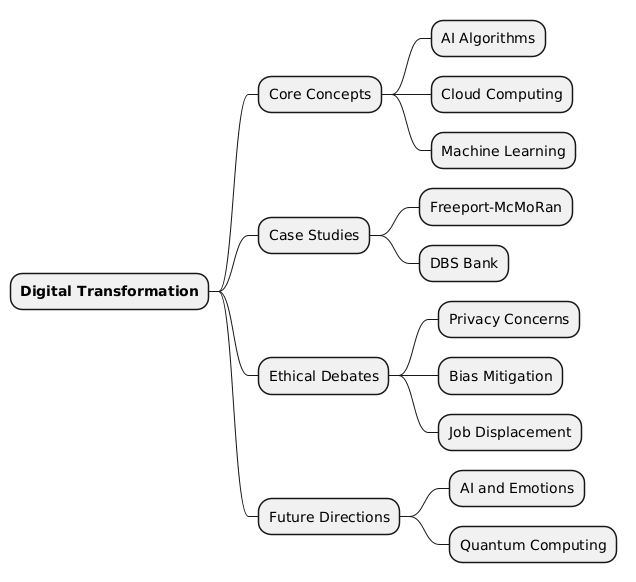
Mind Map
Key Takeaways
- 💡 Insightful Idea: AI and digital technologies are redefining business operations, offering new avenues for efficiency and innovation.
- ⚠️ Warning or Challenge: Ethical considerations, such as privacy and bias, must be addressed to ensure responsible AI deployment.
- 🔍 Key Detail or Discovery: Real-world applications, like those at Freeport-McMoRan and DBS Bank, demonstrate the transformative potential of AI.
- 🚀 Future Opportunity: Emerging technologies, such as quantum computing, promise to amplify AI’s capabilities, driving further innovation.
- 🌍 Societal Impact: The integration of AI in business has far-reaching implications, influencing societal norms and expectations.
This article provides a comprehensive overview of the digital transformation landscape, emphasizing the role of AI in shaping the future of business. As companies continue to embrace these technologies, they must navigate the complexities of implementation, ethics, and societal impact to realize their full potential.