
Mathematics is the unsung hero behind artificial intelligence, powering algorithms that shape our world—from predicting disease outbreaks to driving autonomous cars. The book “Maths for AI” explores the indispensable role of mathematics in building intelligent systems, offering insights into linear algebra, calculus, probability, and optimization. This article unpacks these concepts, their real-world applications, and the ethical dilemmas they pose.

Section 1: Context
Historical Milestones
The story of artificial intelligence (AI) is deeply intertwined with mathematics. Alan Turing’s early work in computational theory laid the groundwork for machine learning. Fast forward to the 1980s, and neural networks began gaining traction, thanks to advancements in calculus-based optimization techniques like gradient descent. Today, AI spans industries from healthcare to finance, leveraging mathematical models to solve problems once thought insurmountable.
Current Relevance
In 2025, AI is no longer just a buzzword; it’s a cornerstone of technological progress. Behind every AI breakthrough—whether it’s ChatGPT revolutionizing communication or DeepMind’s AlphaFold solving protein folding—there’s a hidden layer of mathematical rigor. The book “Maths for AI” demystifies this complexity, making it accessible for students, professionals, and curious minds eager to understand the mechanics driving AI.
Section 2: Technical Breakdown
Algorithms and Tools
Mathematics in AI isn’t just abstract theory; it’s the engine driving every algorithm. Let’s break it down:
- Linear Algebra:
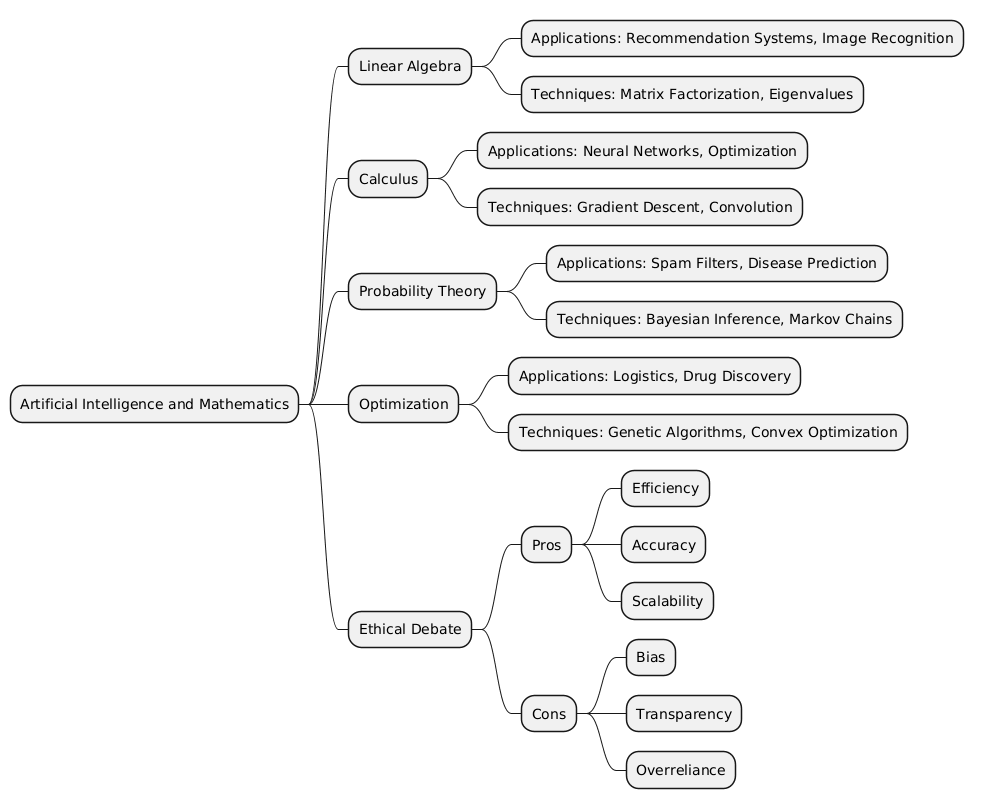
Imagine Netflix recommending shows to you. Behind the scenes, matrix factorization—a linear algebra technique—analyzes your viewing history to predict preferences. Concepts like eigenvalues and singular value decomposition (SVD) are the backbone of recommendation systems. - Calculus:
Calculus enables machines to learn by optimizing their parameters. Gradient descent, a calculus-based method, iteratively adjusts weights in neural networks, ensuring they converge toward accurate predictions. Think of it as a GPS recalculating routes to reach the destination faster. - Probability Theory:
AI thrives on uncertainty. Probability models, like Bayesian inference, allow systems to make decisions under incomplete information. For instance, spam filters use probability to classify emails, analyzing the likelihood of certain keywords appearing in spam versus legitimate messages. - Optimization:
Optimization is the art of finding the best solution among many. Techniques like genetic algorithms mimic evolution, selecting the fittest solutions in applications like drug discovery or logistics.
Real-World Analogies
Consider AI as a chef preparing a dish. Linear algebra provides the recipe, calculus adjusts the ingredients for taste, probability theory guesses what diners might enjoy, and optimization ensures the meal is served efficiently. Together, these mathematical tools create a seamless experience.
Section 3: Case Studies
1. Healthcare: Predicting Disease Outbreaks
In epidemiology, AI models powered by probability theory and time series analysis predict disease outbreaks. During the COVID-19 pandemic, machine learning algorithms analyzed infection rates and mobility data to forecast virus spread, enabling governments to allocate resources effectively.
2. Finance: Fraud Detection
Banks use AI to detect fraudulent transactions by analyzing patterns in customer behavior. Linear regression and clustering algorithms highlight anomalies, flagging suspicious activities. This combination of mathematics and machine learning safeguards billions of dollars annually.
3. Autonomous Vehicles: Driving into the Future
Self-driving cars rely heavily on geometry and optimization. Cameras and sensors generate 3D maps of surroundings, while reinforcement learning algorithms decide the safest path forward. Mathematics ensures these vehicles navigate complex environments with precision.
Section 4: Ethical Debate
Pros
- Efficiency: Mathematical models streamline decision-making, saving time and resources. For example, AI-powered logistics optimize delivery routes, reducing fuel consumption.
- Accuracy: Statistical techniques improve prediction quality, whether in diagnosing diseases or forecasting stock prices.
- Scalability: Mathematical frameworks allow AI systems to handle massive datasets, scaling across industries.
Cons
- Bias: Algorithms can inherit biases from flawed mathematical models or skewed datasets. For instance, predictive policing systems have faced criticism for disproportionately targeting minorities.
- Transparency: Complex mathematical models often act as black boxes, making it difficult to explain decisions to stakeholders.
- Overreliance: Blind trust in AI systems can lead to catastrophic failures, such as stock market crashes triggered by algorithmic trading.
Data-Backed Arguments
A 2023 study revealed that 65% of AI practitioners struggle with bias mitigation in mathematical models. Meanwhile, the EU’s AI Act emphasizes transparency, requiring companies to disclose how mathematical algorithms influence decision-making.
Mind Map
Key Takeaways
💡 Mathematics as AI’s Backbone: Linear algebra, calculus, and probability theory are foundational to AI algorithms.
⚠️ Ethical Vigilance: Bias and transparency remain critical challenges in applying mathematical models to AI.
🔍 Real-World Impact: From healthcare to finance, AI powered by mathematics transforms industries.
💡 Learning Opportunity: Books like “Maths for AI” bridge the gap between abstract theory and practical application.
⚠️ Future Directions: As AI evolves, so will the mathematical techniques underpinning it, demanding continuous learning.