Artificial Intelligence (AI) is transforming how businesses operate, from data-driven decision-making to personalized marketing strategies. This article explores the tools, techniques, and ethical dilemmas discussed in the book AI-Based Data Analytics: Applications for Business Management. By examining real-world applications, we uncover how AI is reshaping industries while raising critical questions about privacy and fairness.

Section 1: Context – A Brief History of AI in Business
AI’s journey into the world of business began decades ago with rule-based systems like expert systems in the 1980s. These early tools were limited, relying on pre-defined rules rather than learning from data. Fast forward to today, and AI has evolved into a powerful force driven by machine learning (ML) and deep learning algorithms. The rise of big data and the cloud has made AI accessible to businesses of all sizes.
In the last five years, AI has moved from a buzzword to a necessity. Companies like Amazon and Netflix have demonstrated how AI can personalize customer experiences, while tools like IBM’s Watson Analytics have made predictive modeling mainstream. Today, AI is not just a tool but a strategic partner in decision-making, marketing, and operations.
Section 2: Technical Breakdown – How AI Works in Business
Algorithms and Tools
At its core, AI in business relies on several key technologies:
- Machine Learning (ML): Algorithms like decision trees and neural networks analyze historical data to predict future trends.
- Natural Language Processing (NLP): Enables chatbots and sentiment analysis by understanding human language.
- Reinforcement Learning: Optimizes decisions by learning from trial and error, much like a game.
Real-World Analogy
Imagine a chess game. Traditional algorithms played by following programmed rules, while modern AI, like DeepMind’s AlphaGo, learns strategies through repeated games. In business, this translates to AI learning customer behavior patterns and optimizing marketing strategies dynamically.
Key Tools
- Hugging Face Transformers: Used for sentiment analysis in social media.
- Federated Learning: Allows multiple organizations to train AI models collaboratively without sharing sensitive data.
- Blockchain Integration: Enhances transparency in supply chains by verifying transactions securely.
Section 3: Case Studies – AI in Action
1. Netflix – Personalized Recommendations
Netflix’s recommendation engine is a textbook example of AI in action. By analyzing viewing habits, the platform suggests content tailored to individual preferences, increasing user engagement by 80%. The algorithm uses collaborative filtering, a technique that finds similarities between users’ behaviors.
2. Walmart – Inventory Optimization
Walmart employs AI to manage its vast inventory. Machine learning models analyze sales data, weather patterns, and even local events to predict demand. This reduces waste and ensures shelves are stocked with the right products at the right time.
3. Smart Cities – IoT and AI Collaboration
In urban planning, AI combined with IoT devices helps create smart cities. For instance, Barcelona uses AI to optimize traffic flow and reduce energy consumption. Sensors collect data, and AI algorithms analyze it to make real-time decisions.
Section 4: Ethical Debate – Opportunities and Challenges
Opportunities
💡 Efficiency Gains: AI automates repetitive tasks, allowing employees to focus on creative work.
💡 Better Decision-Making: Predictive analytics helps businesses anticipate market trends.
💡 Enhanced Customer Experience: Personalization improves customer satisfaction and loyalty.
Challenges
⚠️ Bias in Algorithms: AI systems can perpetuate existing biases in data, leading to unfair outcomes.
⚠️ Privacy Concerns: The use of customer data raises questions about consent and security.
⚠️ Job Displacement: Automation threatens to replace certain roles, requiring workforce reskilling.
Data-Backed Arguments
🔍 Studies show that 85% of AI projects fail due to poor data quality or biased algorithms.
🔍 A 2023 report by McKinsey highlights that while AI can boost productivity by 20%, it requires robust ethical frameworks to ensure fairness.
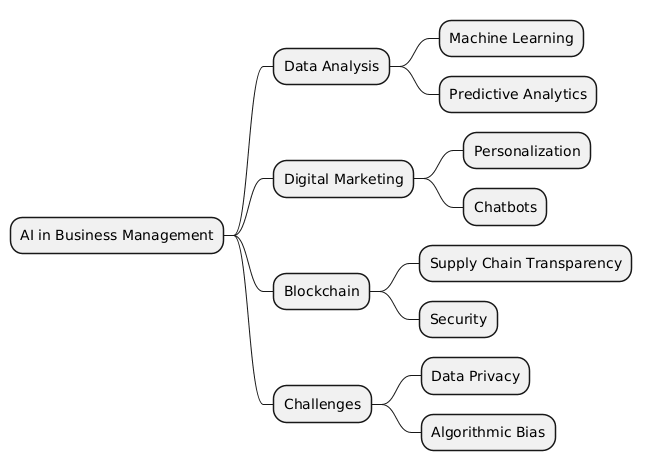
Mind Map
Key Takeaways
- 💡 AI is a strategic partner in decision-making.
- ⚠️ Bias and privacy remain critical challenges.
- 🔍 Real-world examples show AI’s transformative potential.
- 💡 Tools like Hugging Face and federated learning drive innovation.
- ⚠️ Ethical frameworks are essential for responsible AI use.